September 10, 2013

The Rally Fighter is the first automobile manufactured by Local Motors. The car is designed under a freely distributable Creative Commons license. It was featured in an episode of the American version of the television show ‘Top Gear.’
The Rally Fighter was also featured on the Discovery Channel television show ‘Game Changers’ showing the build process that customers who purchase a Rally Fighter would go through. The Rally Fighter is an automobile built by the customer at a Micro Factory owned and operated by Local Motors.
Posted in Technology |
Leave a Comment »
September 1, 2013

Swedish Fish is a fish-shaped wine gum (gum drop type) candy. In 1957, Malaco, a Swedish confectionery manufacturer, expanded its business by exporting a few of their products to North America. Various licorice ribbon and licorice lace candies were the first products to be exported. Malaco CEO Thor Fjørgerson called the move ‘a landmark day for Sweden/US relations.’
International trade experts hailed the move, as it allowed Malaco to extend its brand beyond the Scandinavian Peninsula. Malaco’s export trade grew and in the late 1960s and early 1970s, Swedish Fish and Swedish Berries were developed specifically for the North American market. Malaco was eventually acquired by Leaf International.
read more »
Posted in Food, World |
Leave a Comment »
August 17, 2013
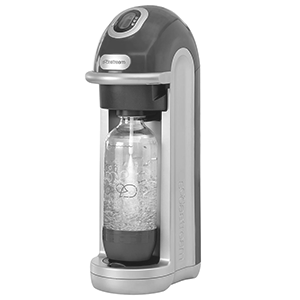
SodaStream is the maker of a consumer home carbonation product based on the principles of making a carbonated drink as originally invented by Guy Gilbey in 1903. The device allows users to take ordinary tap water and carbonate it to create soda water (or carbonated water) to drink.
With the addition of one of over 100 different types of concentrated syrups and flavorings produced by Sodastream, owners can create carbonated beverages. After the company merged with Soda-Club in 1998, it was relaunched with an emphasis on healthier drinks. It went public on the Nasdaq stock exchange in 2010. Sodastream is currently headquartered in Israel, and has 13 production plants.
read more »
Posted in Food, Money |
Leave a Comment »
August 17, 2013

The Flowbee is an electrically powered vacuum cleaner attachment made for cutting hair. It was invented in 1988 by Rick Hunt, a San Diego carpenter. Hunt initially sold the Flowbees out of his garage before finding success with live demonstrations at a county fair. The product was advertised as being capable of performing ‘hundreds of precision layered haircuts’ in frequently aired late-night television infomercials. By 2000, two million Flowbees had been sold.
The Flowbee can also be used to groom dogs with long hair such as Maltese or Bichon Frisé with a special pet grooming attachment which is sold separately. The Flowbee is still being manufactured and sold via their factory (in Corpus Christi, Texas) direct website and various outlets across the Internet.
Posted in Humor, Technology |
Leave a Comment »
July 15, 2013

Slim Jim is a brand of jerky snacks or dried sausage manufactured by ConAgra Foods, Inc., the food conglomerate based in Omaha. They are popular in the United States. More than 500 million are produced annually in at least 20 varieties.
The Slim Jim itself has been transformed in the years since Adolph Levis invented it in 1928. He sold the company in 1967 for about 20 million dollars to General Mills, who moved the operations to Raleigh, N.C., and merged them into other meatpacking operations that it renamed Goodmark Foods. It sold Goodmark in 1982 to a group led by Ron Doggett, who sold it to ConAgra in 1998.
read more »
Posted in Food, Humor |
Leave a Comment »
July 12, 2013

A tater tot is a side dish made from deep-fried, grated potatoes. They are widely recognized by their crispness and cylindrical shape. Tater Tots is a registered trademark of Ore-Ida (a division of the HJ Heinz Company), which has become genericized.
The product was created in 1953 when Ore-Ida founders F. Nephi Grigg and Golden Grigg were trying to figure out what to do with leftover slivers of cut-up potatoes, which at the time was being sold to feed livestock at low margins. They chopped up the slivers, added flour and seasoning, then pushed the mash through holes and sliced off pieces of the extruded mixture. The product was first offered in stores in 1956.
read more »
Posted in Food |
Leave a Comment »
April 21, 2013
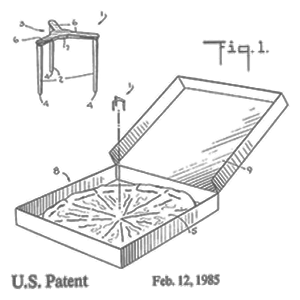
A pizza saver is a device used to prevent the top of a food container, such as a pizza box or cake box, from collapsing in at the center and touching the food inside. A pizza saver is made of plastic and has three (sometimes four) legs. They are often white, and the common practice is to place one pizza saver in the center of the pizza before the box lid is closed for delivery.
The pizza saver is not re-used and is thrown away or recycled by the patron, although some people have found secondary uses for them such as egg holders when turned upside down.
read more »
Posted in Food, Money, Technology |
Leave a Comment »
March 22, 2013
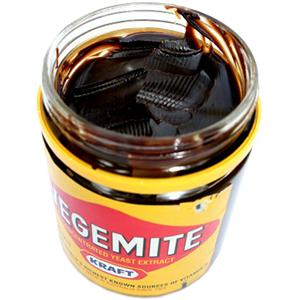
Vegemite [vej-uh-mahyt] is a dark brown Australian food paste made from yeast extract. It is a spread for sandwiches and a filling for pastries. A common method of eating Vegemite is on toasted bread with one layer of butter before spreading a thin layer of Vegemite. It is similar to British, New Zealand and South African Marmite, Australian Promite, Swiss Cenovis and German Hefeextrakt. More recently, other spreads – which are Australian-owned – have come on the market to provide an alternative to the now US-owned product, such as the yeast-based AussieMite.
Vegemite is made from brewers’ yeast extract, a by-product of beer manufacturing, various vegetables, wheat and spice additives. It is salty, slightly bitter and malty, and rich in umami (savory flavor) – similar to beef bouillon. The texture is smooth and the product is a paste. It is not as intensely flavored as British Marmite and it is less sweet than the New Zealand version of Marmite.
read more »
Posted in Food, Health, World |
Leave a Comment »
March 14, 2013
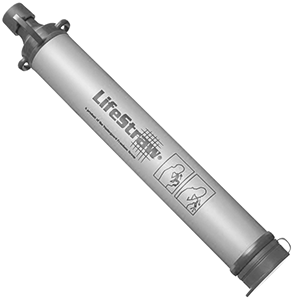
LifeStraw is a water filter that filters a maximum of 1000 liters of water, enough for one person for one year that was designed by the Swiss-based Vestergaard Frandsen for people living in developing nations and for distribution in humanitarian crisis. LifeStraw Family filters a maximum of 18,000 liters of water, providing safe drinking water for a family of five for up to three years. The LifeStraw is a plastic tube 310 millimeters long and 30 millimeters in diameter, Water that is drawn up through the straw first passes through hollow fibers that filter water particles down to 0.2 microns across, using only physical filtration methods and no chemicals.
LifeStraw has been generally praised for its effective and instant method of bacteria and protozoa removal and consumer acceptability. Paul Hetherington, of the charity WaterAid, has criticized the LifeStraw for being too expensive for the target market. He also points to other important problems linked with accessing the water in developing countries, which wait to be solved, but are not addressed by the device itself.
Posted in Food, Health, Technology |
Leave a Comment »
March 14, 2013

Living Machine is a trademark and brand name for a patented form of ecological wastewater treatment designed to mimic the cleansing functions of wetlands. Also known as Solar Aquatics Systems, the latest generation of the technology is based on fixed-film ecology and the ecological processes of a natural tidal wetland, one of nature’s most productive ecosystems.
The Living Machine is an intensive bioremediation system that can also produce beneficial byproducts, such as reuse-quality water, ornamental plants and plant products—for building material, energy biomass, animal feed.
read more »
Posted in Money, Science, Technology |
1 Comment »
March 11, 2013

The Kiss Kasket is an item of merchandise licensed by the rock band Kiss. It is an actual casket, decorated with a Kiss logo and pictures of the band members. In introducing the Kiss Kasket, Simmons quipped, ‘I love livin’, but this makes the alternative look pretty damn good.’ The Kiss Kasket went on sale in 2001. Pantera guitarist Dimebag Darrell was buried in a Kiss Kasket.
In 2010, Kissonline.com announced a new licensing agreement between Kiss and Eternal Image Inc. (a public company engaged in the design, manufacturing, and marketing of officially licensed memorial products) to design, manufacture, and market a limited edition line of official KISS branded memorial products. The line will reportedly include caskets, cremation urns, bronze memorials, memorial prayer cards, registry books, memorial candles, and pet cremation urns—all designed after the famous rock band’s iconic images.
Posted in Death, Humor, Money |
Leave a Comment »
March 10, 2013
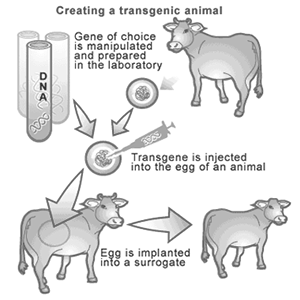
Enviropig is the trademark for a genetically modified line of Yorkshire pigs with the capability to digest plant phosphorus more efficiently than ordinary unmodified pigs that was developed at the University of Guelph.
The benefits of the Enviropig if commercialized include reduced feed cost and reduced phosphorus pollution as compared to the raising of ordinary pigs. Enviropigs produce the enzyme phytase in their salivary glands. When cereal grains are consumed, the phytase mixes with feed in the pig’s mouth, and once swallowed the phytase is active in the acidic environment of the stomach degrading indigestible phytic acid with the release of phosphate that is readily digested by the pig.
read more »
Posted in Food, Science |
Leave a Comment »


 The Daily Omnivore