February 8, 2011

Compression artifacts may intentionally be used as a visual style, sometimes known as glitch art. In still images, an example is Jpegs, by German photographer Thomas Ruff, which intentionally uses JPEG artifacts.
In video art, one technique is datamoshing – mixing two videos sources, or exploiting the way different video codecs process motion and color information. The technique was pioneered by artists Sven König, Takeshi Murata and Paul B. Davis in collaboration with an American art collective called Paperrad.
Posted in Art, Language, Technology |
Leave a Comment »
February 7, 2011

The Stanford torus is a proposed design for a space habitat capable of housing 10,000 to 140,000 permanent residents. It was proposed during the 1975 NASA Summer Study, conducted at Stanford University, with the purpose of speculating on designs for future space colonies. The concept of a ring-shaped rotating space station was previously proposed by Wernher von Braun and Herman Potočnik.
It consists of a torus, or donut-shaped ring, that is 1.8 km in diameter and rotates once per minute to provide between 0.9g and 1.0g of artificial gravity on the inside of the outer ring via centrifugal force. Sunlight is provided to the interior of the torus by a system of mirrors. The ring is connected to a hub via a number of spokes, which serve as conduits for people and materials travelling to and from the hub. Since the hub is at the rotational axis of the station, it experiences the least artificial gravity and is the easiest location for spacecraft to dock.
Posted in Technology |
Leave a Comment »
February 6, 2011

Time Banking refers to an economic system that uses units of time as currency. A Time Bank, also known as a Service Exchange, is a community which practices time banking. The unit of currency, always valued at an hour’s worth of any person’s labor, used by these groups has various names, but is generally known as a Time Dollar in the U.S. and a Time Credit in the U.K. Time Banking is primarily used to provide incentives and rewards for work such as mentoring children, caring for the elderly, being neighborly—work usually done on a volunteer basis—which a pure market system devalues.
Essentially, the ‘time’ one spends providing these types of community services earns ‘time’ that one can spend to receive services. Time Banking had its intellectual genesis in the U.S. in the early 1980s. Today, 26 countries have active Time Banks. There are 108 Time Banks active in the U.K. and 53 officially recognized Time Banks in the U.S.
Posted in Money, Politics |
Leave a Comment »
February 3, 2011

Prince Rupert’s Drops (also known as Rupert’s Balls or Dutch tears) are a glass curiosity created by dripping hot molten glass into cold water. The glass cools into a tadpole-shaped droplet with a long, thin, tail. The water rapidly cools the molten glass on the outside of the drop, while the inner portion of the drop remains hot. When the glass on the inside eventually cools, it contracts inside the already-solid outer part. This contraction sets up very large compressive stresses on the exterior, while the core of the drop is in a state of tensile stress. It can be said to be a kind of tempered glass.
The very high residual stress within the drop gives rise to unusual qualities, such as the ability to withstand a blow from a hammer on the bulbous end without breaking, while the drops will disintegrate explosively if the tail end is even slightly damaged. When the tail end is damaged, the large amount of potential energy stored in the drop’s crystalline or amorphous atomic structure is released, causing fractures to propagate through the material at very high speeds. Due to glass’s inherent transparency, the internal stress within these objects can be demonstrated by viewing them through polarizing filters.
Posted in Science |
Leave a Comment »
February 2, 2011

The fainting game refers to intentionally cutting off oxygen to the brain with the goal of inducing temporary syncope (loss of consciousness) and euphoria. There are two distinct methods used to achieve oxygen deprivation: strangulation and rapid breathing (self-induced hypocapnia). The fainting game is pursued primarily by children and teens to get a high without taking drugs. It is frequently confused with erotic asphyxiation, which is oxygen deprivation for sexual arousal.
The practice goes by many other names in different parts of the world, such as: Riding a Rocket, Airplaning, America Dream Game, Black Out Game, Breath Play, Bum Rushing, California Choke, California Headrush, Choking Out, Cloud Nine, Dying game, Dream Game, Elevator, Flatline Game, Funky Chicken, Harvey Wallbanger, Hyperventilation Game, Indian Headrush, Knockout Game, Pass-out Game, Natural High, Sleeper Hold, Space Cowboy, Space Monkey, Suffocation Roulette, Rising Sun, High Riser, Tingling Game, Trip to Heaven, Speed Dreaming, Wall-Hit, and Purple Dragon.
Posted in Health, Language, Sex |
Leave a Comment »
February 2, 2011

Keepon is a small yellow robot designed to study social development by interacting with children. It was developed at the National Institute of Information and Communications Technology (NICT) in Kyoto, Japan. Keepon has four motors, a rubber skin, two cameras in its eyes, and a microphone in its nose.
Its simple appearance and behavior are intended to help children, even those with developmental disorders such as autism, to understand its attentive and emotive actions. The robot, usually under the control of a teleoperator, has interacted with children in schools and remedial centers for developmental disorders since 2003. Keepon is currently available for purchase at $30,000, though a price drop is speculated after simpler mechanisms are developed.
Posted in Health, Humor, Technology |
Leave a Comment »
February 1, 2011

In vitro meat, also known as cultured meat, is an animal flesh product that has never been part of a complete, living animal. Several current research projects are growing in vitro meat experimentally, although no meat has yet been produced for public consumption. The first-generation products will most likely be minced meat, and a long-term goal is to grow fully developed muscle tissue. Potentially, any animal’s muscle tissue could be grown through the in vitro process.
Posted in Food, Money, Science |
Leave a Comment »
February 1, 2011

Ronald Jenkees is an American composer and musician best known for his YouTube keyboard performances. He has released two independent albums: the self-titled Ronald Jenkees (2007), and Disorganized Fun (2009).
Posted in Art, Technology |
Leave a Comment »
January 31, 2011

Rejected is a surrealist animated short comedy film by Don Hertzfeldt that was nominated for an Academy Award for Best Animated Short Film in 2000. A fictional frame story explains that Hertzfeldt was commissioned to do animated segments for commercials and television network interstitials, but they were all rejected upon receipt. Towards the end of the short the animator begins to break down mentally and the animated world he created literally begins to fall apart, brutally killing all of his characters in the process.
Posted in Art, Humor |
Leave a Comment »
January 31, 2011
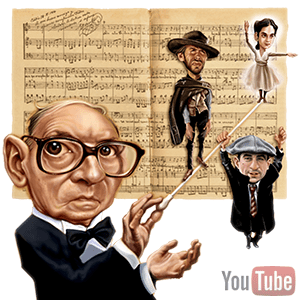
Ennio [en-yo] Morricone [mor-ee-cone-ay] (b. 1928) is an Italian composer and conductor, considered one of the most prolific and influential film composers of his era. He is well-known for his long-term collaborations with international acclaimed directors such as Sergio Leone, Brian De Palma, Barry Levinson, and Giuseppe Tornatore.
He wrote the characteristic film scores of Leone’s Spaghetti Westerns A Fistful of Dollars (1964), For a Few Dollars More (1965), The Good, the Bad and the Ugly (1966) and Once Upon a Time in the West (1968). In the 80s, Morricone composed the scores for John Carpenter’s horror movie The Thing (1982), Leone’s Once Upon a Time in America (1984), Roland Joffé’s The Mission (1986), Brian De Palma’s The Untouchables (1987) and Giuseppe Tornatore’s Cinema Paradiso (1988).
Posted in Art, Money |
Leave a Comment »
January 31, 2011

Spaghetti Western, also known as Italo-western, is a nickname for a broad sub-genre of Western film that emerged in the mid-1960s, so named because most were produced and directed by Italians. The typical team was made up of an Italian director, Italo-Spanish technical staff, and a cast of Italian and Spanish actors, sometimes a fading Hollywood star and sometimes a rising one like the young Clint Eastwood in three of Sergio Leone’s films. The films were typically shot in inexpensive locales resembling the American Southwest, primarily the Andalusia region of Spain, Almería, Sardinia, and Abruzzo.
Because of the desert setting and the readily available low-cost southern Spanish or southern Italian extras, typical themes in spaghetti westerns include the Mexican Revolution, Mexican bandits, and the border region shared by Mexico and the United States. Originally, spaghetti westerns were characterized by their production in the Italian language, low budgets, and a recognizable highly fluid and minimalist cinematography which eschewed many of the conventions of earlier Westerns. This was partly intentional and partly the context of a different cultural background.
Posted in Art, Money, World |
Leave a Comment »
January 29, 2011

Duck Sauce is an American-Canadian DJ duo consisting of Armand Van Helden and A-Trak. The duo are signed to Fool’s Gold Records.
In the summer of 2010, Duck Sauce released a track ‘Barbra Streisand,’ named for the singer of the same name. The track heavily samples Gotta Go Home by Boney M, which is based upon the original tune Hallo Bimmelbahn by the German band Nighttrain.
Posted in Art |
Leave a Comment »


 The Daily Omnivore