April 25, 2011
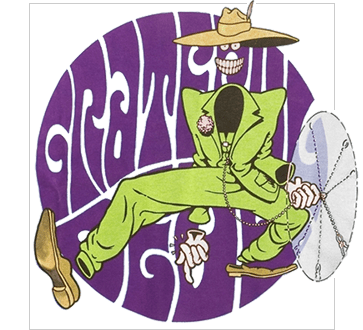
Shakedown street is the area of a Jam Band (e.g. Phish, Widespread Panic) parking lot where the vending takes place. It is named after the Grateful Dead song of the same name and has been popular since the early 1980s. In the Deadhead community, and other likeminded musical scenes, an interesting tailgating culture evolved. More than just a party for fans, it is a way for the faithful to sell wares which in turn fund their tickets and gas to the next concert in order to spend weeks, months, or even entire tours on the road.
Along with the more traditional fare, there is a large selection of vegetarian food such as egg rolls, burritos, pizza, and falafel. Certain illicit foods like hash brownies and ‘ganja gooballs’ are also often found among the foods in the parking lots. Other products available for the tailgaters include handmade jewellery, bumper stickers, t-shirts, or drug paraphernalia.
Posted in Drugs, Food, Money |
Leave a Comment »
April 25, 2011

Rainbow Gatherings are temporary intentional communities, typically held in outdoor settings, and espousing and practicing ideals of peace, love, harmony, freedom and community, as a consciously expressed alternative to mainstream popular culture, consumerism, capitalism and mass media.
Rainbow Gatherings are an expression of a Utopian impulse, combined with bohemianism, hipster and hippie culture, with roots traceable to the 1960’s counterculture. Mainstream society is commonly referred to and viewed as ‘Babylon,’ connoting the participants’ widely held belief that modern lifestyles and systems of government are unhealthy, unsustainable, exploitative and out of harmony with the natural systems of the planet.
read more »
Posted in Money, Philosophy, Politics |
Leave a Comment »
April 25, 2011

In Australia, the United Kingdom and Germany, some nursing homes build false bus stops for their patients who are suffering from dementia.
Some of these bus stops are even fitted with outdated advertisements and timetables – 30 years outdated. The patients will sit at the bus stop waiting for a bus to take them to their imagined destination. After some time the nursing staff comes to escort the clients back to the retirement home.
Posted in Health |
Leave a Comment »
April 24, 2011

A Silver Alert is a public notification system in the United States to broadcast information about missing persons – especially seniors with Alzheimer’s Disease, dementia or other mental disabilities – in order to aid in their return. Approximately 6 in 10 dementia victims will wander at least once, and if not found within 24 hours, up to half of wandering seniors with dementia suffer serious injury or death.
read more »
Posted in Health, Language, Politics |
Leave a Comment »
April 24, 2011
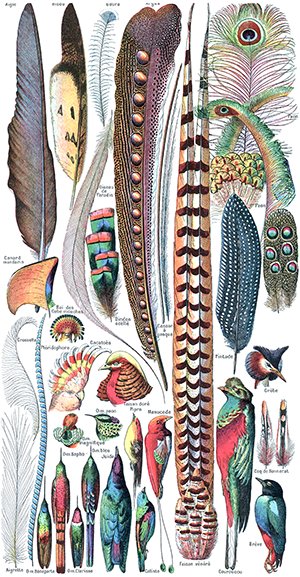
Adolphe Millot [me-low] (1857 – 1921) was a French naturalist illustrator. He worked for the Grand Larousse encyclopédique (a French encyclopedic dictionary).
Posted in Art, Language, Science |
3 Comments »
April 23, 2011

Bacon mania refers to passionate bacon enthusiasm in the US, Canada, and the UK. The movement (sometimes called ‘Bacon Nation’) has been traced to the 1980s and 1990s when high-protein foods became a more prominent diet focus due in part to the Atkins diet. Bacon possesses six ingredient types of umami, which elicits an addictive neurochemical response. Newer bacon creations have joined more traditional foods like the BLT and Cobb salad, including bacon bubble gum, bacon band-aids, sizzling bacon flavored rolling papers, and bacon air freshener.
The growing popularity of bacon has also encouraged product introductions such as bacon salt, maple bacon donuts, and baconnaise. Other bacon food oddities include the bacon explosion (a bacon-wrapped loaf of pork sausage), chicken fried bacon, bacon ice cream, and chocolate covered bacon, all popularized over the internet. A bacon alarm clock that wakes people up with the smell of cooking bacon has also been announced. The increased interest in bacon has led to Bacon-of-the-month clubs, bacon recipe contests, blogs, and even ‘bacon camps.’
Posted in Food, Humor, Language |
Leave a Comment »
April 23, 2011
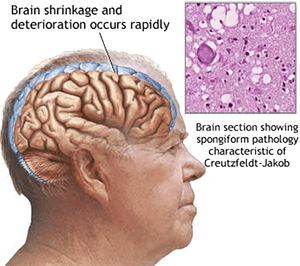
Prions [prahy-on] are infectious, misfolded proteins (large molecules built from small units known as amino acids). They are known to cause many forms of encephalitis, or brain disease, such as scrapie, Creutzfeldt-Jakob Disease, kuru, and Bovine Spongiform Encephalopathy, also known as Mad Cow Disease.
Prions work by changing the shape of proteins in the living things it causes disease in. While normal proteins have lots of alpha helices, or twisted parts, changed proteins have lots of beta sheets, or flat parts. The word ‘prion,’ coined in 1982 by American neurologist, Stanley B. Prusiner, is a portmanteau derived from the words ‘protein’ and ‘infection.’
read more »
Posted in Health, Science |
Leave a Comment »
April 23, 2011
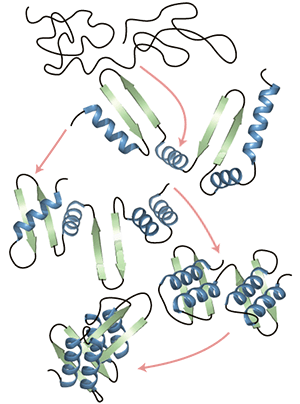
Proteomics [proh-tee-om-iks] is the large-scale study of proteins, particularly their structures and functions. Proteins are vital parts of living organisms, as they are the main components of the physiological metabolic pathways of cells. The term ‘proteomics’ was first coined in 1997 to make an analogy with genomics, the study of the genes. The word ‘proteome’ is a blend of ‘protein’ and ‘genome,’ and was coined by Australian geneticist, Marc Wilkins, in 1994. The proteome is the entire complement of proteins, including the modifications made to a particular set of proteins, produced by an organism or system. This will vary with time and distinct requirements, or stresses, that a cell or organism undergoes.
After genomics, proteomics is considered the next step in the study of biological systems. It is much more complicated than genomics mostly because while an organism’s genome is more or less constant, the proteome differs from cell to cell and from time to time. This is because distinct genes are expressed in distinct cell types. This means that even the basic set of proteins which are produced in a cell needs to be determined.
Posted in Health, Science, Technology |
Leave a Comment »
April 23, 2011
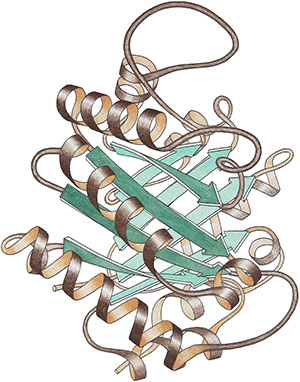
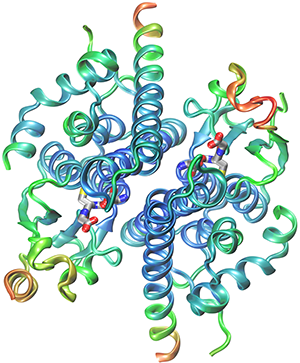
Ribbon diagrams, also known as Richardson Diagrams, are 3D schematic representations of protein structure and are one of the most common methods of protein depiction used today. Ribbon diagrams are generated by interpolating a smooth curve through the polypeptide backbone. Ribbon diagrams are simple, yet powerful, in expressing the visual basics of a molecular structure (twist, fold and unfold). This method has successfully portrayed the overall organization of the protein structure, reflecting its 3-dimensional information, and allowing for better understanding of a complex object both by the expert structural biologists and also by other scientists, students, and the general public.
Originally conceived by Jane S. Richardson in 1980, her hand-drawn ribbon diagrams were the first schematics of 3D protein structure to be produced systematically. They are generated by interpolating a smooth curve through the polypeptide backbone. Alpha-helices are shown as coiled ribbons or thick tubes, Beta-strands as arrows, and lines or thin tubes for random coils. The direction of the polypeptide chain may be indicated by a color ramp along the length of the ribbon.
Posted in Art, Science |
Leave a Comment »
April 23, 2011
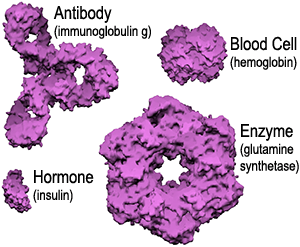

Proteins are large molecules built from peptides: chains of amino acids held together with peptide bonds. A polypeptide is a single linear chain of two or more amino acids. Protein molecules consist of one or more polypeptides put together typically in a biologically functional way. The shortest peptides are dipeptides, consisting of two amino acids joined by a single peptide bond. There can also be tripeptides, tetrapeptides, pentapeptides, etc.
Proteins are used to make new tissue and cells, as enzymes (catalysts that accelerate chemical reactions in the body), hormones (chemical messengers), or antibodies (immunological agents).
read more »
Posted in Food, Health, Science |
Leave a Comment »
April 23, 2011
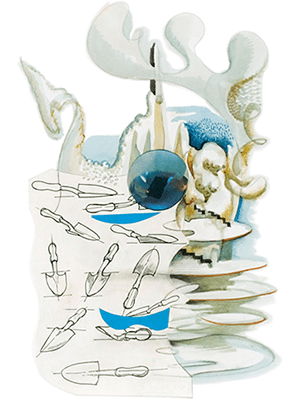
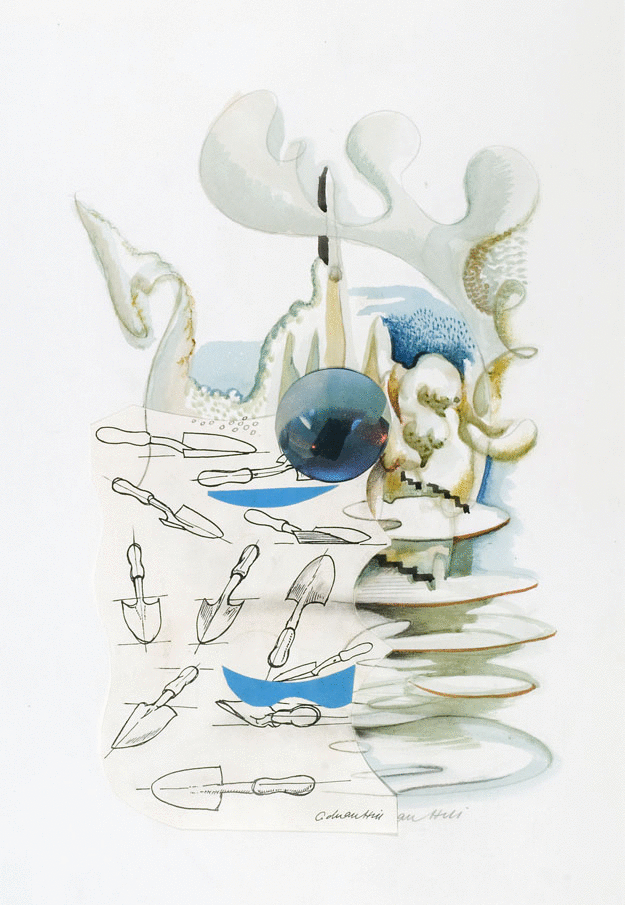
Adrian Hill (1895–1977) was a British artist and pioneering Art Therapist. He wrote many best-selling books about painting and drawing, and in the 1950s and early 1960s presented a BBC children’s television program called ‘Sketch Club.’
His own work combined elements of impressionism and surrealism as well as more conventional representations, and was widely displayed at major art galleries during his lifetime, both in Britain and abroad.
read more »
Posted in Art, Health, Science |
Leave a Comment »
April 21, 2011
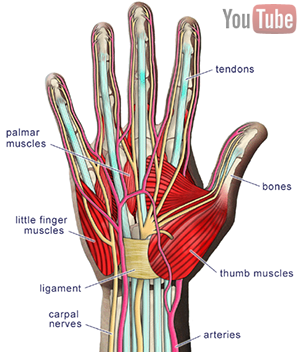
Hand transplantation is a surgical procedure to transplant a hand from one human to another. The operation is carried out in the following order: bone fixation, tendon repair, artery repair, nerve repair, then vein repair. The operation typically lasts 8 to 12 hours. The first short-term success in human hand transplantation occurred with New Zealander Clint Hallam who had lost his hand in an accident while in prison. The operation was performed in 1998 in France by a team assembled from different countries around the world.
Hallam’s transplanted hand was removed at his request in 2001 following an episode of rejection. The first hand transplant to achieve prolonged success was performed on New Jersey native Matthew Scott in 1999. Scott had lost his hand in a fireworks accident at age 24. Later that year the Philadelphia Phillies asked him to do the honors of throwing out the ceremonial first pitch.
Posted in Health, Science |
Leave a Comment »




 The Daily Omnivore