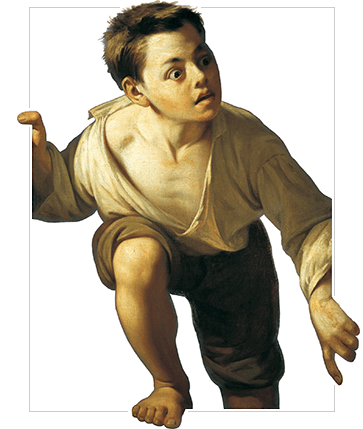
Trompe l’oeil [trawmp loy], French for ‘deceive the eye’, is an art technique involving extremely realistic imagery in order to create the optical illusion that the depicted objects appear in three dimensions. Although the phrase has its origin in the Baroque period, when it refers to perspectival illusionism, use of trompe-l’œil dates back much further. It was (and is) often employed in murals. Instances from Greek and Roman times are known, for instance in Pompeii. A typical trompe-l’œil mural might depict a window, door, or hallway, intended to suggest a larger room.
A version of an oft-told ancient Greek story concerns a contest between two renowned painters. Zeuxis (born around 464 BCE) produced a still life painting so convincing, that birds flew down from the sky to peck at the painted grapes. He then asked his rival, Parrhasius, to pull back a pair of very tattered curtains in order to judge the painting behind them. Parrhasius won the contest, as his painting was of the curtains themselves.
With the superior understanding of perspective drawing achieved in the Renaissance, Italian painters of the late Quattrocento such as Andrea Mantegna (1431–1506) and Melozzo da Forlì (1438–1494), began painting illusionistic ceiling paintings, generally in fresco, that employed perspective and techniques such as foreshortening in order to give the impression of greater space to the viewer below. This type of trompe l’œil illusionism as specifically applied to ceiling paintings is known as ‘di sotto in sù,’ meaning ‘from below, upward’ in Italian. The elements above the viewer are rendered as if viewed from true vanishing point perspective.
Similarly, Vittorio Carpaccio (1460–1525) and Jacopo de’ Barbari (c.1440) added small trompe-l’œil features to their paintings, playfully exploring the boundary between image and reality. For example, a fly might appear to be sitting on the painting’s frame, or a curtain might appear to partly conceal the painting, a piece of paper might appear to be attached to a board, or a person might appear to be climbing out of the painting altogether—all in reference to the contest of Zeuxis and Parrhasius. In a 1964 seminar, the psychoanalyst and theorist Jacques Lacan observed that the myth of the two painters reveals an interesting aspect of human cognition. While animals are attracted to superficial appearances, humans are enticed by the idea of that which is hidden.
Perspective theories in the 17th-century allowed a more fully integrated approach to architectural illusion, which when used by painters to ‘open up’ the space of a wall or ceiling is known as ‘quadratura.’
A fanciful form of architectural Trompe-l’œil is known as quodlibet which features realistically rendered paintings of such items as paper-knives, playing-cards, ribbons and scissors, apparently accidentally left lying around, painted on walls.
Trompe-l’œil can also be found painted on tables and other items of furniture, on which, for example, a deck of playing cards might appear to be sitting on the table. A particularly impressive example can be seen at Chatsworth House in Derbyshire, where one of the internal doors appears to have a violin and bow suspended from it, in a trompe l’œil painted around 1723 by Jan van der Vaart. The American 19th century still-life painter William Harnett specialized in trompe-l’œil. In the 20th century, from the 1960s on, the American Richard Haas and many others painted large trompe-l’œil murals on the sides of city buildings, and from beginning of the 1980s when German Artist Rainer Maria Latzke began to combine classical fresco art with contemporary content trompe-l’œil became increasingly popular for interior murals.
Trompe-l’œil has long been used in set design, so as to create the illusion of a much deeper space than the actual stage. A famous early example is the Teatro Olimpico in Vicenza, with Vincenzo Scamozzi’s seven forced-perspective ‘streets’ (1585) which appear to recede into the distance. Trompe-l’œil is employed in Donald O’Connor’s famous ‘Running up the wall’ scene in the film ‘Singin’ in the Rain’ (1954).
Another variant of trompe-l’œil is matte painting, a technique used in filmmaking where parts of a complicated scenery are painted on glass panels which are mounted in front of the camera during shooting of the scene. This was for instance used in early ‘Star Wars’ movies.
A trompe-l’œil is featured in many ‘Looney Tunes,’ such as the ‘Road Runner’ cartoons, where, for example, Wile E. Coyote paints a tunnel on a rock wall, and the Road runner then races through the fake tunnel. This is usually followed by the coyote’s foolishly trying to run through the tunnel after the road runner, only to smash into the hard rock-face.



Leave a Reply