April 10, 2012


Triclosan [trik-loh-san] is an antibacterial and antifungal agent found in consumer products, including toothpaste, soaps, detergents, toys, and surgical cleaning treatments. In 2016, the FDA announced that effective September 2017, it would prohibit the sale of ‘consumer antiseptic washes’ containing triclosan or 18 other ingredients marketed as antimicrobials due to the FDA’s findings of the lack of efficacy in these products.
Despite being used in many consumer products, beyond its use in toothpaste to prevent gingivitis, there is no evidence according to the FDA that triclosan provides an extra benefit to health in other consumer products. A comprehensive analysis from the University of Michigan School of Public Health indicated that plain soaps are just as effective as consumer-grade antibacterial soaps with triclosan in preventing illness and removing bacteria from the hands.
read more »
Posted in Drugs, Health, Money |
Leave a Comment »
April 10, 2012
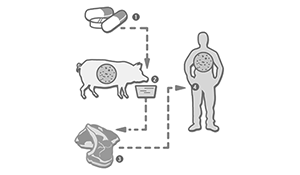

Antibiotic overuse is a contributing factor to the creation of multidrug-resistant bacteria, informally called ‘super bugs’: relatively harmless bacteria can develop resistance to multiple antibiotics and cause life-threatening infections. Though antibiotics are required to treat severe bacterial infections, misuse has contributed to a rise in bacterial resistance. The overuse of fluoroquinolone (a family of antibiotics) and other antibiotics fuels antibiotic resistance in bacteria, which can inhibit the treatment antibiotic-resistant infections. Their excessive use in children with otitis media (ear infection) has given rise to a breed of bacteria resistant to antibiotics entirely.
Widespread use of fluoroquinolones as a first-line antibiotic has led to decreased antibiotic sensitivity, with negative implications for serious bacterial infections such as those associated with cystic fibrosis, where quinolones are among the few viable antibiotics. Antibiotics have no effect on viral infections such as the common cold. They are also ineffective against sore throats, which are usually viral and self-resolving. Most cases of bronchitis (90–95%) are viral as well, passing after a few weeks—the use of antibiotics such as ofloxacin against bronchitis is superfluous and can put the patient at risk of suffering adverse reactions.
read more »
Posted in Drugs, Food, Health |
Leave a Comment »
April 9, 2012

Orgasm Inc. (2009) is the first feature documentary by award-winning director Liz Canner. It premiered at the Hot Docs Documentary Film Festival. In the documentary, filmmaker Liz Canner takes a job editing erotic movies for a drug trial for a pharmaceutical company called Vivus. Her employer is developing what they hope will be the first Viagra drug for women that wins FDA approval to treat a new disease: female sexual arousal disorder (FSD). Initially, she plans to create a movie about science and pleasure but she soon begins to suspect that her employer, along with a cadre of other medical companies, might be trying to take advantage of women (and potentially endanger their health) in pursuit of billion dollar profits.
The film continues from Vivus onto the more general question of whether there is a solid scientific foundation to medical industry claims about what constitutes ‘healthy’ female sexuality and whether drugs and surgery are a suitable first-line approach to obtaining it. The film documents an emerging medical industry intent on convincing women that they have medical problems, and that those problems are best solved by expensive and dangerous medical treatments.
Posted in Drugs, Money, Sex |
1 Comment »
April 9, 2012

In sexuality, the refractory period is the recovery phase after (normally male) orgasm during which it is physiologically impossible for an individual to have additional orgasms. Most men are unable to maintain or achieve an erection during this time, and many perceive a psychological feeling of ‘satiation’ and are temporarily uninterested in further sexual activity. The penis may be hypersensitive and further sexual stimulation may even feel painful during this time frame.
The refractory period varies widely among individuals and across species, ranging from minutes to days. An increased infusion of the hormone oxytocin during ejaculation is believed to be chiefly responsible for the refractory period and the amount by which oxytocin is increased may affect the length of each refractory period. Another chemical which is considered to be responsible for this effect is prolactin, which represses dopamine, which is responsible for sexual arousal.
read more »
Posted in Drugs, Health, Sex |
Leave a Comment »
April 9, 2012


Orgasm (from Greek: ‘to swell’) is the sudden discharge of accumulated sexual tension during the sexual response cycle, resulting in rhythmic muscular contractions in the pelvic region characterized by an intense sensation of pleasure. Experienced by males and females, orgasms are controlled by the involuntary, or autonomic, limbic system.
They are often associated with other involuntary actions, including muscular spasms in multiple areas of the body, a general euphoric sensation, and, frequently, body movements and vocalizations are expressed. The period after orgasm (known as a refractory period) is often a relaxing experience, attributed to the release of the neurohormones oxytocin and prolactin.
read more »
Posted in Health, Sex |
1 Comment »
April 9, 2012

Expanded orgasm is any sexual experience more intense and extensive than what can be described as, or included in the definition of, an ordinary orgasm. It includes a range of sensations that include orgasms that are full-bodied, and orgasms that last from a few minutes to many hours. The term was coined in 1995 by Dr. Patricia Taylor. It was used in her Ph.D. research of intense sensual experiences of 44 couples from various backgrounds and referenced in a video she produced in 1998. Distinguishing features of expanded orgasm are energetic sensations and contractions all over the body, especially in the abdomen, inner thighs, hands, feet, and genitals.
Dr. Taylor describes reports of practitioners going into various altered states of consciousness, bringing about deep emotional release and rejuvenation, profound spiritual experiences, having awarenesses not normally perceived in regular orgasm, and perceiving energy expanding beyond the limits of their bodies. Similar experiences were reported in studies by Dr. Jenny Wade, and by David Deida. Theories for the biological processes required for achieving these states include the progressive and balanced stimulation and elevation of the sympathetic and parasympathetic nervous system; this is evidenced by the tantric practice of using breathing techniques to engage the parasympathetic nervous system during sexual activities.
Posted in Philosophy, Sex |
Leave a Comment »
April 9, 2012

Aubrey Beardsley (1872 – 1898) was an English illustrator and author. His drawings in black ink, influenced by the style of Japanese woodcuts, emphasized the grotesque, the decadent, and the erotic.
He was a leading figure in the Aesthetic movement which also included Oscar Wilde and James A. McNeill Whistler. Beardsley’s contribution to the development of the Art Nouveau and poster styles was significant, despite the brevity of his career before his early death from tuberculosis.
read more »
Posted in Art, Sex |
Leave a Comment »
April 9, 2012

Romain de Tirtoff (1892 – 1990) was a Russian-born French artist and designer known by the pseudonym Erté [er-tey], the French pronunciation of his initials, R.T. He was a diversely talented 20th-century artist and designer who flourished in an array of fields, including fashion, jewellery, graphic arts, costume and set design for film, theater, and opera, and interior decor.
Tirtoff was born in Saint Petersburg, to a distinguished family with roots tracing back to 1548. In 1910, Romain moved to Paris to pursue a career as a designer. He made this decision despite strong objections from his father, who wanted him to continue the family tradition and become a naval officer. Romain assumed his pseudonym to avoid disgracing the family.
read more »
Posted in Art, World |
Leave a Comment »
April 9, 2012


Food faddism refers to idiosyncratic diets and eating patterns that promote short-term weight loss, usually with no concern for long-term weight maintenance, which enjoy temporary popularity. The term ‘food fad’ may also be used with a neutral connotation to describe the short term popularity among restaurants and consumers of an ingredient, dish, or preparation technique.
‘Fad diet’ is a term of popular media, not science. Some so-called fad diets may make pseudo-scientific claims, but others labeled ‘fad’ are based on science. According to one definition, fad diets claim to be scientific but do not follow the scientific method in establishing their validity. Among the scientific shortcomings of the claims made in support of fad diets: not being open to revisions, whereas real science is; and observations that prompt explanations are used as evidence of the validity of the explanation.
read more »
Posted in Food, Health, Money |
Leave a Comment »
April 9, 2012

Yo-yo dieting, also known as ‘weight cycling,’ is a term coined by Kelly D. Brownell, Ph.D., at Yale University. In this process, the dieter is initially successful in the pursuit of weight loss but is unsuccessful in maintaining the loss long-term and begins to gain the weight back. The dieter then seeks to lose the regained weight, and the cycle begins again.
The reasons for yo-yo dieting are varied but often include embarking upon a hypocaloric diet that was initially too extreme. At first the dieter may experience elation at the thought of their rejection of food. Over time, however, the limits imposed by such extreme diets cause effects such as depression or fatigue that make the diet impossible to sustain. Ultimately, the dieter reverts to their old eating habits, now with the added emotional effects of failing to lose weight by restrictive diet. Such an emotional state leads many people to eating more than they would have before dieting, causing them to rapidly regain weight.
Posted in Food, Health |
Leave a Comment »
April 9, 2012


Tarsem Singh Dhandwar (b. 1961), known professionally as Tarsem, is an Indian film director. He began his career directing music videos, including those of ‘Hold On’ by En Vogue, ‘Sweet Lullaby’ by Deep Forest, and R.E.M.’s smash hit ‘Losing My Religion,’ the latter of which won Best Video of the Year at the 1991 MTV Video Music Awards. He has directed dozens of commercials for brands such as Nike and Coca-Cola.
Tarsem’s feature film directorial debut was ‘The Cell’ (2000), starring Jennifer Lopez. His second film, ‘The Fall,’ debuted at the 2006 Toronto International Film Festival and was released theatrically in the United States in 2008. His third film was 2011’s ‘Immortals.’ He directed an adaptation of the Brothers Grimm story of Snow White, called ‘Mirror Mirror’ in 2012.
Posted in Art, Money |
Leave a Comment »
April 9, 2012

‘On Writing: A Memoir of the Craft’ by Stephen King, published in 2000, is a memoir of the prolific author’s experiences as a writer, and also serves as a guide book for those who choose to enter the craft. The first section of the book is an Autobiography mainly about King’s early exposure to writing, and his childhood attempts at writing. King talks about his early attempts to get published, and his first novel ‘Carrie.’ He also talks about his fame as a writer, and what it took to get there. This includes his relationship with his wife, the death of his mother and his history of drug and alcohol abuse.
The second section is practical advice on writing, including tips on grammar and ideas about developing plot and character. King himself describes it as a guide for how ‘a competent writer can become a good one.’ This includes his beliefs that a writer should edit out unnecessary details and avoid the use of unnecessary adverbs. He also uses quotes from other books and authors to illustrate his points. The third section is also autobiographical, in which he discusses the 1999 automobile accident in which he was struck by a vehicle while walking down an isolated country road. He describes serious injuries, his painful recovery and his struggle to start writing again.
Posted in Art, Language, Money |
1 Comment »


 The Daily Omnivore