April 18, 2012

Vertical farming is a concept that argues that it is economically and environmentally viable to cultivate plant or animal life within skyscrapers, or on vertically inclined surfaces.
The idea of a vertical farm has existed at least since the early 1950s and built precedents are well documented by John Hix in his canonical text ‘The Glass House.’
read more »
Posted in Food, Money, Technology |
1 Comment »
April 18, 2012

A food desert is any area in the industrialized world where healthy, affordable food is difficult to obtain. Food deserts are prevalent in rural as well as urban areas and are most prevalent in low-socioeconomic minority communities. They are associated with a variety of diet-related health problems. Food deserts are also linked with supermarket shortage.
The food desert concept was first introduced in the United Kingdom in the early 1990s to examine disparities in food pricing and to describe geographical areas with limited access to retail grocery stores. A food desert is a food environment unsupportive of health; it is defined by barriers which restrict access to healthful foods. Barriers may include lack of access to food retailers, availability of nutritious foods, or affordability of foods. Research has defined food deserts quantitatively or by neighborhood characteristics such as economic and social barriers.
read more »
Posted in Food, Health, Money |
1 Comment »
April 18, 2012

A spectrum auction is a process whereby a government uses an auction system to sell the rights (licences) to transmit signals over specific bands of the electromagnetic spectrum and to assign scarce spectrum resources. Depending on the specific auction format used, a spectrum auction can last from a single day to several months from the opening bid to the final winning bid.
With a well-designed auction, resources are allocated efficiently to the parties that value them the most, the government securing revenue in the process. Spectrum auctions are a step toward market-based spectrum management, and are a way for governments to allocate scarce resources. Alternatives to auctions include administrative licensing, such as the comparative hearings conducted historically (sometimes referred to as ‘beauty contests’), or lotteries.
read more »
Posted in Money, Politics, Technology |
Leave a Comment »
April 18, 2012


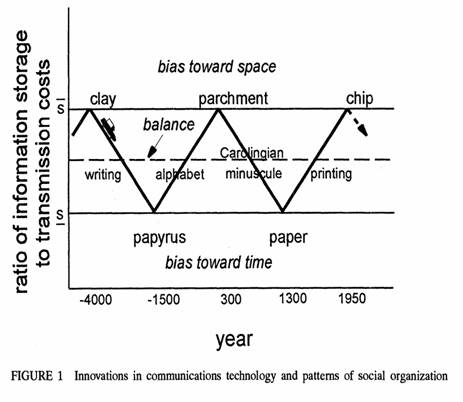
The Canadian economic historian Harold Innis developed the concept of monopolies of knowledge in his later writings on communications; they arise when ruling classes maintain political power through control of key communications technologies. In ancient Egypt, for example, a complex writing system conferred a monopoly of knowledge on literate priests and scribes. Mastering the art of writing and reading required long periods of apprenticeship and instruction, confining knowledge to this powerful class.
This theory suggests that monopolies of knowledge gradually suppress new ways of thinking. Entrenched hierarchies become increasingly rigid and out of touch with social realities. Challenges to elite power are often likely to arise on the margins of society. The arts, for example, are often seen as a means of escape from the sterility of conformist thought.
read more »
Posted in Education, Money, Politics |
Leave a Comment »
April 17, 2012

Media Consolidation is a process whereby progressively fewer individuals or organizations control increasing shares of the mass media. As of 2010, The Walt Disney Company is the largest media conglomerate in the US, with News Corporation, Time Warner, and Viacom ranking second, third and fourth respectively. Net neutrality is at stake when media mergers are occurring. Net neutrality involves a lack of restrictions on content on the internet, however, with big businesses supporting campaigns financially they tend to have influence over political issues, which can translate into their mediums.
Critics of consolidation raise the issue of whether monopolistic or oligopolistic control of a local media market can be fully accountable and dependable in serving the public interest. On the local end, reporters have often seen their stories refused or edited beyond recognition. An example would be the repeated refusal of networks to air ‘ads’ from anti-war advocates to liberal groups like MoveOn.org, or religious groups like the United Church of Christ. Journalists and their reports may be directly sponsored by parties who are the subject of their journalism leading to reports which favor the sponsor. Consequently, if the companies dominating a media market choose to suppress stories that do not serve their interests, the public suffers, since they are not adequately informed of some crucial issues that may affect them.
Posted in Money, Politics, World |
Leave a Comment »
April 17, 2012

Eric Klinenberg is an American sociologist and a scholar of urban studies, culture, and media. He is best known for his contributions as a public sociologist. He is currently Professor of Sociology, Public Policy, and Media, Culture, and Communications at New York University, as well as the editor of the journal ‘Public Culture.’ Klinenberg’s first book, ‘Heat Wave: A Social Autopsy of Disaster in Chicago,’ was published by the University of Chicago Press in 2002.
It was praised as ‘trenchant, persuasive tale of slow murder by public policy.’ Klinenberg’s second book, ‘Fighting for Air: The Battle to Control America’s Media,’ was called ‘a must-read for those who wonder what happened to good radio, accurate reporting and autonomous public interest.’ Since its publication, he has testified before the FCC and briefed Congress on his findings. His latest book, ‘Going Solo: The Extraordinary Rise and Surprising Appeal of Living Alone,’ was published in 2012.
Posted in Language, Politics, Science |
Leave a Comment »
April 17, 2012

Katie Piper (b. 1983) is a former model and television presenter from the UK. Piper had hoped to have a full-time career in the media, but in 2008 sulfuric acid was thrown in her face. The attack, which blinded Piper in one eye, was arranged by Piper’s ex-boyfriend, Daniel Lynch, and carried out by an accomplice, Stefan Sylvestre. Lynch and Sylvestre were arrested and are serving life sentences in prison for their crimes.
Surgeons removed all the skin from her face before rebuilding it with a skin substitute and then a skin graft. The procedure was the first of its kind to be completed in a single operation. In 2009, Piper chose to give up her anonymity and attempt to increase awareness about burn victims. The Channel 4 documentary ‘Katie: My Beautiful Face’ was first aired that autumn.
Posted in Health, Politics |
Leave a Comment »
April 17, 2012

Lorin Ashton, better known by the stage name Bassnectar, is a freeform electronic music and dubstep artist, DJ, and producer based in San Francisco. He is best known for his live performances, light shows, and community engagement. Bassnectar was originally influenced by heavy metal and grunge groups such as Metallica, Megadeth, and Nirvana, bringing these influences with him into his own musical career. He’s also mentioned that early IDM and Ambient artists like Orbital also played a major influence.
He has been creating genre-bending music since the 1990s, using a variety of programs such as Vision/OpCode, Reason, and Ableton Live. Bassnectar describes his music as amorphous and ever-changing, which is reflected in the distinct sounds and personalities of his numerous albums, EPs, and podcasts. He has collaborated with and remixed a host of artists and producers, including Lupe Fiasco, Ellie Goulding, Gogol Bordello, Sound Tribe Sector 9, Datsik, ill.Gates, and Jantsen, among others.
Posted in Art, Technology |
1 Comment »
April 17, 2012

Electric Daisy Carnival is an annual electronic dance music festival held in the South West United States on the last weekend of June. The first Electric Daisy Carnival was held in 1997 at the Shrine Expo Hall in Southern California. The name usage was acquired by Insomniac’s partner Philip Blaine. This refers to the name borrowed from Steve Kool-Aid’s original creation from several years prior whom Philip knew through his colleague Gary (Steve’s partner) at 1500 Records.
In 2010, the event drew criticism from local authorities and promoters alike after minors gained entrance and numerous people were taken to the hospital by paramedics, and as well after an underage (15 year old female) attendee who died of an overdose of ecstasy. The city of Los Angeles began to consider banning all raves from being held in the city. The Coliseum Commission put a moratorium on booking any future events, pending the outcome of the use of new security and safety provisions. Those new provisions include a minimum age of 18 on all future events and the presence of on-site doctors.
Posted in Art, Drugs, Money |
Leave a Comment »
April 17, 2012

Prison–industrial complex is a term used to attribute the rapid expansion of the US inmate population to the political influence of private prison companies and businesses that supply goods and services to government prison agencies. The term is analogous to the military–industrial complex that President Dwight D. Eisenhower warned of in his famous 1961 farewell address.
Such groups include corporations that contract prison labor, construction companies, surveillance technology vendors, lawyers, and lobby groups that represent them. Activists have described the prison industrial complex as perpetuating a belief that imprisonment is a quick fix to underlying social problems such as homelessness, unemployment, drug addiction, mental illness, and illiteracy.
read more »
Posted in Money, Politics |
Leave a Comment »
April 17, 2012

A Narcocorrido [nahr-koh-koh-ree-doh] is a type of Mexican music and song tradition which evolved out of the norteño folk corrido tradition. This type of music is heard on both sides of the US–Mexican border. It uses a danceable, accordion-based polka as a rhythmic base. The first corridos that focus on drug smugglers dated to the 1930s. Early corridos (non-narco) go back as far to the Mexican Revolution of 1910, telling the stories of revolutionary fighters. Music critics have compared narcocorrido music to gangster rap. Narcocorrido lyrics refer to particular events and include real dates and places. The lyrics tend to speak approvingly of illegal criminal activities such as murder, torture, racketeering, extortion, drug smuggling, illegal immigration, and sometimes political protest due to government corruption.
Among the earliest exponents of narcocorrido music were Los Alegres de Teran, who recorded many. In the 1980s, Rosalino ‘Chalino’ Sánchez contributed to narcocorridos. Known throughout Mexico as ‘l Pelavacas’ (‘Cow Skin Peeler’), El Indio (The Indian, from his corrido ‘El Indio Sánchez’), and ‘Mi Compa’ (‘My Friend’), Sánchez was a Mexican immigrant living in Los Angeles. He then began distributing his music. His lyrics composed of heartbreak, revolution, and socioeconomic issues. Soon he was selling mass copies. Chalino Sánchez was murdered in 1992 after a concert in Culiacán. In death, he became a legend and one of the most influential musicians to emerge from California, he was known throughout Mexico and United States as El Rey del Corrido (‘The King of the Corrido’).
Posted in Art, Death, Drugs |
1 Comment »
April 17, 2012

The terms empathogen [em-path-uh-jen] and entactogen are used to describe a class of psychoactive drugs that produce distinctive emotional and social effects similar to those of MDMA (‘Ecstasy’) characterized by increased empathy (the ability to understand and share the feelings of another). Putative members of this class include 2C-B, 2C-I, MDMA, MDA, MDEA, MBDB, 2C-T-7, and 2C-T-2, among others.
The chemical structure of many entactogens contains a substituted amphetamine core, and most belong to the phenethylamine class of psychoactive drugs, although several (AET and AMT) are tryptamines. When referring to MDMA and its counterparts, the term ‘MDxx’ is often used with the exception of MDPV.
read more »
Posted in Drugs, Health, Language |
Leave a Comment »



 The Daily Omnivore