February 3, 2013
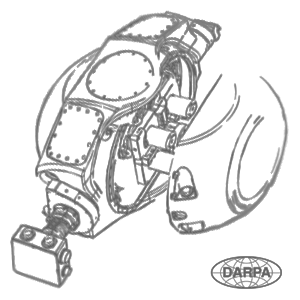
The ARGUS-IS, or the Autonomous Real-Time Ground Ubiquitous Surveillance Imaging System, is a Defense Advanced Research Projects Agency (DARPA) project contracted to BAE Systems.
According to DARPA: ‘The mission of the Autonomous Real-time Ground Ubiquitous Surveillance – Imaging System (ARGUS-IS) program is to provide military users a flexible and responsive capability to find, track and monitor events and activities of interest on a continuous basis in areas of interest.
read more »
Posted in Technology, War |
1 Comment »
February 3, 2013

Sentiocentrism [sen-tee-oh-sen-triz-uhm] is the belief that sentient individuals are the center of moral concern; all and only sentient beings (animals that feel, including humans) have intrinsic value and moral standing; the rest of the natural world has instrumental value. Both humans and other sentient animals have rights and/or interests that must be considered.
The sentiocentrists consider the discrimination of sentient beings of other species to be speciesism, an arbitrary discrimination. Therefore, the coherent sentiocentrism means taking into consideration and respect all sentient animals, and often living a vegan lifestyle. The utilitarian criterion of moral standing is, therefore, all and only sentient beings (sentiocentrism).
read more »
Posted in Philosophy, Politics |
Leave a Comment »
February 3, 2013

Devolution [dev-uh-loo-shuh] is the notion that a species can change into a more ‘primitive’ form over time. Devolution presumes that there is a preferred hierarchy of structure and function, and that evolution must mean ‘progress’ to ‘more advanced’ organisms. This may include the idea that some modern species that have lost functions or complexity accordingly must be degenerate forms of their ancestors.
However, according to the definition of evolution, and particularly of the modern evolutionary synthesis in which natural selection leads to evolutionary adaptation, phenomena represented as instances of devolution are in every sense evolutionary. The idea of devolution is based at least partly on the presumption that ‘evolution’ requires some sort of purposeful direction towards ‘increasing complexity.’ Modern evolutionary theory poses no such presumption and the concept of evolutionary change is independent of either any increase in complexity of organisms sharing a gene pool, or any decrease, such as in vestigiality or in loss of genes.
read more »
Posted in Science |
Leave a Comment »
February 3, 2013

In the context of human evolution, human vestigiality [ve-stij-ee-al-i-tee] involves those characters (such as organs or behaviors) occurring in the human species that are considered vestigial—in other words having lost all or most of their original function through evolution. Although structures usually called ‘vestigial’ often appear functionless, a vestigial structure may retain lesser functions or develop minor new ones.
In some cases, structures once identified as vestigial simply had an unrecognized function. The examples of human vestigiality are numerous, including the anatomical (such as the human appendix, tailbone, wisdom teeth, and inside corner of the eye), the behavioral (goose bumps and infant grasp reflex), sensory (decreased olfaction), and molecular (junk DNA). Many human characteristics are also vestigial in other primates and related animals.
read more »
Posted in Health, Science |
Leave a Comment »
February 3, 2013

In political theory and theology, to immanentize [im-uh-nuhnt-ize] the eschaton [ess-cah-ton] means trying to bring about the eschaton (the final, heaven-like stage of history) in the immanent world. It has been used by conservative critics as a pejorative reference to certain utopian projects, such as socialism, communism, and transhumanism. In all these contexts it means ‘trying to make that which belongs to the afterlife happen here and now (on Earth)’ or ‘trying to create heaven here on Earth.’
According to conservative columnist Jonah Goldberg, writing in ‘National Review Online’: ‘In modern parlance, the phrase was coined by Eric Voegelin in The New Science of Politics in 1952. In the 1950s and 1960s, thanks largely to William F. Buckley’s popularization of the phrase, Young Americans for Freedom turned it into a political slogan.’ Buckley was the most notable of many US conservative readers of Voegelin’s work. Voegelin, a German-born American political philosopher, identified a number of similarities between ancient Gnosticism and the beliefs held by a number of modernist political theories, particularly Communism and Nazism.
read more »
Posted in Philosophy, Politics, Technology |
Leave a Comment »
February 2, 2013

Capsaicin [kap-sey-uh-sin] is a chemical substance. It is responsible for the sense of hotness found in chile peppers. In mammals, it causes a sensation of burning of the tissues it comes in contact with. Capsicain, and other similar substances called capsaicinoids are produced by chile peppers and other plants, probably as deterrents against certain herbivores and fungi. Pure capsaicin is a hydrophobic, colorless, odorless, crystalline to waxy compound.
Capsaicinoids are added to food to make it have a hot taste, but it can also be used as an analgesic (painkiller). Such painkillers are often directly used on the skin. The burning of the capsaicin masks the real pain. Capsicaicin is also the main agent in pepper spray. Capsicain is not soluble in water; it binds to oil and fat. Soap can be used to wash it off. In 2006, it was discovered that the venom of a certain tarantula species activates the same pathway of pain as is activated by capsaicin, the first demonstrated case of such a shared pathway in both plant and animal anti-mammal defense.
read more »
Posted in Drugs, Food |
Leave a Comment »
February 2, 2013

A jukebox is a partially automated music-playing device, usually a coin-operated machine, that will play a patron’s selection from self-contained media. The classic jukebox has buttons with letters and numbers on them that, when entered in combination, are used to play a specific selection. Coin-operated music boxes and player pianos were the first forms of automated coin-operated musical devices.
These instruments used paper rolls, metal disks, or metal cylinders to play a musical selection on the instrument, or instruments, enclosed within the device. In the 1890s these devices were joined by machines which used actual recordings instead of physical instruments. In 1890, Louis Glass and William S. Arnold invented the nickel-in-the-slot phonograph, the first of which was an Edison Class M Electric Phonograph retrofitted with a device patented under the name of Coin Actuated Attachment for Phonograph. The music was heard via one of four listening tubes.
read more »
Posted in Money, Technology |
Leave a Comment »
February 1, 2013

James Randi (b. 1928) is a Canadian-American stage magician and scientific skeptic best known as a challenger of paranormal claims and pseudoscience. Randi is the founder of the James Randi Educational Foundation (JREF). Randi began his career as a magician, as The Amazing Randi, but after retiring at age 60, he began investigating paranormal, occult, and supernatural claims, which he collectively calls ‘woo-woo.’ He has written about the paranormal, skepticism, and the history of magic.
JREF sponsors The One Million Dollar Paranormal Challenge offering a prize of US$1,000,000 to anyone who can demonstrate evidence of any paranormal, supernatural or occult power or event under test conditions agreed to by both parties. Although often referred to as a ‘debunker,’ Randi dislikes the term’s connotations and prefers to describe himself as an ‘investigator.’ He has written about the paranormal, skepticism, and the history of magic. He was a frequent guest on ‘The Tonight Show Starring Johnny Carson’ and was occasionally featured on the television program ‘Penn & Teller: Bullshit!’
read more »
Posted in Money, Science |
Leave a Comment »
February 1, 2013

Life extension science, also known as anti-aging medicine and experimental gerontology, is the study of slowing down or reversing the processes of aging to extend both the maximum and average lifespan.
Some researchers in this area, and ‘life extensionists’ or ‘longevists’ (those who wish to achieve longer lives themselves), believe that future breakthroughs in tissue rejuvenation with stem cells, molecular repair, and organ replacement (such as with artificial organs or xenotransplantations) will eventually enable humans to have indefinite lifespans (agerasia) through complete rejuvenation to a healthy youthful condition.
read more »
Posted in Death, Health |
Leave a Comment »


 The Daily Omnivore