April 15, 2013
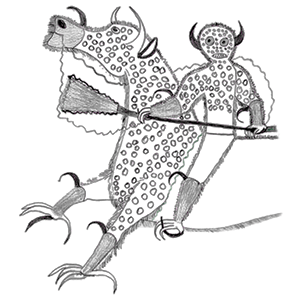
Heyoka [hay-oh-kah] is a spirit in Lakota Mythology that is seen as a trickster. It speaks, moves and reacts in an opposite fashion to the people around it. It is not a spirit that people wish to meet at any time; it usually appears to people when it wishes to take something from you or cause some sort of mayhem.
The Lakota people have learned to respect it enough to leave it be, avoiding it as much as possible. The word refers to the Lakota concept of a contrarian, jester, satirist, or sacred clown. The Heyoka are healers and have many functions, for example healing through laughter and awakening people to deeper meaning and concealed truth and to prepare the people for oncoming disaster with laughter.
read more »
Posted in Humor, Philosophy |
Leave a Comment »
April 15, 2013

Ritual clowns, also called sacred clowns, are a characteristic feature of the ritual life of many traditional religions, and they typically employ scatology and sexual obscenities. Ritual clowning is where comedy and satire originated; in Ancient Greece, ritual clowning, phallic processions (or penis parades) and aischrologia (ritual insults) found their literary form in the plays of Aristophanes.
Two famous examples of ritual clowns in North America are the Koyemshis (also known as Koyemshi, Koyemci or Mudheads) and the Newekwe (also spelled Ne’wekwe or Neweekwe). French sociologist Jean Cazeneuve is particularly renowned for elucidating the role of ritual clowns; reprising Ruth Benedict’s famous distinction of societies into Apollonian and Dionysian, he said that precisely because of the strictly repressive (apollonian) nature of the Zuñi society, the ritual clowns are needed as a dionysian element, a safety valve through which the community can give symbolic satisfaction to the antisocial tendencies. The Koyemshis clowns are characterized by a saturnalian (riotously merry) symbolism.
Posted in Humor, Philosophy, World |
3 Comments »
April 12, 2013

In Tibetan Buddhism Crazy wisdom or ‘yeshe chölwa’ (Tibetan: ‘wisdom gone wild’) refers to unconventional, outrageous, or unexpected behavior, being either a manifestation of buddha nature and spiritual teaching (enlightened activity) on the part of the guru (‘teacher’ or ‘master’), or a method of spiritual investigation undertaken by the student.
It is also held to be one of the manifestations of a siddha or a mahasiddha (the highest level gurus).
read more »
Posted in Philosophy |
1 Comment »
April 11, 2013
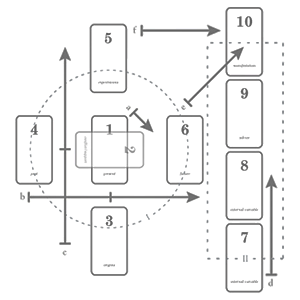
Fortune-telling is the practice of predicting information about a person’s life. The scope of fortune-telling is in principle identical with the practice of divination (‘to foresee, to be inspired by a god’).
The difference is that divination is the term used for predictions considered part of a religious ritual, invoking deities or spirits, while the term fortune-telling implies a less serious or formal setting, even one of popular culture, where belief in occult workings behind the prediction is less prominent than the concept of suggestion, spiritual or practical advisory or affirmation. Historically, fortune-telling grows out of folkloristic reception of Renaissance magic, specifically associated with Gypsies.
read more »
Posted in Money, Philosophy, Politics |
1 Comment »
April 11, 2013
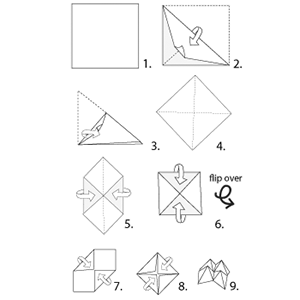
Querent [kweer-ent] as ‘one who seeks’ is derived, according to the Oxford English Dictionary, from the Latin word for ‘to seek, gain, ask.’ Querent denotes ‘a person who questions an Oracle,’ usually for otherworldly advice. This oracle may simply be a divinatory technique, such as the I Ching, that is manipulated by the Querent themselves without recourse to any other human agency. Alternatively it may involve another person, someone perhaps seen as a ‘fortune teller’ — particularly a Practitioner of Tarot reading or other form of Mediumship — from whom advice is sought.
The mindset of a Querent plays a significant role in a reading. Those who approach a reading with heavy skepticism, especially if they are dealing with a human oracle, are often unwilling to engage the Reader at all, which can result in a stifling of the prophetic flow that is required for divination. Conversely, some approach with great respect, as if they predetermine that the Diviner or the system of divination is influence by some kind of higher, even divine, power and thereby will believe virtually anything they are told. A third ideal group will talk freely with a human oracle and accept their advice with a healthy dose of skepticism, yet still remain open minded to the possibility of revelation.
Posted in Language, Philosophy |
Leave a Comment »
April 10, 2013
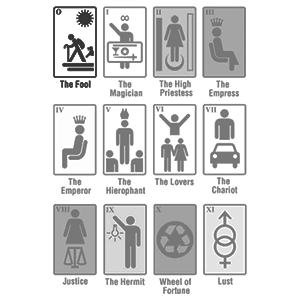
The Fool or The Jester is one of the 78 cards in a Tarot deck; it is in a suit of 22 trump cards called the ‘Major Acana.’ In many esoteric systems of interpretation, The Fool is usually interpreted as the protagonist of a story, and the Major Arcana is the path he takes through the great mysteries of life and the main human archetypes.
This path is known traditionally in Tarot as the ‘Fool’s Journey,’ and is frequently used to introduce the meaning of Major Arcana cards to beginners. The Fool is considered either the XXII or the 0 card in the suit, the highest or lowest trump). Traditionally, the Major Arcana in Tarot cards are numbered with Roman numerals. The Fool is numbered with the zero, an Arabic numeral.
read more »
Posted in Games, Philosophy |
1 Comment »
April 10, 2013

The Joker is a special type of playing card found in most modern decks, or else a type of tile in some Mahjong game sets, specifically used in the American version of Mahjong. It is believed that the term ‘Joker’ comes from ‘Jucker,’ the original German spelling of ‘Euchre,’ (a trick-taking card game for which the Joker card was invented).
The card was originally introduced in about 1860 to be used as the highest trump. Catherine Perry Hargrave documents jokers from 1862 and 1865 in her book ‘A History of Playing Cards.’ The 1862 card has a tiger on it and the label ‘Highest Trump,’ while the one from 1865 is inscribed ‘This card takes either Bower’ and ‘Imperial Bower,’ or ‘Highest Trump Card.’
read more »
Posted in Games, Humor, Language |
1 Comment »
April 9, 2013

Building Stories is a 2012 graphic novel by American cartoonist Chris Ware. The unconventional work is made up of fourteen printed works—cloth-bound books, newspapers, broadsheets and flip books—packaged in a boxed set.
The work took a decade to complete, and was published by Pantheon Books. The intricate, multilayered stories pivot around an unnamed female protagonist with a missing leg. It mainly focuses on her time in a three-story brownstone apartment building in Chicago, but follows her later in her life as a mother. The parts of the work can be read in any order.
read more »
Posted in Art, Language |
Leave a Comment »
April 9, 2013

Franklin Christenson Ware (b. 1967), known professionally as Chris Ware, is an American comic book artist and cartoonist, notable for his ‘Acme Novelty Library’ series and the graphic novels ‘Jimmy Corrigan, the Smartest Kid on Earth,’ and ‘Building Stories.’ His works explore themes of social isolation, emotional torment and depression.
His works tend to use a vivid color palette and are full of realistic, meticulous detail. His lettering and images are often elaborate and sometimes evoke the ragtime era or another early 20th-century American design style. Ware often refers to himself in the publicity for his work in self-effacing, even withering tones. He is considered by some critics and fellow notable illustrators and writers, such as Dave Eggers, to be among the best currently working in the medium.
read more »
Posted in Art, Humor, Language |
1 Comment »
April 9, 2013

In psychology-related slang, control freak is a derogatory term for a person who attempts to dictate how everything around them is done. The phrase was first used in the late 1960s — an era when great stress was laid on the principle of ‘doing one’s own thing’ and letting others do the same.
Control freaks are often perfectionists defending themselves against their own inner vulnerabilities in the belief that if they are not in total control they risk exposing themselves once more to childhood angst. Such persons manipulate and pressure others to change so as to avoid having to change themselves, and use power over others to escape an inner emptiness. When a control freak’s pattern is broken, ‘the Controller is left with a terrible feeling of powerlessness … But feeling their pain and fear brings them back to themselves.’
read more »
Posted in Health, Money |
1 Comment »
April 9, 2013

Culinary name is the name of an ingredient when used in the kitchen for preparing food, as opposed to their names in agriculture or in scientific nomenclature. Some are used because they sounds more attractive than the real name, or because a cheaper ingredient can be linked with a more expensive one. The culinary name may also refer to a way of cooking or to a region, or using a particular ingredient.
Additionally, name given on a menu may be different from the culinary name. For example, from the 19th until the mid-20th century, many restaurant menus were written in French and not in the local language. Examples include veal (calf), calamari (squid), scampi (Italian-American name for shrimp), and sweetbreads (pancreas or thymus gland). Culinary names are especially common for fish and seafood, where multiple species are marketed under a single familiar name.
read more »
Posted in Food, Language, Money |
Leave a Comment »
April 9, 2013
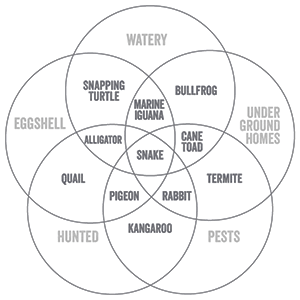
‘Tastes like chicken‘ is a common declaration used when trying to describe the flavor of a food. The expression has been used so often that it has become somewhat of a cliché. As a result, the phrase also sometimes gets used for incongruous humor by being deployed for foods or situations to which it has no real relevance. As an explanation of why unusual meats would taste more like chicken than common alternatives such as beef or pork, different possibilities have been offered.
One idea is that chicken has a bland taste because fat contributes more flavor than muscle (especially in the case of a lean cut such as a skinless chicken breast), making it a generic choice for comparison. Also, chicken reportedly has lower levels of glutamates that contribute to the ‘savory’ aspect of taste known as umami; processing or tenderizing other meats also lowers glutamate levels and makes them taste more like chicken.
read more »
Posted in Food, Humor, Science |
Leave a Comment »


 The Daily Omnivore