September 8, 2025

Clanker is a slur for robots and artificial intelligence software. The term has been used in ‘Star Wars’ media, first appearing in the franchise’s 2005 video game ‘Star Wars: Republic Commando.’ In 2025, the term became widely used to discuss distaste for machines ranging from delivery robots to large language models. This trend has been attributed to anxiety around the negative societal effects of artificial intelligence.
Whereas AI slop describes low-quality output from artificial intelligence, clanker belittles the underlying robotic systems. While other science fiction media includes pejoratives for robots, such as ‘skinjob’ in ‘Blade Runner’ and ‘toaster’ in ‘Battlestar Galactica,’ clanker is believed to have gained popularity because its usage is intuitive and flexible.
read more »
Posted in Language, Technology |
Leave a Comment »
August 28, 2025


A data broker is an individual or company that specializes in collecting personal data (such as income, ethnicity, political beliefs, or geolocation data) or data about people, mostly from public records but sometimes sourced privately, and selling or licensing such information to third parties for a variety of uses.
Sources, usually Internet-based since the 1990s, may include census and electoral roll records, social networking sites, court reports and purchase histories. The information from data brokers may be used in background checks used by employers and housing.
read more »
Posted in Money, Politics, Technology |
Leave a Comment »
August 11, 2025
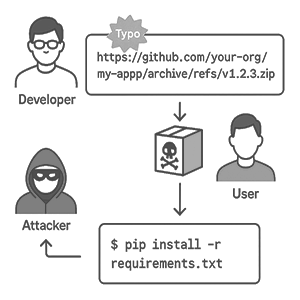
Slopsquatting is a type of cybersquatting. It is the practice of registering a non-existent software package name that a large language model (LLM) may hallucinate in its output, whereby someone unknowingly may copy-paste and install the software package without realizing it is fake. Attempting to install a non-existent package should result in an error, but some have exploited this for their gain in the form of typosquatting.
In 2023, security researcher Bar Lanyado noted that LLMs hallucinated a package named ‘huggingface-cli. While this name is identical to the command used for the command-line version of HuggingFace Hub, it is not the name of the package. The software is correctly installed with the code pip install -U ‘huggingface_hub[cli].’ Lanyado tested the potential for slopsquatting by uploading an empty package under this hallucinated name. In three months, it had received over 30,000 downloads. The hallucinated packaged name was also used in the README file of a repo for research conducted by Alibaba.
read more »
Posted in Money, Technology |
Leave a Comment »
July 25, 2025

Flâneur [flah-neyr] is a French term for a type of urban male ‘stroller,’ ‘lounger,’ ‘saunterer,’ or ‘loafer.’ Traditionally depicted as male, a flâneur is an ambivalent figure of urban affluence and modernity, representing the ability to wander detached from society, for an entertainment from the observation of the urban life. Flânerie is the act of strolling, with all of its accompanying associations. A near-synonym of the noun is boulevardier.
The flâneur was first a literary type from 19th-century France, essential to any picture of the streets of Paris. The word carried a set of rich associations: the man of leisure, the idler, the urban explorer, the connoisseur of the street. Drawing on the work of Charles Baudelaire who described the flâneur in his poetry and 1863 essay ‘The Painter of Modern Life,’ Walter Benjamin promoted 20th-century scholarly interest in the flâneur as an emblematic archetype of urban, modern (even modernist) experience.
read more »
Posted in Language, World |
1 Comment »
July 15, 2025

Pasta with strawberries (makaron z truskawkami) is a dish from Polish cuisine. It is made by pouring a strawberry and cream sauce over cooked pasta. The dish may be eaten at lunch or as a dessert, and is often served in schools. In Polish culture, pasta with strawberries is often considered to be a nostalgic food associated with childhood. The dish became famous worldwide at Wimbledon 2025, when Polish tennis player, Iga Świątek, said that pasta with strawberries is one of her favorite meals.
The origins of pasta with strawberries are unknown, but strawberries are popularly eaten with similar dishes in Poland. In Polish cuisine, strawberries may be added to rice and soups or stuffed into pierogi. Pasta with strawberries is commonly eaten in summer, as strawberry season lasts from May until July. During this time, strawberries are ripe and inexpensive. Kashubian strawberries are considered to be especially desirable for this dish, since they are reputed to have a high quality taste and aroma.
read more »
Posted in Food, World |
Leave a Comment »
June 29, 2025
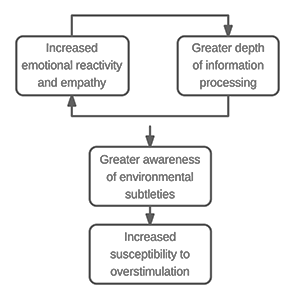
Sensory processing sensitivity (SPS) is a temperamental or personality trait involving ‘an increased sensitivity of the central nervous system and a deeper cognitive processing of physical, social, and emotional stimuli.’ The trait is characterized by ‘a tendency to ‘pause to check’ in novel situations, greater sensitivity to subtle stimuli, and the engagement of deeper cognitive processing strategies for employing coping actions, all of which is driven by heightened emotional reactivity, both positive and negative.’
A human with a particularly high measure of SPS is considered to have ‘hypersensitivity,’ or be a highly sensitive person (HSP). The terms SPS and HSP were coined in the mid-1990s by psychologists Elaine Aron and her husband Arthur Aron, who developed the Highly Sensitive Person Scale (HSPS) questionnaire by which SPS is measured. Other researchers have applied various other terms to denote this responsiveness to stimuli that is seen in humans and other species.
read more »
Posted in Health |
Leave a Comment »
June 11, 2025

You Will was an AT&T marketing campaign that launched in 1993, consisting of commercials directed by David Fincher. Each ad presented a futuristic scenario beginning with “Have you ever…” and ending with “…you will. And the company that will bring it to you: AT&T.” The ads were narrated by Tom Selleck. One of the first web banner ads ever sold was part of an AT&T campaign that ran on HotWired starting October 27, 1994, asking “Have you ever clicked your mouse right HERE? You Will.”
In 2016, technology writer Timothy B. Lee commented that ‘overall, the ads were remarkably accurate in predicting the cutting-edge technologies of the coming decades. But the ads were mostly wrong about one thing: the company that brought these technologies to the world was not AT&T. At least not on its own. AT&T does provide some of the infrastructure on which the world’s communications flow. But the gadgets and software that brought these futuristic capabilities to consumers were created by a new generation of Silicon Valley companies that mostly didn’t exist when these ads were made.’
read more »
Posted in Money, Technology |
Leave a Comment »
May 27, 2025

The Toyota War of 1987 was the last phase of the Chadian–Libyan War. It takes its name from the Toyota pickup trucks, primarily the Toyota Hilux and the Toyota Land Cruiser, used to provide mobility for the Chadian troops as they fought against the Libyans, and as technicals, non-standard tactical vehicles (NSTV) modified to carry heavy weapons for combat use.
The 1987 war resulted in a heavy defeat for Libya, which, according to American sources, lost one tenth of its army, with 7,500 men killed and US$1.5 billion worth of military equipment destroyed or captured. Chadian forces suffered 1,000 deaths.
read more »
Posted in Money, War, World |
Leave a Comment »
May 13, 2025

Zersetzung [zer-set-zung] (German for ‘decomposition’ and ‘disruption’) was a psychological warfare technique used by the Ministry for State Security (Stasi) to repress political opponents in East Germany during the 1970s and 1980s. Zersetzung served to combat alleged and actual dissidents through covert means, using secret methods of abusive control and psychological manipulation to prevent anti-government activities.
Among the defining features of it was the widespread use of offensive counterespionage methods as a means of repression. People were commonly targeted on a preemptive and preventive basis, to limit or stop activities of political dissent and cultural incorrectness that they may have gone on to perform, and not on the basis of crimes they had actually committed. Zersetzung methods were designed to break down, undermine, and paralyze people behind ‘a facade of social normality’ in a form of ‘silent repression.’
read more »
Posted in Politics, World |
1 Comment »
April 28, 2025

Linear B is the earliest known form of written Greek. It is a Mycenaean syllabic script that predates the Greek alphabet by several centuries, the earliest known examples dating to around 1450 BCE. It is adapted from the earlier Linear A, an undeciphered script perhaps used for writing the Minoan language. Linear B, found mainly in the palace archives at Knossos, Kydonia, Pylos, Thebes, and Mycenae, disappeared with the fall of Mycenaean civilization (1750-1050 BCE) during the Late Bronze Age collapse. The succeeding period, known as the Greek Dark Ages, provides no evidence of the use of writing.
Linear B was deciphered in 1952 by English architect and self-taught linguist Michael Ventris based on the research of American classicist Alice Kober. It is the only Bronze Age Aegean script to have been deciphered, with Linear A, Cypro-Minoan, and Cretan hieroglyphic remaining unreadable.
read more »
Posted in Language, World |
Leave a Comment »
April 21, 2025

Prussian blue (also known as Berlin blue, Brandenburg blue, Parisian and Paris blue) is a dark blue pigment produced by oxidation of ferrous ferrocyanide salts. Turnbull’s blue is essentially identical chemically, excepting that it has different impurities and particle sizes—because it is made from different reagents—and thus it has a slightly different color.
Prussian blue was created in the early 18th century and is the first modern synthetic pigment. It is prepared as a very fine colloidal dispersion, because the compound is not soluble in water. It contains variable amounts of other ions and its appearance depends sensitively on the size of the colloidal particles. The pigment is used in paints, it became prominent in 19th-century aizuri-e Japanese woodblock prints, and it is the traditional ‘blue’ in technical blueprints.
read more »
Posted in Art, Science |
Leave a Comment »
April 13, 2025
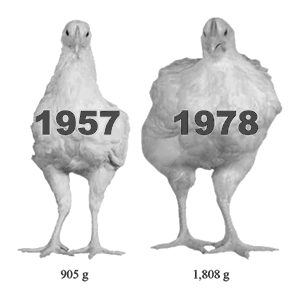
Woody breast is an abnormal muscle condition that impacts the texture and usability of chicken breast meat. The affected meat is described as tough, chewy, and gummy due to stiff or hardened muscle fibers that spread through the filet. The specific cause is not known but may be related to factors associated with rapid growth rates.
Companies often use a three-point scale to grade the woodiness of a particular breast. Although distasteful to many, meat that exhibits woody breast is not known to be harmful to humans who consume it. When detected by suppliers, product shown to have the condition present may be discounted or processed as ground chicken.
read more »
Posted in Food, Money |
Leave a Comment »


 The Daily Omnivore