February 15, 2016
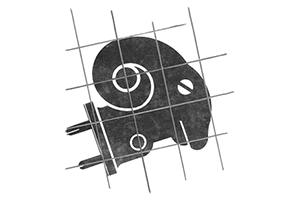

Do Androids Dream of Electric Sheep? is a science fiction novel by American writer Philip K. Dick. First published in 1968, the novel is set in a post-apocalyptic San Francisco, where Earth’s life has been greatly damaged by nuclear global war. Most animal species are endangered or extinct due to extreme radiation poisoning, so that owning an animal is now a sign of status and empathy, an attitude encouraged towards animals. The book served as the primary basis for the 1982 film ‘Blade Runner.’
The main plot follows a single day in the life of Rick Deckard, a bounty hunter hired by the San Francisco Police Department to ‘retire’ (kill) six escaped androids. A secondary plot follows John Isidore, a driver for an electric-animal repair company, who is a ‘special’ (a radioactively-damaged, intellectually slow human whose status prohibits him from emigrating). In connection with Deckard’s mission, the novel explores the issue of what it is to be human. Unlike humans, the androids are claimed to possess no sense of empathy.
read more »
Posted in Art, Language, Technology |
1 Comment »
February 9, 2016
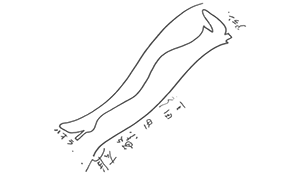

Ma is a Japanese word which can be roughly translated as ‘gap,’ ‘space,’ ‘pause,’ or ‘the space between two structural parts.’ It is best described as a consciousness of place, not in the sense of an enclosed three-dimensional entity, but rather the simultaneous awareness of form and non-form, similar to the concept of ‘negative space’ in graphic design. Ma is not something that is created by compositional elements; it is the thing that takes place in the imagination of the human who experiences these elements. Therefore, ma can be defined as experiential place understood with emphasis on interval.
In his 2001 book ‘The Art of Looking Sideways,’ graphic designer Alan Fletcher discusses the importance of exemplifying ‘space’ as a substance: ‘Cézanne painted and modelled space. Giacometti sculpted by ‘taking the fat off space.’ Mallarmé conceived poems with absences as well as words. Ralph Richardson asserted that acting lay in pauses… Isaac Stern described music as ‘that little bit between each note – silences which give the form’… The Japanese have a word (‘ma’) for this interval which gives shape to the whole. In the West we have neither word nor term. A serious omission.’
Posted in Art, Philosophy, World |
Leave a Comment »
February 8, 2016

Helmut Krone (1925 – 1996) was a pioneer of modern advertising. He spent over 30 years at the advertising agency Doyle Dane Bernbach where he was the art director for the popular 1960s campaign for the Volkswagen Beetle, which featured a large unadorned photo of the car with the tiny word ‘Lemon’ underneath it. He was also responsible for the series of ‘When you’re only No. 2, you try harder’ advertisements for Avis, and the creation of Juan Valdez, who personified Colombian coffee. His work has been collected by the Museum of Modern Art and the Smithsonian. Krone’s ‘Think Small’ advertisement for Volkswagen was voted the best campaign of all time in Advertising Age’s 1999 ‘The Century of Advertising issue.’
Krone was born in Yorkville, on the upper east side of Manhattan, which was at that time a German neighborhood. He attended Public School 77 in Queens before enrolling at the School of Industrial Art, where he hoped to become a product designer. When he was 21, he took his first step towards advertising, working with designer Robert Greenwell doing freelance advertisements for magazines. He followed naval service in World War II with postwar classes with Alexey Brodovitch and stints at ‘Esquire’ and ‘Sudler & Hennessey.’ Then, at the age of 29, he began to work for Doyle Dane Bernbach.
Posted in Art, Money |
Leave a Comment »
January 29, 2016


A Raisin in the Sun is a play by African American playwright Lorraine Hansberry that debuted on Broadway in 1959. The title comes from the poem ‘Harlem’ by Langston Hughes: ‘What happens to a dream deferred? Does it dry up like a raisin in the sun?’ The story tells a black family’s experiences in the Washington Park Subdivision of Chicago’s Woodlawn neighborhood as they attempt to ‘better’ themselves with an insurance payout from the death of the father.
Walter and Ruth Younger, their son Travis, along with Walter’s mother Lena (Mama) and sister Beneatha, live in poverty in a dilapidated two-bedroom apartment on Chicago’s south side. Walter is barely making a living as a limousine driver. Though Ruth is content with their lot, Walter is not and desperately wishes to become wealthy. His plan is to invest in a liquor store in partnership with Willy and Bobo, street-smart acquaintances of Walter’s.
read more »
Posted in Art, Language, Politics |
Leave a Comment »
January 24, 2016

Miquela Sousa, better known as Lil Miquela, is a fictional character and digital art project. Miquela is an Instagram model and music artist claiming to be from Downey, California. In 2017, Miquela released her first single, ‘Not Mine.’ Her pivot into music has been compared to virtual musicians Gorillaz and Hatsune Miku.
The project began in 2016 as an Instagram profile. By 2018, the account had amassed more than a million followers. Miquela portrays the lifestyle of an Instagram it-girl over social media. The account also details a fictional narrative which presents her as a sentient robot in conflict with other digital projects.
read more »
Posted in Art, Money, Technology |
Leave a Comment »
January 1, 2016

Visual brand language is the unique ‘alphabet’ of design elements – such as shape, color, materials, finish, typography and composition – which directly and subliminally communicate a company’s values and personality through compelling imagery and design style. This ‘alphabet,’ properly designed, results in an emotional connection between the brand and the consumer. Visual brand language is a key ingredient necessary to make an authentic and convincing brand strategy that can be applied uniquely and creatively in all forms of brand communications to both employees and customers.
For example, the BMW ‘split grill’ has come to represent the brand. While the grill size and design details evolve over time, the underlying idea is constant and memorable. The use of color is also a powerful associative element for consistent imagery, as exemplified by the comprehensive application of orange by The Home Depot across all its brand materials.
read more »
Posted in Art, Language, Money |
Leave a Comment »
December 16, 2015

The Dreamachine is a stroboscopic flicker device that produces visual stimuli. Artist Brion Gysin and William S. Burroughs’s ‘systems adviser’ Ian Sommerville created the device after reading neurophysiologist and robotician William Grey Walter’s 1963 book, ‘The Living Brain.’ In its original form, a Dreamachine is made from a cylinder with slits cut in the sides. The cylinder is placed on a turntable and rotated at 78 or 45 revolutions per minute. A light bulb is suspended in the center of the cylinder and the rotation speed allows the light to come out from the holes at a constant frequency of between 8 and 13 pulses per second.
This frequency range corresponds to alpha waves, electrical oscillations normally present in the human brain while relaxing. A Dreamachine is ‘viewed’ with the eyes closed: the pulsating light stimulates the optic nerve and thus alters the brain’s electrical oscillations. Users experience increasingly bright, complex patterns of color, which become shapes and symbols, swirling around. It is claimed that by using a Dreamachine one may enter a hypnagogic state (the dreamlike transfer from wakefulness to sleep). This experience may sometimes be quite intense, but to escape from it, one needs only to open one’s eyes.
Posted in Art, Technology |
Leave a Comment »
December 12, 2015
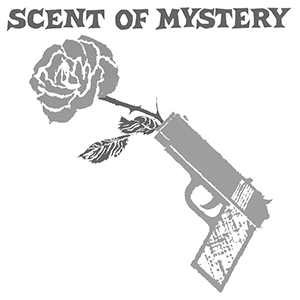
Smell-O-Vision was a system that released odor during the projection of a film so that the viewer could ‘smell’ what was happening in the movie. The technique was created by inventor Hans Laube and made its only appearance in the 1960 film ‘Scent of Mystery,’ produced by Mike Todd, Jr., son of film producer Mike Todd. The process injected 30 odors, such as freshly-baked bread, pipe tobacco, and salty ocean air, into a movie theater’s seats when triggered by the film’s soundtrack.
The use of scents in conjunction with film dates back to 1906, before the introduction of sound. In this first instance, a 1958 issue of ‘Film Daily’ claims that Samuel Roxy Rothafel of the Family Theatre in Forest City, Pennsylvania, placed a wad of cotton wool that had been soaked in rose oil in front of an electric fan during a newsreel about the Rose Bowl Game. Arthur Mayer installed an in-theater smell system in Paramount’s Rialto Theater on Broadway in 1933, which he used to deliver odors during a film. However, it would take over an hour to clear the scents from the theater, and some smells would linger for days afterward.
read more »
Posted in Art, Humor, Technology |
Leave a Comment »
December 8, 2015

A pastiche [pa-steesh] is a work of visual art, literature, theatre, or music that imitates the style or character of the work of one or more other artists. Unlike parody, pastiche celebrates, rather than mocks, the work it imitates. The word pastiche is a French cognate of the Italian noun ‘pasticcio,’ which is a pâté or pie-filling mixed from diverse ingredients.
Metaphorically, pastiche and pasticcio describe works that are either composed by several authors, or that incorporate stylistic elements of other artists’ work. They are examples of eclecticism in art. Pastiche is sometimes confused with allusion, but a literary allusion may refer to another work, but it does not reiterate it. Moreover, allusion requires the audience to share in the author’s cultural knowledge. Both allusion and pastiche are mechanisms of intertextuality (the shaping of a text’s meaning by another text).
read more »
Posted in Art, Language |
Leave a Comment »
December 7, 2015
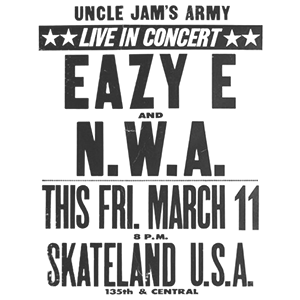
NWA (Niggaz Wit Attitudes) was an American hip hop group from Compton, California. It was one of the earliest and most significant popularizers of the gangsta rap and West Coast hip hop subgenres. Active from 1986 to 1991, the rap group endured controversy owing to their music’s explicit lyrics that many viewed as being disrespectful of women, as well as its glorification of drugs and crime.
The group was subsequently banned from many mainstream American radio stations. In spite of this, the group has sold over 10 million units in the US alone. The group was also known for their deep hatred of the police system, which sparked much controversy over the years. Their debut album ‘Straight Outta Compton’ marked the beginning of the new gangsta rap era as the production and social commentary in their lyrics were revolutionary within the genre.
read more »
Posted in Art, Politics |
Leave a Comment »
December 3, 2015

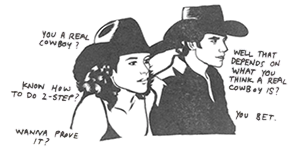
The term honky-tonk has been applied to various styles of 20th century American music. A honky-tonk a type of bar that provides country music for entertainment to its patrons. Bars of this kind are common in the Southern and Southwestern regions of the US, and many country music legends, such as Loretta Lynn, Merle Haggard, Patsy Cline, and Ernest Tubb began their careers as amateur musicians in honky-tonks.
Honky tonks were rough establishments that served alcoholic beverages to a working class clientele, and sometimes offered dancing, piano players, or small bands. Some were local hubs of underground prostitution. Dance researcher Katrina Hazzard-Gordon writes that the honky-tonk was ‘the first urban manifestation of the ‘jook” (‘juke joints,’ African American roadhouses and bars). Honky tonk originally referred to bawdy variety shows in the West and to the theaters housing them. The distinction between honky tonks, saloons and dancehalls was often blurred, especially in cowtowns, mining districts, military forts, and oilfields.
read more »
Posted in Art |
Leave a Comment »
November 9, 2015

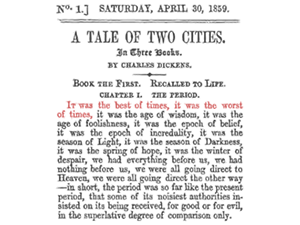
‘Once upon a time‘ is a stock phrase used to introduce a narrative of past events, typically in fairy tales and folktales. It has been used in some form since at least 1380 in storytelling in the English language and has opened many oral narratives since 1600. These stories often then end with ‘and they all lived happily ever after,’ or, originally, ‘happily until their deaths.’
The phrase is particularly common in fairy tales for younger children, where it is almost always the opening line of a tale. It was commonly used in the original translations of the stories of Charles Perrault as a translation for the French ‘il était une fois,’ of Hans Christian Andersen as a translation for the Danish ‘der var engang,’ (literally ‘there was once’), the Brothers Grimm as a translation for the German ‘es war einmal’ (literally ‘it was once’). An alternative German fairy tale opening translates to: ‘Back in the days when it was still of help to wish for a thing…’
Posted in Art, Language |
Leave a Comment »



