November 9, 2014
The Sekhmet Hypothesis was first published in 1995 by author Iain Spence. It suggested a possible link between the emergence of youth culture archetypes in relation to the 11 year solar cycles. The hypothesis was published again in 1997 in ‘Towards 2012’ and covered in 1999 in ‘Sleazenation’ magazine. Spence eventually abandoned the idea as not based in scientific fact, pointing to Strauss-Howe generational theory as a better model of social change.
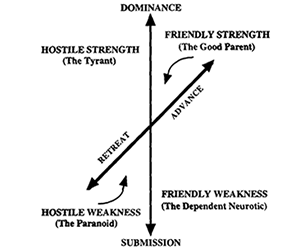
The origins of the hypothesis can be traced back to philosopher Robert Anton Wilson’s book, ‘Prometheus Rising,’ in which he makes a singular correlation between the archetype of the flower child with the mood of friendly weakness. Spence extended the comment into a study of various youth archetypes and linked in their behavior to transactional analysis (a theory of human interaction). The idea of linking pop culture to the solar cycles had been influenced from remarks made by modern occultist Peter J. Carroll, in his book, ‘Psychonaut.’ Sekhmet is the Egyptian goddess of the sun.
read more »
Posted in Art, Language, Philosophy |
Leave a Comment »
November 9, 2014


‘The Caine Mutiny‘ is a 1951 Pulitzer Prize-winning novel by American author Herman Wouk. The book grew out of Wouk’s personal experiences aboard a destroyer-minesweeper in the Pacific in World War II and deals with, among other things, the moral and ethical decisions made at sea by the captains of ships. The mutiny of the title is legalistic, not violent, and takes place during a historic typhoon in December 1944. The court-martial that results provides the dramatic climax to the plot.
The story is told through the eyes of Willis Seward ‘Willie’ Keith, an affluent, callow young man who signs up for midshipman school with the Navy to avoid being drafted into the Army during World War II. After barely surviving a series of misadventures that earn him the highest number of demerits in the history of the school, he is commissioned and assigned to the destroyer minesweeper USS Caine, an obsolete warship converted from a World War I-era destroyer.
read more »
Posted in Art, Politics, War |
Leave a Comment »
November 8, 2014

Bathroom singing is common because the hard wall surfaces, often tiles or wooden panels, and lack of soft furnishings, create an aurally pleasing acoustic environment. The multiple reflections from walls enrich the sound of one’s voice. Small dimensions and hard surfaces of a typical bathroom produce various kinds of standing waves, reverberation and echoes, giving the voice ‘fullness and depth.’
This habit was first reported (with an attempt of explanations) in the 14th century by Arab historian Ibn Khaldun. In Chapter 1 of his ‘Muqaddimah’ writes: ‘Likewise, when those who enjoy a hot bath inhale the air of the bath, so that the heat of the air enters their spirits and makes them hot, they are found to experience joy. It often happens that they start singing, as singing has its origin in gladness.’
read more »
Posted in Art, Humor |
1 Comment »
November 7, 2014
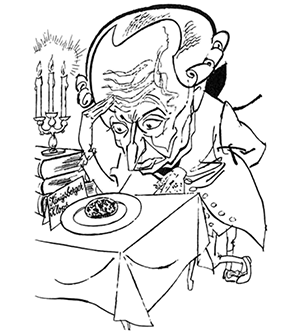
In sociology, taste is an individual’s personal and cultural patterns of choice and preference. It is drawing qualitative distinctions between things such as styles, manners, consumer goods, and works of art. Aesthetic preferences and attendance to various cultural events are associated with education and social origin. Different socioeconomic groups are likely to have different tastes, and social class is one of the most prominent factors structuring taste. The concept of aesthetics has been the interest of philosophers such as Plato, Hume and Kant, who understood it as something pure and searched for the ‘essence of beauty,’ the ontology of taste. But it was not until the beginning the early 19th century that the question was problematized in its social context.
In his aesthetic philosophy, Kant denies any standard of a good taste, which would be the taste of the majority or any social group. For Kant, beauty is not a property of an object, but a judgement based on a subjective feeling. He claims that even if a universal, non-relativistic ‘good taste’ does exist, it can not be empirically identified, or found in any standards or generalizations, and the validity of a judgement is not the general view of the majority or some specific social group. Taste is both personal and beyond reasoning, and therefore disputes over matters of taste never reach a finite conclusion. Kant stresses that our preferences, even on generally liked things, do not justify our judgements.
read more »
Posted in Art, Money, Politics |
Leave a Comment »
November 4, 2014

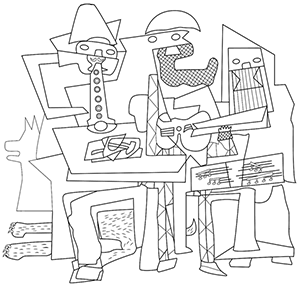
Commedia [kuh-mey-dee-uh] dell’arte [del-ahr-tee] is a form of improvisational theater that began in Italy in the 16th century. The actors often wore masks and the stories were often about the cunning pursuit of love, money, or simply food. The genre developed several stock characters that represent fixed social types, such as foolish old men, devious servants, or military officers full of false bravado including Harlequin (comic servant), Pantalone (rich old miser), Colombina (tricky slave wife), Pulcinella (disfigured trickster), Pierrot (unrequited clown), and Scaramuccia (roguish clown).
Stock characters can be divided into three groups, ‘Innamorati’ (‘The Lovers,’ who are never masked nor well developed as characters), ‘Vecchi’ (‘The Old People,’ often the Lovers’ parents, who get in the way of their romance), and ‘Zanni’ (‘The Servants/ Commoners,’ always hungry, and often responsible for the Lovers finding their way to the altar). Characters such as Pantalone, the Venetian merchant; Dottore Gratiano, the pedant from Bologna; or Arlecchino, the mischievous servant from Bergamo, began as satires on Italian ‘types’ and became the archetypes of many of the favorite characters of 17th- and 18th-century European theater.
read more »
Posted in Art, Humor, Language |
1 Comment »
October 26, 2014


The red pill and its counterpart, the blue pill, are popular culture symbols representing the choice between embracing the sometimes painful truth of reality (red pill) and the blissful ignorance of illusion (blue pill).
The concept was popularized by the 1999 film ‘The Matrix,’ in which the protagonist is offered the choice of remaining in the fabricated reality of a computer simulation, living the ‘ignorance of illusion,’ or the freedom to live the ‘truth of reality’ even though it is a harsher, more difficult life.
read more »
Posted in Art, Philosophy |
Leave a Comment »
October 20, 2014


In engineering, fiction, and thought experiments, unobtainium [uhn-uhb-tey-nee-uhm] is any fictional, extremely rare, costly, or impossible material, or (less commonly) device needed to fulfill a given design for a given application. The properties of any particular unobtainium depend on the intended use. For example, a pulley made of unobtainium might be massless and frictionless; however, if used in a nuclear rocket, unobtainium would be light, strong at high temperatures, and resistant to radiation damage. The concept of unobtainium is often applied flippantly or humorously.
Since the late 1950s, aerospace engineers have used the term when referring to unusual or costly materials, or when theoretically considering a material perfect for their needs in all respects, except that it does not exist. By the 1990s, the term was in wide use, even in formal engineering papers such as ‘Towards unobtainium [new composite materials for space applications].’ The word may well have been coined in the aerospace industry to refer to materials capable of withstanding the extreme temperatures expected in reentry. Aerospace engineers are frequently tempted to design aircraft which require parts with strength or resilience beyond that of currently available materials.
read more »
Posted in Art, Humor, Technology |
Leave a Comment »
October 16, 2014
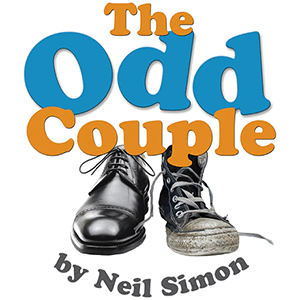
In fiction, a foil is a character who contrasts with another character (usually the protagonist) in order to highlight particular qualities in their counterpart (the term derives from the practice of backing gems with foil to increase their brilliance). In some cases, a subplot can be used as a foil to the main plot, particularly in metafiction (‘breaking the fourth wall’) and the ‘story within a story’ motif. A foil often differs drastically from the lead character, but can also be extremely similar, with only a key difference setting them apart. Foils generally serve one or more of three broad functions: contrast (‘this is different than X’), exclusion (‘this is not X’), or blame (‘X did this’).
In ‘Frankenstein,’ by Mary Shelley, the two main characters of Dr. Frankenstein and his ‘Adam of your Labors,’ his ‘creature,’ his ‘wretch,’ are both together literary foils. Both are hungry for knowledge, but whereas the doctor is selfish and arrogant, the monster is compassionate and gentle. In ‘Pride and Prejudice,’ Mary’s absorption in her studies places her as a foil to her sister Lydia Bennet’s lively and distracted nature. Similarly, in Shakespeare’s ‘Julius Caesar,’ the naive Brutus has foils in Cassius and Mark Antony, who are ambitious and experienced politicians.
Posted in Art, Language |
Leave a Comment »
October 6, 2014
A sidekick is a close companion who is generally regarded as subordinate to the one he accompanies. Some well-known fictional sidekicks include Don Quixote’s Sancho Panza, Sherlock Holmes’ Doctor Watson, The Lone Ranger’s Tonto, and Batman’s Robin.
The origin of the term is unknown. It was originally ‘side kicker’ (as seen in the short stories of American writer O Henry), having grown from the 1850s term ‘side partner.’ Contrary to popular folk etymology, it is unrelated to the early-20th century British pickpocket slang ‘kick,’ referring to a trouser pocket. One of the earliest recorded sidekicks may be Enkidu, who adopted a sidekick role to Gilgamesh after they became allies in the ‘Epic of Gilgamesh’ (an epic poem from Mesopotamia). Other early examples include Achilles’ Patroclus from the ‘Iliad,’ and Moses’ Aaron from the Bible.
read more »
Posted in Art, Language |
Leave a Comment »
October 3, 2014

Comic relief is the inclusion of a humorous character, scene, or witty dialogue in an otherwise serious work, often to relieve tension. It is a narrative technique that momentarily alleviates the stressful emotions and angst building up in a dramatic story. Comic relief often takes the form of a bumbling, wisecracking sidekick of the hero or villain in a work of fiction. The secondary character will often remark on the absurdity of the hero’s situation and make comments that would be inappropriate for a character who is to be taken seriously. Other characters may use comic relief as a means to irritate others or keep themselves confident.
Comic relief can also occur during dramatic moments in comedies. Greek tragedy does not allow any comic relief. Even the Elizabethan critic Sidney following Horace’s ‘Ars Poetic’ pleaded for the exclusion of comic elements from a tragic drama. But in Renaissance England, Marlowe among the University Wits (a group of late-16th-century English playwrights and pamphleteers who were educated at Oxford or Cambridge) introduced comic relief through the presentation of crude scenes in ‘Doctor Faustus’ following the native tradition of Interlude which was usually introduced between two tragic plays. In fact, in the classical tradition the mingling of the tragic and the comic was not allowed.
Posted in Art, Humor |
Leave a Comment »
October 2, 2014
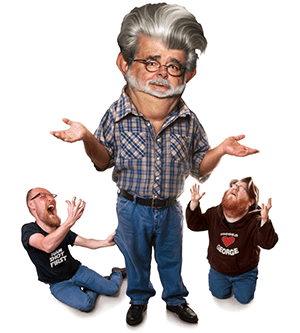
Jar Jar Binks is a fictional character from the Star Wars saga created by George Lucas for his prequel trilogy. He was the first lead computer generated character of the franchise, he was portrayed by Ahmed Best in most of his appearances. Jar Jar’s primary role in ‘Episode I’ was to provide comic relief for the audience, and was generally met with extremely negative comments from both critics and viewers. He is often acknowledged as one of the worst and most hated characters of all time.
Joe Morgenstern of ‘The Wall Street Journal’ described him as a ‘Rastafarian Stepin Fetchit on platform hoofs, crossed annoyingly with Butterfly McQueen.’ Race theorist Patricia J. Williams suggested that many aspects of Jar Jar’s character are reminiscent of blackface minstrelsy, while others have suggested the character is a ‘laid-back clown character’ representing a black Caribbean stereotype. George Lucas has denied any racist implications. Ahmed Best also rejected the allegations, saying that ‘Jar Jar has nothing to do with the Caribbean.’
read more »
Posted in Art, Humor |
Leave a Comment »
October 1, 2014

A fan edit is a version of a film modified by a viewer, that removes, reorders, or adds material in order to create a new interpretation of the source material. This includes the removal of scenes or dialogue, replacement of audio and/or visual elements, and adding material from sources such as deleted scenes or even other films. The field was popularized by an individual calling himself the ‘Phantom Editor’ (later revealed as professional editor Mike J. Nichols). He removed elements from George Lucas’ ‘The Phantom Menace’ that he felt detracted from the film, and made minor changes in dialogue, languages, and subtitles to give the film’s villains a more menacing tone.
There were a total of 18 minutes cut from the original film, reducing the run time from 136 minutes to 118 minutes. The end result became known as ‘The Phantom Edit,’ which circulated Hollywood studios on VHS in 2000. It was the first unauthorized re-edit of a major film to receive publicity and acclaim and inspired dozens of other edits to surface on the internet. Lucasfilm, the production company of series creator George Lucas, condoned the edit, and did not pursue legal action against its distributors.
read more »
Posted in Art, Money |
1 Comment »