February 26, 2014

The Discreet Charm of the Bourgeoisie (‘Le Charme discret de la bourgeoisie’) is a 1972 surrealist film directed by Luis Buñuel and written by Jean-Claude Carrière in collaboration with the director. The narrative concerns a group of upper-middle-class people attempting — despite continual interruptions — to dine together.
The film consists of several thematically linked scenes: five gatherings of a group of bourgeois friends, and the four dreams of different characters. The beginning of the film focuses on the gatherings, while the latter part focuses on the dreams, but both types of scenes are intertwined. There are also scenes involving other characters, such as two involving a Latin American female terrorist from the fictitious Republic of Miranda. The film’s world is not logical: the bizarre events are accepted by the characters, even if they are impossible or contradictory.
read more »
Posted in Art, Money, World |
Leave a Comment »
February 22, 2014

Itasha [ee-tah-sha] (literally ‘painful car’) is a Japanese term for a fashion of individuals decorating the bodies of their cars with fictional characters of anime, manga, or video games (especially ‘bishojo game’ and ‘eroge’ – dating and porn games). These characters are predominantly ‘cute’ females. The decorations usually involve paint schemes and stickers. Automobiles are called ‘itasha,’ while similar motorcycles and bicycles are called ‘itansha’ and ‘itachari,’ respectively.
In the 1980s, when Japan was at the zenith of its economic might, Tokyo’s streets were a parade of luxury import cars. Among them, the ‘itasha’—originally Japanese slang meaning an imported Italian car—was the most desired. Since then, ‘itasha’ (as the decorated vehicle) was derived from combining the Japanese words for ‘itai’ (‘painful’) and ‘sha’ (‘vehicle’). ‘Painful’ can be interpreted as ‘painfully embarrassing’ or ‘painful for the wallet’ due to the high costs involved.
Posted in Art, Technology, World |
Leave a Comment »
February 21, 2014
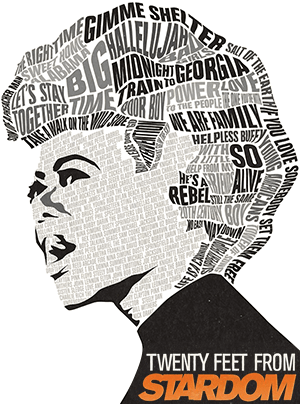
A backup singer (also known as a backing vocalist, background singer, or harmony vocalist) is a singer who provides vocal harmony with the lead vocalist or other backing vocalists. In some cases, a backing singer may sing alone as a lead-in to the main vocalist’s entry or a counter-melody. Solo artists may employ professional backing vocalists in studio recording sessions as well as during concerts and other live performance routines.
Working as a backup singer can give a vocalist the onstage experience and vocal training they need to develop into a lead vocalist. A number of lead vocalists such as Ace Frehley, Mariah Carey, Cher, Gwen Stefani, Pink, Whitney Houston, Phil Collins, Sheryl Crow, Trisha Yearwood, Dave Grohl, and Elton John, learned their craft as backup singers, or singing backup vocals as part of a choir.
read more »
Posted in Art, Money |
Leave a Comment »
February 20, 2014
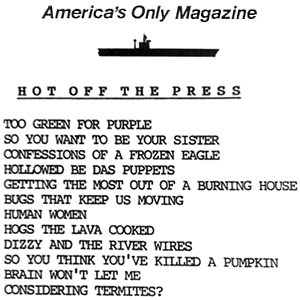
‘Army Man‘ (tagline: ‘America’s Only Magazine’) was a short-lived comedy magazine published in the late 1980s by George Meyer, the acclaimed writer for ‘The Simpsons.’ The magazine consisted mostly of very short and very surreal jokes, along with some cartoons. Each issue also featured Jack Handey’s ‘Deep Thoughts,’ as well as other pieces written by him. Only three issues were ever published. Although Army Man was never widely distributed, it gathered a lot of attention in the comedy world.
Two of its writers (John Swartzwelder and Jon Vitti) were picked up alongside Meyer to be part of the original writing staff of ‘The Simpsons’ by the show’s developer and show-runner Sam Simon, an enormous fan of the magazine. Eventually other ‘Army Man’ writers would go on to write for ‘The Simpsons’ in later seasons. The writers were usually people Meyer knew from his years at the ‘Harvard Lampoon’ or who worked with him in TV shows like ‘Late Night with David Letterman,’ ‘The New Show,’ ‘Not Necessarily The News,’ and ‘Saturday Night Live.’
Posted in Art, Humor, Language |
Leave a Comment »
February 19, 2014

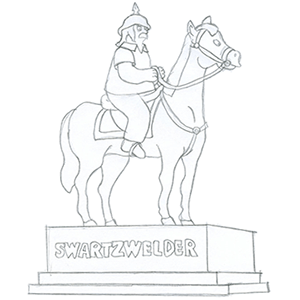
John Swartzwelder (b. 1950) is an American comedy writer and novelist, best known for his work on the animated television series ‘The Simpsons,’ as well as a number of novels. He is credited with writing the largest number of ‘Simpsons’ episodes by a large margin (59 full episodes, with contributions to several others). Swartzwelder was one of several writers recruited to show from the pages of George Meyer’s ‘Army Man’ magazine (a short-lived comedy periodical published in the late 1980s; Meyer would also go on to become an acclaimed ‘Simpsons’ writer).
Swartzwelder has been animated in the background of several episodes of ‘The Simpsons.’ His animated likeness closely resembles musician David Crosby, which prompted Matt Groening to state that anytime that David Crosby appears in a scene for no apparent reason, it is really John Swartzwelder. Additionally, Matt Groening has stated that the recurring character ‘Herman Hermann’ (the owner of Herman’s Military Antiques) was originally physically based on Swartzwelder–with the exception of his one arm.
read more »
Posted in Art, Humor, Language |
Leave a Comment »
February 15, 2014

A holodeck, in the fictional ‘Star Trek’ universe, is a simulated reality facility located on starships and starbases. It first appeared in the pilot episode of ‘Star Trek: The Next Generation,’ ‘Encounter at Farpoint,’ although a conceptually similar ‘recreation room’ appeared in an episode of ‘Star Trek: the Animated Series’ in 1974. In the timeline of the fictional universe, the concept of a holodeck was first shown to humans in an encounter with the Xyrillian race in the ‘Star Trek: Enterprise’ episode ‘Unexpected.’
The holodeck is depicted as an enclosed room in which objects and people are simulated by a combination of transported matter, replicated matter, tractor beams, and shaped force fields onto which holographic images are projected. Most holodeck programs shown in the episodes run in first person ‘subjective mode,’ in which the user actively interacts with the program and its characters. The user may also employ third-person ‘objective mode,’ in which he or she is unseen by program characters.
read more »
Posted in Art, Technology |
1 Comment »
February 12, 2014


The mola [moh-luh] forms part of the traditional woman’s attire for the Kuna (an indigenous people of Panama and Colombia), two mola panels being incorporated as front and back panels in a blouse. The full costume traditionally includes a patterned wrapped skirt (saburet), a red and yellow headscarf (musue), arm and leg beads (wini), a gold nose ring (olasu), and earrings in addition to the mola blouse (dulemor).
In Dulegaya, the Kuna’s native language, ‘mola’ means ‘shirt’ or ‘clothing.’ The mola originated with the tradition of Kuna women painting their bodies with geometrical designs, using available natural colors; in later years these same designs were woven in cotton, and later still, sewn using cloth bought from the European settlers of Panamá.
read more »
Posted in Art, World |
Leave a Comment »
February 10, 2014

The Monuments, Fine Arts, and Archives (MFAA) program under the Civil Affairs and Military Government Sections of the Allied armies was established in 1943 to help protect cultural property in war areas during and after World War II. The group of about 400 servicemembers and civilians worked with military forces to safeguard historic and cultural monuments from war damage, and as the conflict came to a close, to find and return works of art and other items of cultural importance that had been stolen by the Nazis or hidden for safekeeping.
Many of the men and women of the MFAA, also known as Monuments Men, went on to have prolific careers. Largely art historians and museum personnel, they had formative roles in the growth of many of the United States’ greatest cultural institutions, including the National Gallery of Art, the Metropolitan Museum of Art, and the New York City Ballet, as well as in museums and other institutions in Europe.
read more »
Posted in Art, War |
Leave a Comment »
February 3, 2014


An eponymous [uh-pon-uh-muhs] hairstyle is a particular style of hair that has become fashionable during a certain period of time through its association with a prominent individual. Imitation of such styles can sometimes be attributed to what became known in the 1980s as the ‘wannabe’ effect, a term used particularly with reference to young women who wished to emulate (i.e. ‘wanna be’ like) the American singer Madonna. A 2010 study of British women found that half took a copy of a celebrity’s photograph to their salons to obtain a similar hairstyle.
The quest for a particular eponymous style was caricatured in Plum Sykes’ novel ‘Bergdorf Blondes’ (2004), in which it was rumored that a glamorous New York heiress (Julie Bergdorf) had her blonde hair touched up every thirteen days (‘$450 a highlight’) by a stylist at her family’s store, Bergdorf Goodman. Thus, other ‘Thirteen Day Blondes’ who attained Julie’s precise color—likened to that of the ‘very white’ hair of Carolyn Bessette Kennedy—became known as ‘Bergdorf Blondes.’
read more »
Posted in Art, Humor |
Leave a Comment »
January 27, 2014

CuteCircuit is a fashion company based in London founded in 2004 by Ryan Genz and Francesca Rosella that designs wearable technology and interactive fashion. The company is among the first in fashion to offer smart textile-based garments with micro electronics. CuteCircuit designs dresses and costumes for international artist special performances or tours. Such as, Katy Perry’s catsuit for her performance on ‘American Idol,’ U2 leather jackets for their ‘U2 360 Tour,’ and Azealia Banks’ mermaid dress.
The Kinetic Dress, designed in 2004, lights up and changes its patterns following the person’s movement. The Hug Shirt is a t-shirt that recreates the sensation of touch, warmth, and emotion of a hug from the distant one using Bluetooth and sensors technology. The 2008 M Dress accepts a standard SIM card and allows to make and receive calls. Designed in partnership with Ballantine’s, TshirtOS is the world’s first t-shirt, that can be programmed by an iOS app to show images and texts, play music, take photos and share them.
Posted in Art, Technology |
Leave a Comment »
January 16, 2014
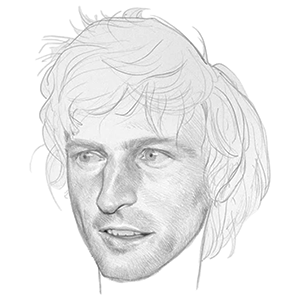
Spike Jonze (b. 1969) is an American filmmaker best known for his collaborations with writer Charlie Kaufman, which include the 1999 film ‘Being John Malkovich’ and the 2002 film ‘Adaptation,’ and as the co-writer and director of the 2009 film ‘Where the Wild Things Are.’ He is also well known for his music video collaborations with Fatboy Slim, Weezer, Beastie Boys, and Björk.
He was also a co-creator and executive producer of ‘MTV’s Jackass.’ Since 2007, he has been the creative director at VBS.tv, an online television network supplied by Vice and funded by MTV. He is also part owner of skateboard company Girl Skateboards with riders Rick Howard and Mike Carroll. He also co-founded Directors Label, with filmmakers Chris Cunningham and Michel Gondry, and the Palm Pictures company
read more »
Posted in Art |
Leave a Comment »
January 13, 2014

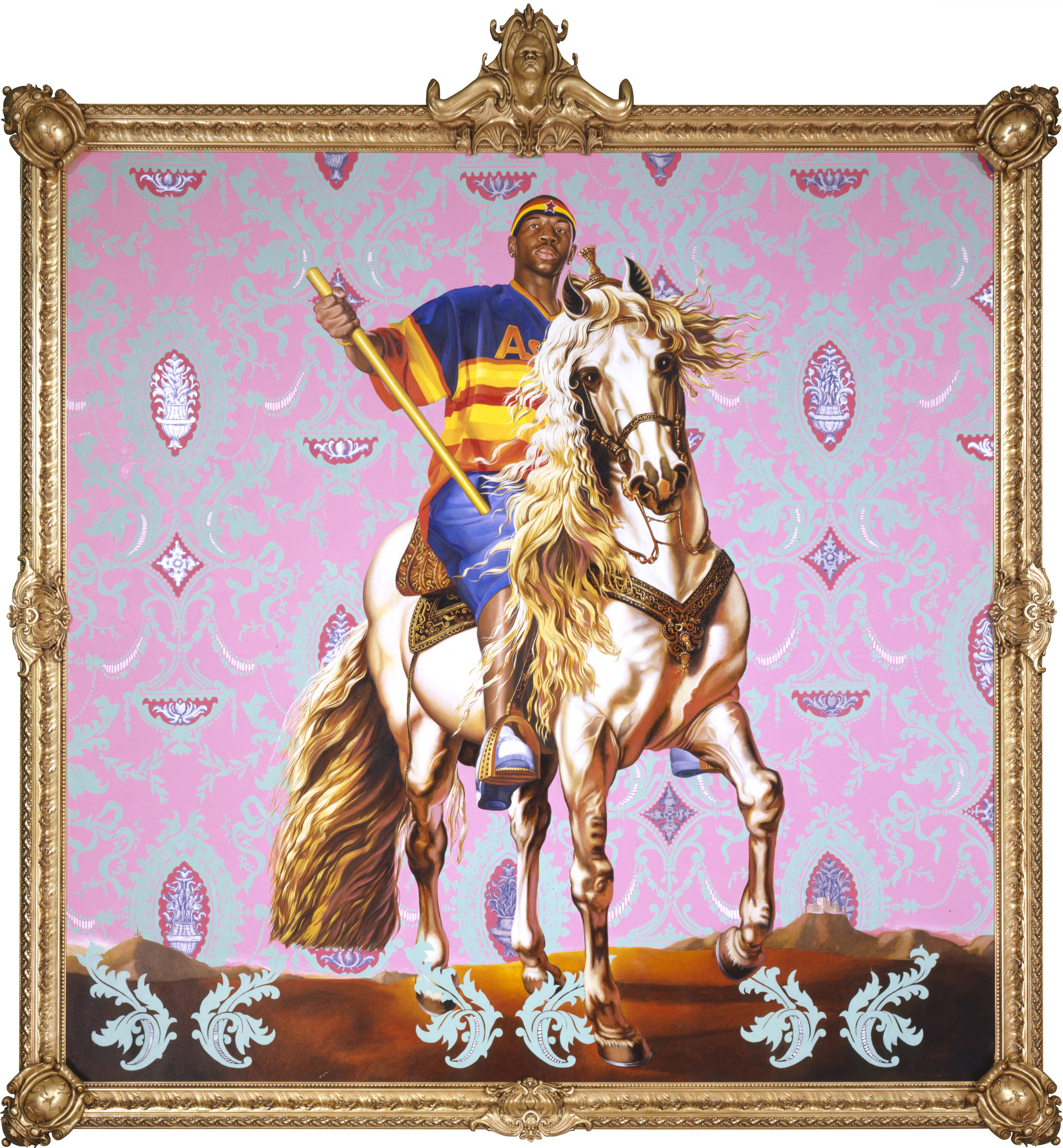
Kehinde [keh-hin-day] Wiley (b. 1977) is a New York-based portrait painter, who is known for his highly naturalistic paintings of people with black and brown skin in heroic poses. His portraits are based on photographs of young men who Wiley sees on the street. He painted men from Harlem’s 125th Street, then South Central neighborhood where he was born.
Dressed in street clothes, his models were asked to assume poses from the paintings of Renaissance masters, such as Tiziano Vecellio and Giovanni Battista Tiepolo. The artist describes his approach as ‘interrogating the notion of the master painter, at once critical and complicit.’ His figurative paintings ‘quote historical sources and position young black men within that field of power.’
read more »
Posted in Art, Politics, World |
Leave a Comment »




 The Daily Omnivore