December 11, 2012

‘How to Rob‘ is a 1999 song by American hip hop recording artist 50 Cent. The song serves as his debut single and the lead single from his album ‘Power of the Dollar’ (officially unreleased but heavily bootlegged).
The album, which was originally set for a 2000 release, was supposed to be his debut with Columbia Records, but was cancelled after 50 Cent was dropped from the label when Columbia discovered that he had been shot. ‘How to Rob’ was produced by Tone & Poke of Trackmasters and features D-Dot, also known as The Madd Rapper. The song was also included on the soundtrack to the 1999 film ‘In Too Deep,’ staring LL Cool J and Omar Epps.
read more »
Posted in Art, Humor, Money |
Leave a Comment »
December 11, 2012
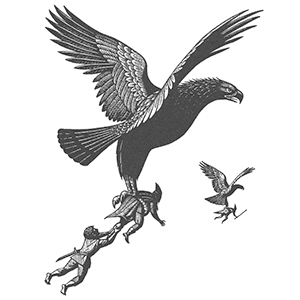
Eucatastrophe [yew-kuh-tas-truh-fee] is a term coined by J. R. R. Tolkien which refers to the sudden turn of events at the end of a story which ensure that the protagonist does not meet some terrible, impending, and very plausible doom. He formed the word by affixing the Greek prefix ‘eu,’ meaning ‘good,’ to ‘catastrophe,’ the word traditionally used in classically-inspired literary criticism to refer to the ‘unraveling’ or conclusion of a drama’s plot.
For Tolkien, the term appears to have had a thematic meaning that went beyond its implied meaning in terms of form. In his definition as outlined in his 1947 essay ‘On Fairy-Stories,’ it is a fundamental part of his conception of mythopoeia (the creation of myths). Though Tolkien’s interest is in myth, it is also connected to the gospels; Tolkien calls the Incarnation (God taking a physical form, as Jesus in Tolkien’s view) the eucatastrophe of ‘human history’ and the Resurrection the eucatastrophe of the Incarnation.
read more »
Posted in Art, Language |
1 Comment »
December 11, 2012
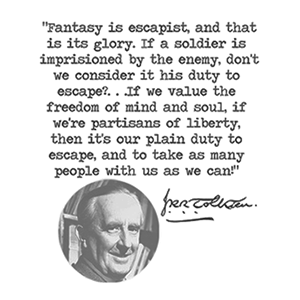
‘On Fairy-Stories‘ is an essay by J. R. R. Tolkien which discusses the fairy-tale as a literary form. It was initially written (and entitled simply ‘Fairy Stories’) for presentation by Tolkien as the Andrew Lang lecture at the University of St Andrews, Scotland, in 1939.
It first appeared in print, with some enhancement, in 1947, in a festschrift volume (a book honoring a respected person), ‘Essays Presented to Charles Williams,’ compiled by C. S. Lewis. British poet Charles Williams, a friend of Lewis’s, had been relocated with the Oxford University Press staff from London to Oxford during the London blitz in World War II. This allowed him to participate in gatherings of the Inklings (an informal literary discussion group) with Lewis and Tolkien.
read more »
Posted in Art, Language, Philosophy |
Leave a Comment »
December 6, 2012

The Shockwave Rider is a 1975 science fiction novel by John Brunner, notable for its hero’s use of computer hacking skills to escape pursuit in a dystopian future, and for the coining of the word ‘worm’ to describe a program that propagates itself through a computer network. It also introduces the concept of a ‘Delphi pool’ (a large group of people used as a statistical sampling resource), perhaps derived from the RAND Corporation’s Delphi method – a futures market on world events which bears close resemblance to DARPA’s controversial and cancelled Policy Analysis Market (dubbed the ‘Terrorism Market’ by the media).
The title derives from the futurist work ‘Future Shock’ by Alvin Toffler. The hero is a survivor in a hypothetical world of quickly changing identities, fashions, and lifestyles, where individuals are still controlled and oppressed by a powerful and secretive state apparatus. His highly developed computer skills enable him to use any public telephone to punch in a new identity, thus reinventing himself. As a fugitive, he must do this from time to time in order to escape capture. The title is also a metaphor for survival in an uncertain world.
read more »
Posted in Art, Language, Technology |
Leave a Comment »
December 6, 2012
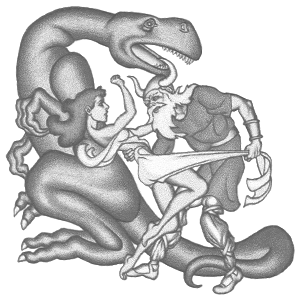
‘Sidewise in Time‘ is a science fiction short story by Murray Leinster that was first published in a 1934 issue of ‘Astounding Stories.’ In the story, professor Minott is a mathematician at Robinson College in Virginia who has determined that an apocalyptic cataclysm is fast approaching that could destroy the entire universe. The cataclysm manifests itself on June 5, 1935 (one year in the future in terms of the story’s original publication) when sections of the Earth’s surface begin changing places with their counterparts in alternate timelines.
A Roman legion from a timeline where the Roman Empire never fell appears on the outskirts of St. Louis, Missouri. Viking longships from a timeline where the Vikings settled North America raid a seaport in Massachusetts. A traveling salesman from Louisville, Kentucky finds himself in trouble with the law when he travels into an area where the South won the American Civil War. A ferry approaching San Francisco finds the flag of Czarist Russia flying from a grim fortress dominating the city.
read more »
Posted in Art, Language |
Leave a Comment »
December 6, 2012

‘A Logic Named Joe‘ is a science fiction short story by Murray Leinster that was first published in a 1946 issue of ‘Astounding Science Fiction.’ The story actually appeared under Leinster’s real name, Will F. Jenkins, since the issue also included a story under the Leinster pseudonym ‘Adapter.’
The story is particularly noteworthy as a prediction of massively networked personal computers and their drawbacks, written at a time when computing was in its infancy. The story’s narrator is a ‘logic’ (much like a personal computer) repairman nicknamed Ducky. In the story, a logic whom he names ‘Joe’ develops some degree of sapience and ambition.
read more »
Posted in Art, Language, Technology |
Leave a Comment »
December 4, 2012

David Doubilet (b. 1946) is a well known underwater photographer published frequently in ‘National Geographic Magazine.’ He was born in New York and started taking photos underwater at the young age of 12. He started with a Brownie Hawkeye in a rubber anesthesiologist’s bag. During his summer holidays, he spent his time along the New Jersey coast. He later worked as a diver and photographer for the Sandy Hook Marine Laboratories in New Jersey. He also spent much time in the Caribbean. While a dive instructor in the Bahamas he found his motivation to capture the beauty of the sea and everything in it.
His goal as a photographer is to ‘redefine photographic boundaries’ every time he enters the water. The main obstacle in underwater photography is the impossibility of changing lenses or film underwater, thus Doubilet invented the split lens camera. This allowed him to take pictures above and below water simultaneously; there is a separate focus point on the top half and bottom half of the scene. When the picture is taken, it is recorded onto the same negative. He is well known for his reports on the sea and has written many books in recent years, one of which includes ‘Australia’s Great Barrier Reef’ by National Geographic.
Posted in Art, Science |
Leave a Comment »
December 2, 2012
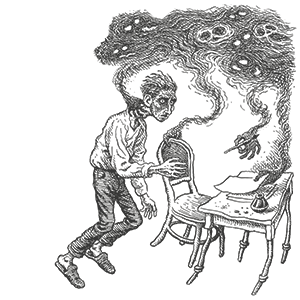
Introducing Kafka, also known as Kafka for Beginners, is a 1993 illustrated biography of Franz Kafka by David Zane Mairowitz and Robert Crumb. The book includes comic adaptations of some of Kafka’s most famous works including ‘The Metamorphosis,’ ‘A Hunger Artist,’ ‘In the Penal Colony,’ and ‘The Judgment,’ as well as brief sketches of his three novels ‘The Trial,’ ‘The Castle,’ and ‘Amerika.’
The book also details Kafka’s biography in a format that is part illustrated essay, part sequential comic panels. The book was released as part of the ‘Introducing…’ series by Totem Books which also features a volume each on Sigmund Freud and Wilhelm Reich. The popularity of Crumb’s renditions of Kafka’s works led to additional printings under the title ‘R. Crumb’s Kafka.’
Posted in Art, Humor, Language |
1 Comment »
December 2, 2012

Internet Killed Television is a web series which documents the lives of Charles Trippy, his wife Alli and their dogs Zoey and Marley. The show consists of episodes averaging around one to twenty minutes that are filmed, edited, and then aired every day onto YouTube by mid-afternoon Eastern Standard Time. The series was originally planned to last for only one year; however, after the success of the first season, the couple have decided to continue.
The YouTube series has now reached its fourth year and every year, so far, they have reached out to their audience, the CTFxC(ers) to create a montage featuring the main events that had occurred that year.
read more »
Posted in Art, Humor, Technology |
1 Comment »
November 28, 2012

How to Speak Hip is a spoken-word comedy album by improv pioneer Del Close and John Brent, released by Mercury Records in 1959. The album is designed as a satire of language-learning records, where the secret language of the ‘hipster’ is treated as a foreign language.
Part of the joke, however, is that it actually does a good job of describing the Beat Generation/Beatnik sub-culture: Basic concepts such as ‘cool’ and ‘uncool’ are taught, as well as vocabulary building (‘dig,’ ‘dig it,’ ‘dig yourself, baby,’ ‘dig the chick,’ ‘dig the cat,’ ‘What a drag!’).
read more »
Posted in Art, Humor, Language |
Leave a Comment »
November 28, 2012

Harold is a structure used in longform theatrical improvisation. Developed by Del Close and brought to fruition through Close’s collaboration with Charna Halpern, the Harold has become the signature form of Chicago’s iO and the Upright Citizens Brigade Theater in New York and Los Angeles. It is now performed by improvisational theater troupes and teams across the world.
The Committee, a San Francisco improv group, performed the first Harold in Concord, California in 1967. They were invited to a high school and decided to do their improvisations on the war in Vietnam. On the way home they were discussing the performance when one of them asked what they should call it. Allaudin (Bill) Mathieu called out ‘Harold.’ It was a joking reference to a line from ‘A Hard Days Night’ where a reporter asked George Harrison what he called his haircut; he answered ‘Arthur.’ Close later remarked that he wished he had chosen a better name.
read more »
Posted in Art, Games, Humor |
Leave a Comment »
November 28, 2012

Del Close (1934 – 1999) is one of the premier influences on modern improvisational theater. He was also an actor appearing in a number of films and television shows.
He was a co-author of the book ‘Truth in Comedy,’ which outlines techniques now common to longform improvisational theater and describes the overall structure (he named ‘Harold’) which remains a common frame for longer improvisational scenes. His favorite framework for comedic storytelling was the structures of Wagner’s ‘Ring Cycle.’
read more »
Posted in Art, Games, Humor |
Leave a Comment »


 The Daily Omnivore