December 4, 2012

David Doubilet (b. 1946) is a well known underwater photographer published frequently in ‘National Geographic Magazine.’ He was born in New York and started taking photos underwater at the young age of 12. He started with a Brownie Hawkeye in a rubber anesthesiologist’s bag. During his summer holidays, he spent his time along the New Jersey coast. He later worked as a diver and photographer for the Sandy Hook Marine Laboratories in New Jersey. He also spent much time in the Caribbean. While a dive instructor in the Bahamas he found his motivation to capture the beauty of the sea and everything in it.
His goal as a photographer is to ‘redefine photographic boundaries’ every time he enters the water. The main obstacle in underwater photography is the impossibility of changing lenses or film underwater, thus Doubilet invented the split lens camera. This allowed him to take pictures above and below water simultaneously; there is a separate focus point on the top half and bottom half of the scene. When the picture is taken, it is recorded onto the same negative. He is well known for his reports on the sea and has written many books in recent years, one of which includes ‘Australia’s Great Barrier Reef’ by National Geographic.
Posted in Art, Science |
Leave a Comment »
December 2, 2012
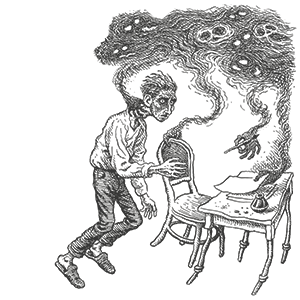
Introducing Kafka, also known as Kafka for Beginners, is a 1993 illustrated biography of Franz Kafka by David Zane Mairowitz and Robert Crumb. The book includes comic adaptations of some of Kafka’s most famous works including ‘The Metamorphosis,’ ‘A Hunger Artist,’ ‘In the Penal Colony,’ and ‘The Judgment,’ as well as brief sketches of his three novels ‘The Trial,’ ‘The Castle,’ and ‘Amerika.’
The book also details Kafka’s biography in a format that is part illustrated essay, part sequential comic panels. The book was released as part of the ‘Introducing…’ series by Totem Books which also features a volume each on Sigmund Freud and Wilhelm Reich. The popularity of Crumb’s renditions of Kafka’s works led to additional printings under the title ‘R. Crumb’s Kafka.’
Posted in Art, Humor, Language |
1 Comment »
December 2, 2012

Internet Killed Television is a web series which documents the lives of Charles Trippy, his wife Alli and their dogs Zoey and Marley. The show consists of episodes averaging around one to twenty minutes that are filmed, edited, and then aired every day onto YouTube by mid-afternoon Eastern Standard Time. The series was originally planned to last for only one year; however, after the success of the first season, the couple have decided to continue.
The YouTube series has now reached its fourth year and every year, so far, they have reached out to their audience, the CTFxC(ers) to create a montage featuring the main events that had occurred that year.
read more »
Posted in Art, Humor, Technology |
1 Comment »
November 28, 2012
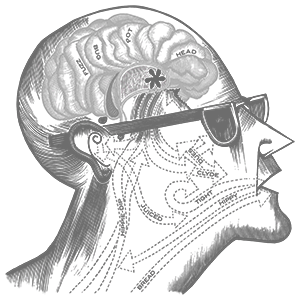
How to Speak Hip is a spoken-word comedy album by improv pioneer Del Close and John Brent, released by Mercury Records in 1959. The album is designed as a satire of language-learning records, where the secret language of the ‘hipster’ is treated as a foreign language.
Part of the joke, however, is that it actually does a good job of describing the Beat Generation/Beatnik sub-culture: Basic concepts such as ‘cool’ and ‘uncool’ are taught, as well as vocabulary building (‘dig,’ ‘dig it,’ ‘dig yourself, baby,’ ‘dig the chick,’ ‘dig the cat,’ ‘What a drag!’).
read more »
Posted in Art, Humor, Language |
Leave a Comment »
November 28, 2012

Harold is a structure used in longform theatrical improvisation. Developed by Del Close and brought to fruition through Close’s collaboration with Charna Halpern, the Harold has become the signature form of Chicago’s iO and the Upright Citizens Brigade Theater in New York and Los Angeles. It is now performed by improvisational theater troupes and teams across the world.
The Committee, a San Francisco improv group, performed the first Harold in Concord, California in 1967. They were invited to a high school and decided to do their improvisations on the war in Vietnam. On the way home they were discussing the performance when one of them asked what they should call it. Allaudin (Bill) Mathieu called out ‘Harold.’ It was a joking reference to a line from ‘A Hard Days Night’ where a reporter asked George Harrison what he called his haircut; he answered ‘Arthur.’ Close later remarked that he wished he had chosen a better name.
read more »
Posted in Art, Games, Humor |
Leave a Comment »
November 28, 2012

Del Close (1934 – 1999) is one of the premier influences on modern improvisational theater. He was also an actor appearing in a number of films and television shows.
He was a co-author of the book ‘Truth in Comedy,’ which outlines techniques now common to longform improvisational theater and describes the overall structure (he named ‘Harold’) which remains a common frame for longer improvisational scenes. His favorite framework for comedic storytelling was the structures of Wagner’s ‘Ring Cycle.’
read more »
Posted in Art, Games, Humor |
Leave a Comment »
November 28, 2012

Sergei Eisenstein (1898 – 1948) was a pioneering Soviet Russian film director and film theorist, often considered to be the ‘Father of Montage.’
He is noted in particular for his silent films ‘Strike’ (1924), ‘Battleship Potemkin’ (1925), and ‘October’ (1927), as well as the historical epics ‘Alexander Nevsky’ (1938) and ‘Ivan the Terrible’ (1944).
read more »
Posted in Art, Politics, World |
Leave a Comment »
November 28, 2012

Recess is an American animated television series created by Paul Germain and Joe Ansolabehere (credited as ‘Paul and Joe’) and produced by Walt Disney Television Animation. The series focuses on six elementary school students and their interaction with other classmates and teachers.
The title refers to the period of time during the school day in which children are not in lessons and are outside in the schoolyard, in North American society. One of the main features of the series is how the children form their own society, complete with government and a class structure, set against the backdrop of a regular school.
read more »
Posted in Art, Humor |
Leave a Comment »
November 28, 2012

SIGGRAPH (short for Special Interest Group on GRAPHics and Interactive Techniques) is the name of the annual conference on computer graphics started in 1974. The conference is attended by tens of thousands of computer professionals. Some highlights of the conference are its Animation Theater and Electronic Theater presentations, where recently created CG films are played. There is a large exhibition floor, where several hundred companies set up elaborate booths and compete for attention and recruits. Most of the companies are in the engineering, graphics, motion picture, or video game industries.
There are also many booths for schools which specialize in computer graphics or interactivity. Dozens of research papers are presented each year, and SIGGRAPH is widely considered the most prestigious forum for the publication of computer graphics research. In 1984, under LucasFilm Computer Group, John Lasseter’s first computer animated short, ‘The Adventures of André & Wally B.,’ premiered at SIGGRAPH. Pixar’s first computer animated short, ‘Luxo, Jr.’ debuted in 1986, and Pixar has debuted numerous shorts at the conference since. Since 2008, a second yearly SIGGRAPH conference has been held in Asia. The first SIGGRAPH Asia conference was held in Singapore; the second one in Yokohama, Japan in the period in 2009; and the third in Seoul, Korea in 2010.
Posted in Art, Money, Technology |
Leave a Comment »
November 27, 2012

‘Walk On By‘ is a song composed by Burt Bacharach, with lyrics by frequent collaborator Hal David. The song was originally recorded by Dionne Warwick at the same December 1963 session that yielded her hit ‘Anyone Who Had a Heart.’ ‘Walk On By’ was the follow-up to that single, released in 1964 and reaching #6 on the U.S. Billboard Hot 100. Warwick also recorded a German version of the song, entitled ‘Geh Vorbei.’ Funk/soul musician Isaac Hayes released a cover version in 1969 on his album ‘Hot Buttered Soul’ and transformed the song into a twelve-and-a-half minute funk vamp.
Edited for single release down to under 5 minutes, this single reached #30 on the U.S. charts. In 1978, The Stranglers recorded a gritty punk-inspired version (with an extended organ solo) that charted in the UK. Alicia Keys recorded a hip hop version of the song on 2003 mutli-platinum album ‘The Diary of Alicia Keys.’ The Isaac Hayes version samples from a cover of the song by The Jackson 5, and was itself sampled by numerous artists, notably Hooverphonic in ‘2Wicky,’ The Notorious B.I.G. in ‘Warning,’ 2Pac in ‘Me Against the World,’ and Portishead in ‘All Mine.’
Posted in Art |
Leave a Comment »
November 19, 2012

Diegesis [dahy-uh-jee-sis] is a style of storytelling in fiction which presents an interior view of a world and is: that world itself experienced by the characters in situations and events of the narrative; telling, recounting, as opposed to showing, enacting. In diegesis the narrator tells the story. The narrator presents to the audience or the implied readers the actions, and perhaps thoughts, of the characters.
Diegesis (‘narration’) and ‘mimesis’ (‘imitation’) have been contrasted since Plato’s and Aristotle’s times. Mimesis shows rather than tells, by means of action that is enacted. Diegesis, however, is the telling of the story by a narrator. The narrator may speak as a particular character or may be the invisible narrator or even the all-knowing narrator who speaks from above in the form of commenting on the action or the characters.
read more »
Posted in Art, Language, Philosophy |
1 Comment »
November 19, 2012
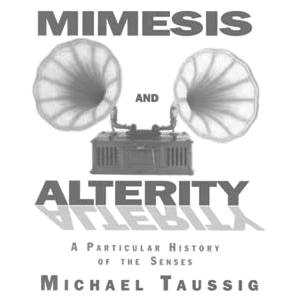
Mimesis [my-mee-sis] (‘to immitate’) is a critical and philosophical term that carries a wide range of meanings, which include imitation, representation, mimicry, Dionysian imitatio (an influential literary method of imitation, receptivity, nonsensuous similarity, the act of resembling, the act of expression, and the presentation of the self.
In ancient Greece, mimesis was an idea that governed the creation of works of art, in particular, with correspondence to the physical world understood as a model for beauty, truth, and the good. Plato contrasted ‘mimesis,’ or ‘imitation,’ with ‘diegesis,’ or ‘narrative.’ After Plato, the meaning of mimesis eventually shifted toward a specifically literary function in ancient Greek society, and its use has changed and been reinterpreted many times since then.
read more »
Posted in Art, Philosophy |
Leave a Comment »




