February 6, 2012

Hugo Leclercq (b. 1994), known by his stage name Madeon, is a French electropop producer. He started composing music at the age of 11, and adopted a nu-disco style under the name Madeon in 2010. In the fall of that year, he gained popularity for his award-winning remix of ‘The Island’ by Pendulum.
In the summer of 2011, a YouTube video of his live mashup ‘Pop Culture’ went viral, which combines 39 pop hits into one song. He is known to use Novation’s Launchpad, a MIDI controlled monome, and FL Studio (FruityLoops).
Posted in Art, Technology |
Leave a Comment »
February 5, 2012

Parachuting Rat is an artwork in Melbourne, Australia created by Banksy in 2003. In 2010 it was painted over by council contractors, leading to local and international coverage and debate on the nature of street art and its preservation, and new measures for its protection. Parachuting Rat is a purple rat with aviator glasses descending by parachute. Banksy’s oeuvre is largely directed towards anti-capitalist and anti-war themes.
Banksy’s work is described as distinctive in style, satirical, and provocative. Banksy himself has written, in connection with his works involving rats, ‘they exist without permission. They are hated, hunted and persecuted … if you are dirty, insignificant and unloved then rats are the ultimate role model’; that ‘you can win the rat race but you’re still a rat’; and also that he had been painting rats for three years before someone told him that the word is an anagram of art.
read more »
Posted in Art, Money, Politics |
3 Comments »
February 5, 2012
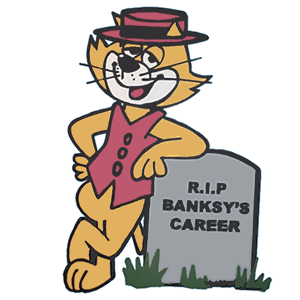
King Robbo is an English underground graffiti artist who became more widely known following a graffiti war with Banksy. Robbo painted his first train in 1985 and the ‘Merry Christmas’ train of 1988, a joint piece created with ‘Drax WD,’ received coverage in the British media.
His feud with Banksy burnished Robbo’s profile and he entered the commercial art world with a number of gallery shows and commissions in 2010. In 1985 King Robbo painted a large full color graffiti piece called ‘Robbo Incorporated’ on a wall beside Regent’s Canal in London which was only accessible by water. Over the years it became degraded with a few small pieces of graffiti over the top.
read more »
Posted in Art, Money |
Leave a Comment »
February 4, 2012
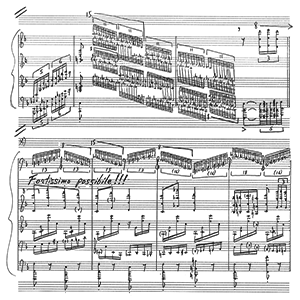
Circus Galop is a piece for player piano written by Marc-André Hamelin. It was composed between 1991 and 1994 and it is dedicated to Beatrix and Jürgen Hocker, piano roll makers. Its duration is approximately 4–5 minutes. Scores of this piece are available through the Sorabji Archive. Piano rolls of this piece are available from Wolfgang Heisig and Jürgen Hocker, who have recorded all three of Hamelin’s player piano pieces on the MDG label, which were released in 2008.
It is impossible for a single human to play, as at some points all the piano staves are played at the same time, and up to 21 notes simultaneously. It is used to test MIDI software to drive it to its maximum potential, such as Synthesia, or PianoMIDI.
Posted in Art, Technology |
Leave a Comment »
February 3, 2012
Eduardo Paolozzi [pow-laz-zi] (1924 – 2005), was a Scottish sculptor and artist. Paolozzi investigated how we can fit into the modern world to resemble our fragmented civilization through imagination and fantasy. By the dramatic juxtaposition of ideas in his work, he let us see the confusion as well as the inspiration. Paolozzi’s ‘I was a Rich Man’s Plaything’ (1947) is considered the first standard bearer of Pop Art and first to display the word ‘pop.’ Paolozzi showed the collage in 1952 as part of his groundbreaking ‘Bunk!’ series presentation at the initial Independent Group meeting in London.
He established his first studio in Chelsea, London; a workshop filled with hundreds of found objects, models, sculptures, materials, tools, toys and stacks of books. Paolozzi was interested in everything and would use a variety of objects and materials in his work, particularly his collages. He came to public attention in the 1950s by producing a range of striking screenprints and ‘Art Brut’ sculpture. Paolozzi was a founder of the Independent Group in 1952, which is regarded as the precursor to the mid 1950s British and late 1950s American Pop Art movements.
Posted in Art |
Leave a Comment »
February 3, 2012
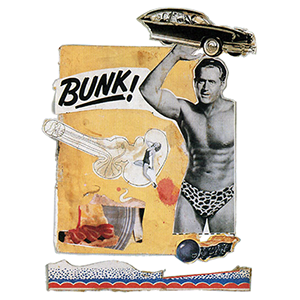
The Independent Group (IG) met at the Institute of Contemporary Arts (ICA, an artistic and cultural center on The Mall in London). The IG consisted of painters, sculptors, architects, writers, and critics who wanted to challenge prevailing modernist approaches to culture. They introduced mass culture into debates about high culture, re-evaluated modernism and created the ‘as found’ or ‘found object’ aesthetic. Currently the subject of renewed interest in our post disciplinary age, the IG was the topic of a two-day, international conference at the Tate Britain in 2007. The Independent Group is regarded as the precursor to the Pop Art movement in Britain and the United States.
The Independent Group had its first meeting early in 1952 which consisted of artist and sculptor Eduardo Paolozzi feeding a mass of colorful images from American magazines through an epidiascope (early image projector). These images, composed of advertising, comic strips and assorted graphics, were collected when Paolozzi was resident in Paris from 1947-49. Much of the material was assembled as scrapbook collages and formed the basis of his ‘BUNK!’ series of screenprints (1972) and the ‘Krazy Kat’ Archives now held at the V & A Museum. In fact, Paolozzi’s seminal 1947 collage ‘I was a Rich Man’s Plaything was the first such ‘found object’ material to contain the word ‘pop’ and is considered the initial standard bearer of ‘Pop Art.”
Posted in Art, World |
Leave a Comment »
February 3, 2012


Larry Cuba (b. 1950) is a computer-animation artist who became active in the late 1970s and early 80s. Born in Atlanta, he did his Master’s Degree at California Institute of the Arts which includes parallel schools of Dance, Music, Film, Theater, Fine Arts, and Writing.
In 1975, early computer animator John Whitney, Sr. invited Cuba to be the programmer on one of his films. The result of this collaboration was ‘Arabesque.’ Subsequently, Cuba produced three more computer-animated films: ‘3/78 (Objects and Transformations),’ ‘Two Space,’ and ‘Calculated Movements.’ Cuba also provided computer graphics for ‘Star Wars Episode IV: A New Hope’ in 1977. His animation of the Death Star is shown to pilots in the Rebel Alliance.
read more »
Posted in Art, Technology |
Leave a Comment »
February 3, 2012


John Whitney (1917 – 1995) was an American animator, composer and inventor, widely considered to be one of the fathers of computer animation. Whitney was born in Pasadena, California and attended Pomona College. His first works in film were 8 mm movies of a lunar eclipse which he made using a homemade telescope. In 1937-38 he spent a year in Paris, studying twelve-tone composition under French composer Rene Leibowitz. In 1939 he returned to America and began to collaborate with his brother James on a series of abstract films.
During the 1950s Whitney used his mechanical animation techniques to create sequences for television programs and commercials. In 1952 he directed engineering films on guided missile projects. One of his most famous works from this period was the animated title sequence from Alfred Hitchcock’s 1958 film ‘Vertigo,’ which he collaborated on with the graphic designer Saul Bass.
read more »
Posted in Art, Technology |
Leave a Comment »
February 3, 2012

Spirograph is a geometric drawing toy that produces mathematical curves of the variety technically known as hypotrochoids and epitrochoids. The term has also been used to describe a variety of software applications that display similar curves, and applied to the class of curves that can be produced with the drawing equipment (so in this sense it may be regarded as a synonym of hypotrochoid).
The name is a registered trademark of Hasbro, Inc. Drawing toys based on gears have been around since at least 1908, when The Marvelous Wondergraph was advertised in the Sears catalog. The ‘Boys Mechanic’ publication of 1913 had an article describing how to make a Wondergraph drawing machine. An instrument called a spirograph was invented by the mathematician Bruno Abakanowicz between 1881 and 1900 for calculating an area delimited by curves. The Spirograph toy was developed by the British engineer Denys Fisher, who exhibited it in 1965 at the Nuremberg International Toy Fair. In 1968, Kenner introduced Spirotot, a less complex version of Spirograph, for preschool-age children, too young for Spirograph.
Posted in Art, Games, Science |
Leave a Comment »
February 2, 2012
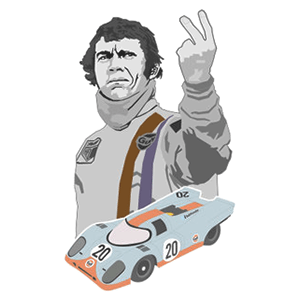
Steve McQueen (1930 – 1980) was an American movie actor. He was nicknamed ‘The King of Cool.’ His ‘anti-hero’ persona, which he developed at the height of the Vietnam counterculture, made him one of the top box-office draws of the 1960s and 1970s.
His popular films include ‘The Magnificent Seven,’ ‘The Great Escape,’ ‘The Thomas Crown Affair,’ ‘Bullitt,’ ‘The Getaway,’ ‘Papillon,’ and ‘The Towering Inferno.’ In 1974, he became the highest-paid movie star in the world. Although McQueen was combative with directors and producers, his popularity put him in high demand and enabled him to command large salaries.
read more »
Posted in Art |
1 Comment »
February 2, 2012

Charles Bronson (1921 – 2003), born Charles Dennis Buchinsky was an American actor, best-known for such films as ‘Once Upon a Time in the West,’ ‘The Magnificent Seven,’ ‘The Dirty Dozen,’ ‘The Great Escape,’ ‘Rider on the Rain,’ ‘The Mechanic,’ and the popular ‘Death Wish’ series.
He often cast in the role of a police officer or gunfighter, often in revenge-oriented plot lines.
read more »
Posted in Art |
1 Comment »
January 31, 2012

15 minutes of fame is short-lived, often ephemeral, media publicity or celebrity of an individual or phenomenon. The expression was coined by Andy Warhol, who said in 1968 that ‘In the future, everyone will be world-famous for 15 minutes.’ The phenomenon is often used in reference to figures in the entertainment industry or other areas of popular culture, such as reality TV and YouTube. It is believed that the statement was an adaption of a theory of Marshall McLuhan, explaining the differences of media, where TV differs much from other media using contestants.
The expression is a paraphrase of a line in Warhol’s catalog for a 1968 exhibit at the Moderna Museet in Stockholm. In 1979 Warhol reiterated his claim, ‘…my prediction from the sixties finally came true: In the future everyone will be famous for 15 minutes.’ Becoming bored with continually being asked about this particular statement, Warhol attempted to confuse interviewers by changing the statement variously to ‘In the future 15 people will be famous’ and ‘In 15 minutes everybody will be famous.’
read more »
Posted in Art, Humor, Language |
Leave a Comment »