November 22, 2011

‘Space Jazz: The soundtrack of the book Battlefield Earth’ is a music album and soundtrack companion to the novel ‘Battlefield Earth’ by L. Ron Hubbard, released in 1982. Hubbard composed the music for the album. A 1983 press release put out by the Church of Spiritual Technology subsidiary company Author Services Inc. marketed the concept album as ‘the only original sound track ever produced for a book before it becomes a movie.’
The album includes performances by Chick Corea, Stanley Clarke, Nicky Hopkins and Gayle Moran. The album included music from the Fairlight CMI synthesizer; it was one of the first professional uses of this device. A demonstration of the ‘computer space jazz’ soundtrack was one of the festival displays at the 1982 US Festival rock concert in California.
Posted in Art, Humor |
Leave a Comment »
November 22, 2011

Terry Richardson (b. 1965) is an American fashion photographer. Richardson was born in New York City, the son of Bob Richardson, a fashion photographer who struggled with schizophrenia and drug abuse. Richardson was raised in Hollywood. He was shy as a teenager and at some times deemed ‘completely lacking in social skills.’ He played bass guitar in the punk rock band The Invisible Government for 5 years. Richardson began photography when the band broke up and his mother introduced him to Tony Kent, a photographer who hired him as an assistant.
Richardson’s photographs often contain graphic sexual subject matter. Richardson has shot advertisements for fashion designers and editorial photographs. His alleged attitude towards models has been criticized by Danish model and filmmaker Rie Rasmussen and others, who have accused Richardson of exploiting and sexually abusing the models he photographs.
Posted in Art, Money, Sex |
Leave a Comment »
November 22, 2011

Glamorama is a novel by American writer Bret Easton Ellis, published in 1998. Unlike Ellis’ previous novels, Glamorama is set in and satirizes the 1990s, specifically celebrity culture and consumerism. Ellis wanted to write a Stephen King-style ghost story novel (which would eventually become ‘Lunar Park’); finding it difficult at the time, he began work on the other novel which he had in mind, a Robert Ludlum-style thriller, with the intention of using one of his own vapid characters who lack insight as the narrator. The novel is a satire of modern celebrity culture, featuring models-turned-terrorists.
A character remarks, ‘basically, everyone was a sociopath…and all the girls’ hair was chignoned.’ (A chignon is an arrangement of long hair in a roll or knot at the back of the head). The novel plays upon the conspiracy thriller conceit of someone ‘behind all the awful events,’ to dramatize the revelation of a world of random horror. The lack of resolution contributes to Ellis’ artistic effect. The obsession with beauty is reflected in consistent namedropping; this satirizes Victor’s obsession with looks, and perhaps is indicative of the author’s own attraction to glamor.
read more »
Posted in Art, Language, Money |
Leave a Comment »
November 22, 2011

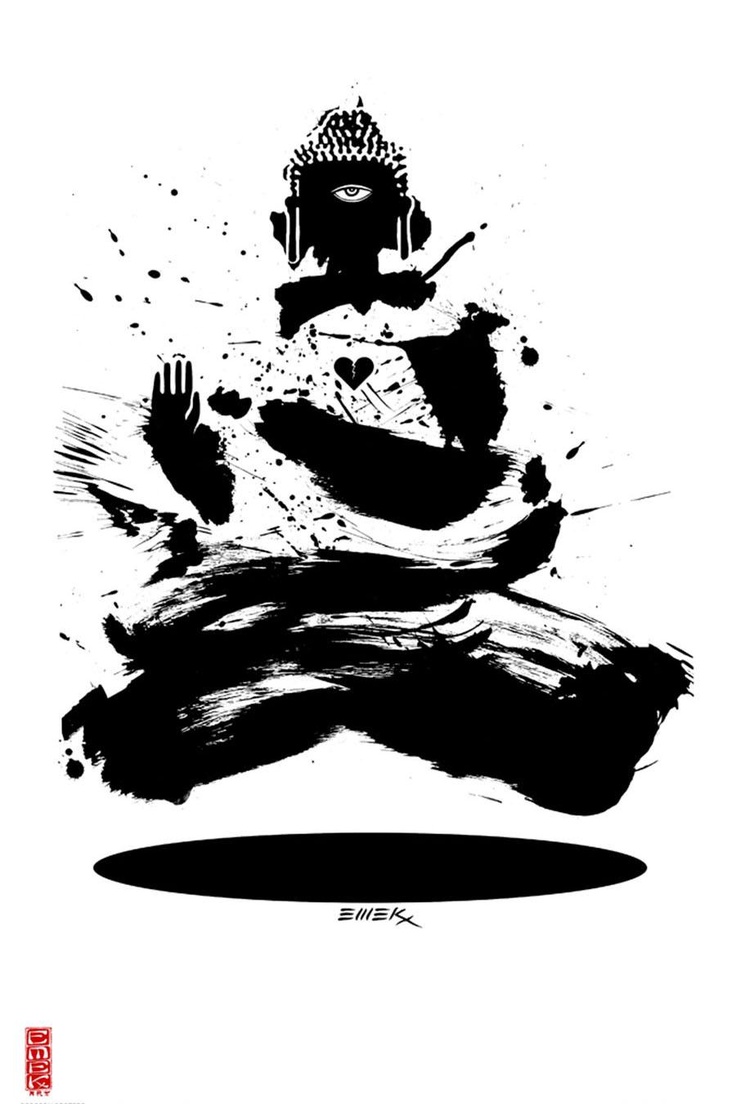
Emek (b. 1970) is a popular graphic designer and concert poster designer since the early 1990s. He is widely credited with helping to revive the rock poster scene. He is the brother of artist and author Gan Golan. His style, known for its attention to detail and layers of meaning, infuses socio-political commentary into pop culture imagery.
In the tradition of psychedelic posters from the 1960s, Emek still draws his posters by hand. He was shaped by both rock art posters from the 1960s, and punk flyers from the 1980s. Emek’s poster-making career accelerated in the 1990s with alternative rock acts from Europe and North America, including Pearl Jam, Radiohead, Queens of the Stone Age, Tool, and Marilyn Manson.
read more »
Posted in Art |
Leave a Comment »
November 21, 2011

Steve Haworth is a body modification artist based in Phoenix, Arizona. He is responsible for the invention and popularization of subdermal and transdermal implants, such as the ‘Metal Mohawk.’ He designed specialized medical instruments called dermal elevators for this process. He has also done pioneering work with surface bars, ear shaping, tongue splitting, magnetic implants, and artistic branding (using electrocautery units). He has worked on individuals noted for their extensive modifications such as The Enigma, Katzen, Stalking Cat and The Lizardman. Many other respected artists in the body modification community cite Haworth as an inspiration. Fellow body modification artist Samppa von Cyborg says that ‘He’s the most important, most respected body modder out there.’ Shawn Porter of body modification blog ‘Scar Wars’ explains, ‘I directly credit Steve’s branding as a main influence on the newer generation of scarification artists; his high detail branding (which caused a stir when it was featured in ‘In the Flesh,’ ‘Body Art,’ and ‘Bizarre’) showed people that you could do more than just dots, chevrons and geometric shapes.’
Haworth’s father was a manufacturer of surgical equipment, and he continued in the family business, eventually branching into piercing jewelry and body modification instruments. Currently he is retired from regular piercing, preferring to concentrate on 3D implants and other types of body modification. He continues to manufacture body jewelry and tools for body modification. He and his business partner Jesse Jarrell create unique silicone jewelry for large-gauge piercing with their company Kaos Softwear. Haworth travels around the country and the world frequently, and conducts seminars on his body modification techniques. He founded the body suspension group ‘Life Suspended’ and performs suspensions with them on regular basis. He is also the co-founder of the production company ‘Horns & Halos,’ which puts on several fetish-themed events every year.
Posted in Art, Health, Technology |
Leave a Comment »
November 21, 2011
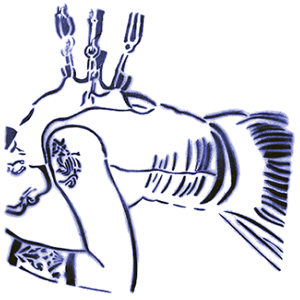
A suspension is the act of suspending a human body from hooks that have been put through body piercings. These piercings are temporary and are performed just prior to the actual suspension.
Multiple hooks are usually located around the shoulders, upper arm, and back, as well as around the knees (depending on the position in which the body is to be suspended). Finding the proper hook placement and number requires an understanding of human anatomy and physiology, as well as the durability of the individual’s skin. If the number of hooks are too few, the suspended individual’s skin will be unable to withstand the body’s weight and will rip.
read more »
Posted in Art, Games, Philosophy |
Leave a Comment »
November 21, 2011

In body modification, an implant is a device placed under the human skin for decorative purposes. Such implants may be subdermal (beneath the skin) or transdermal (partially below and partially above the skin). In the context of body modification, some may consider injections of silicone and other substances a type of implant as well. Some types of implants may be performed by doctors or other medical professionals, while others are performed by body modification artists.
Examples include collarbone piercing, deep chest piercing, eyeball implants, flesh stapling, genital beading, magnetic implants, and scrotal implants. A clavicle or collarbone piercing is a very deep piercing that passes beneath the collarbone, and therefore enters the body cavity. These are highly prone to rejection as the collarbone placement is a high movement area.
read more »
Posted in Art, Health, Technology |
Leave a Comment »
November 21, 2011
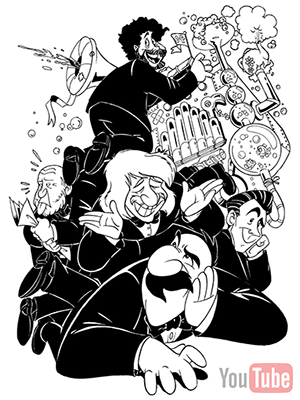
Les Luthiers [loo-tee-ers] is an Argentine comedy-musical group, very popular also in several other Spanish-speaking countries. They were formed in 1967 by Gerardo Masana, during the height of a period of very intense Choral Music activity in Argentina’s state universities.
Their outstanding characteristic is the home-made musical instruments (hence the name luthiers, French for ‘musical instrument maker’), some of them extremely sophisticated, which they skillfully employ in their recitals to produce music and texts full of high class and refined humor.
read more »
Posted in Art, Humor, World |
1 Comment »
November 21, 2011
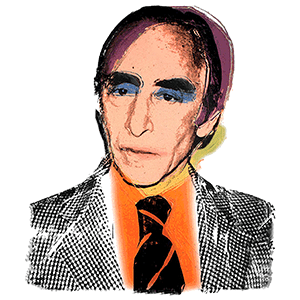
Leo Castelli (1907 – 1999), born Leo Krausz, was an American art dealer whose gallery showcased cutting edge Contemporary art for five decades. Castelli showed Surrealism, Abstract Expressionism, Neo-Dada, Pop Art, Op Art, Color field painting, Hard-edge painting, Lyrical Abstraction, Minimal Art, Conceptual Art, and Neo-expressionism, among other movements. Leo Castelli was born at Trieste, of Italian and Austro-Hungarian Jewish origin. Castelli’s first American curatorial effort was the famous Ninth Street Show of 1951, a seminal event of Abstract Expressionism.
In 1957, he opened the Leo Castelli Gallery in a townhouse on 77th Street between Madison and Fifth Avenues. Initially the gallery showcased European Surrealism, Wassily Kandinsky, and other European artists. However the gallery also exhibited American Abstract Expressionism. Jackson Pollock and Willem de Kooning were some artists who were included in group shows. In 1958, Robert Rauschenberg and Jasper Johns joined the gallery, signaling a turning away from Abstract Expressionism, towards Pop Art, Minimalism and Conceptual Art. From the early 1960s through the late 70s, Frank Stella, Roy Lichtenstein, Andy Warhol, and Ed Ruscha joined the stable of Castelli artists.
Posted in Art, Money |
Leave a Comment »
November 20, 2011
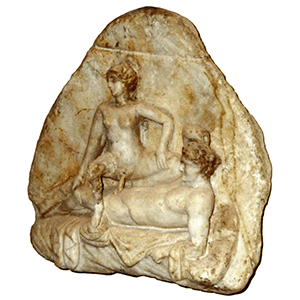
The term Secret Museum (Gabinetto Segreto) principally refers to the collection of erotic or sexually explicit finds from Pompeii, held in separate galleries in the Naples National Archaeological Museum, the former Museo Borbonico. The British Museum also contained secret rooms containing erotica. Throughout ancient Pompeii, erotic frescoes, depictions of the god Priapus, sexually explicit symbols, inscriptions, and even household items (such as phallic oil lamps) were found.
Ancient Roman culture had a different sense of shame for sexuality, and viewed sexually explicit material very differently to most present-day cultures. Ideas about obscenity developed from the 18th century to the present day into a modern concept of pornography.
read more »
Posted in Art, Sex, World |
Leave a Comment »
November 19, 2011

A lip dub is a type of music video that combines lip synching and audio dubbing. It is made by filming individuals or a group of people lip synching while listening to a song or any recorded audio then dubbing over it in post editing with the original audio of the song. There is often some form of mobile audio device used such as an MP3 player. Often they look like simple music videos, although many involve a lot of preparation and production. Lip dubs can be done in a single unedited shot that often travels through different rooms and situations within a building. They have become popular with the advent of mass participatory video content sites like YouTube.
Jake Lodwick, the co-founder of video sharing website Vimeo, coined the term in 2006, in a video entitled ‘Lip Dubbing: Endless Dream.’ In the video’s description, he wrote, ‘I walked around with a song playing in my headphones, and recorded myself singing. When I got home I opened it in iMovie and added an MP3 of the actual song, and synchronized it with my video. Is there a name for this? If not, I suggest ‘lip dubbing’.’ Lodwick also directed the ‘Flagpole Sitta’ ‘office lip dub’ in 2007.
Posted in Art, Humor, Technology |
Leave a Comment »
November 18, 2011


A fictional currency is some form of defined or alluded currency in works of fiction. The names of such units of currency are sometimes based on extant or historic currencies (e.g. ‘Altairian dollars’ or ‘Earth yen’) while others, such as ‘Kalganids’ in Asimov’s ‘Foundation’ series, may be wholly invented. A particularly common type, especially in science fiction, is electronically managed ‘credits.’ In some works of fiction, exchange media other than money are used. These are not currency as such, but rather nonstandard media of exchange used to avoid the difficulties of ensuring ‘double coincidence of wants’ in a barter system.
Authors have to take care when naming fictional currencies because of the associations between currency names and countries; recognizable names for currencies of the future may be used to imply how history has progressed, but would appear out of place in an entirely alien civilization. Historical fiction may need research. Writers need not explain the exact value of their fictional currencies or provide an exchange rate to modern money; they may rely on the intuitive grasp of their readers, for instance that one currency unit is probably of little value, but that millions of units will be worth a lot.
read more »
Posted in Art, Language, Money |
Leave a Comment »