January 31, 2012

Pixy Stix is a powdered candy packaged in a wrapper that resembles a drinking straw. Pixy Stix used to be made by Sunline which was started 1952 in St. Louis. Originally it was a drink mix in the late 1940s, sold as Frutola, but J. Fish Smith found that kids were eating the sweet & sour powder right from the package instead of putting it in water. He shifted the name to Fruzola and added a spoon. Later it was repackaged with a dipping candy stick as Lik-M-Aid and also sold in little straws called Pixy Stix. It wasn’t until parents complained about the grainy, sticky powder that Sunline came up with a compressed tablet form, the SweeTart in 1963.
The candy is usually poured into the mouth from the wrapper, which is made out of plastic (large size) or paper (small). The ingredients in Pixy Stix are as follows: Dextrose, Citric Acid, less than 2% artificial and natural flavors. Pixy Stix do not contain protein or essential vitamins or minerals.
Posted in Food, Money |
Leave a Comment »
January 19, 2012
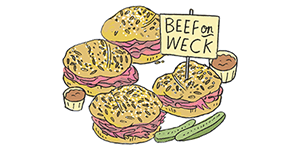

Au jus [oh joos] is French for ‘with [its own] juice.’ In American cuisine, the term is mostly used to refer to a light sauce for beef recipes, which may be served with the food or placed on the side for dipping. In French cuisine, jus is a natural way to enhance the flavor of dishes, mainly chicken, veal and lamb. ‘Jus’ means the natural juices given off by the food. To prepare a natural jus, the cook may simply skim off the fat from the juices left after cooking and bring the remaining meat stock and water to a boil.
Often prepared in the United States is a seasoned sauce with several additional flavorings. American recipes au jus often use soy sauce, Worcestershire sauce, salt, pepper, white or brown sugar, garlic, onion, or other ingredients to make something more like a gravy. So-called jus is sometimes prepared separately, rather than being produced naturally by the food being cooked. An example could be a beef jus made by reducing beef stock to a concentrated form, to accompany a meat dish.
Posted in Food, Language, World |
1 Comment »
January 19, 2012
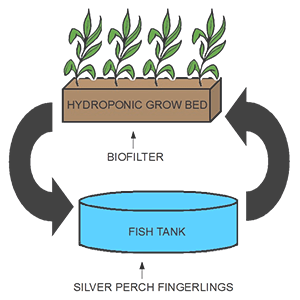
Aquaponics [ak-wuh-pon-iks] is a sustainable food production system that combines a traditional aquaculture (raising aquatic animals such as fish, crayfish or prawns in tanks) with hydroponics (cultivating plants in water) in a symbiotic environment. In the aquaculture, effluents accumulate in the water, increasing toxicity for the fish. This water is led to a hydroponic system where the by-products from the aquaculture are filtered out by the plants as vital nutrients, after which the cleansed water is recirculated back to the animals.
Aquaponic systems vary in size from small indoor or outdoor units to large commercial units, using the same technology. The systems usually contain fresh water, but salt water systems are plausible depending on the type of aquatic animal and which plants.
read more »
Posted in Food, Money, Technology |
Leave a Comment »
January 12, 2012

‘The End of The Line: How Overfishing Is Changing the World And What We Eat is a 2004 book by journalist Charles Clover about overfishing. Clover, an environment editor of the ‘Daily Telegraph,’ describes how modern fishing is destroying ocean ecosystems. He concludes that current worldwide fish consumption is unsustainable. The book provides details about overfishing in many of the world’s critical ocean habitats, such as the New England fishing grounds, west African coastlines, the European North Atlantic fishing grounds, and the ocean around Japan.
The book was made into a documentary film of the same name in 2009, featuring Clover, along with tuna farmer turned whistle blower Roberto Mielgo, top scientists from around the world, indigenous fishermen and fisheries enforcement officials, who predict that seafood could potentially extinct in 2048. The film also challenges the notion that farmed fish is a solution. Furthermore, it advocates consumer responsibility to purchase sustainable seafood and for no-take zones in the sea to protect marine life.
Posted in Food, Money, Politics |
Leave a Comment »
January 11, 2012


Sidney Frank (1919 – 2006) was an American businessman who became a billionaire through his promotion of Grey Goose vodka and Jägermeister. He attended Brown University, but left because he could only afford one year of tuition. He later made enormous gifts to the university to ensure that no student would ever be forced to leave Brown because of inability to pay tuition. During World War II, Frank worked for Pratt and Whitney as an aircraft engine mechanic in the South Pacific.
Frank’s first wife, Louise Rosenstiel, was the daughter of Lewis Rosenstiel, founder of Schenley Industries, one of the largest American distiller and spirit importers. Frank joined Schenley after his marriage and rose to the company presidency, but was forced out in a family dispute in 1970. In 1973 his wife died and he started his own company, Sidney Frank Importing Company, where he served as chairman and chief executive officer. The company is based in New Rochelle, New York where Frank lived part of the year (he had a home in Rancho Santa Fe, California as well).
read more »
Posted in Drugs, Food, Money |
Leave a Comment »
January 11, 2012

The New York Pizza Connection, or Pizza Principle, is a humorous but generally historically accurate ‘economic law’ proposed by native New Yorker Eric M. Bram. He noted in 1980 that from the early 1960s the price of a slice of pizza ‘matched, with uncanny precision, the cost of a New York City Subway ride.’ The term ‘Pizza Connection’ referring to this phenomenon was coined in early 2002 by ‘New York Times’ columnist Clyde Haberman. He predicted the cost of a slice of pizza would increase by as high as two dollars in midtown Manhattan.
In 2003 ‘The New Yorker’ magazine proclaimed the validity of the Pizza Connection (which they renamed the pizza principle) in accurately predicting the rise of the subway fare to $2.00 the week before. They also quoted Mr. Bram (by then a patent attorney) as warning that since the New York City Transit Authority had announced the discontinuation of the subway token itself in favor of the variable-fare cost MetroCard, the direct correlation between the cost of an off-the-street slice of cheese pizza and the cost of a subway token might not continue to hold. However, in 2005, and again in 2007, Haberman noted the price of a slice was again rising, and, citing the Pizza Connection, worried that the subway fare might soon rise again. The fare did indeed rise to $2.25 in 2009 and again in 2011 to $2.50.
Posted in Food, Humor, Money |
Leave a Comment »
January 1, 2012
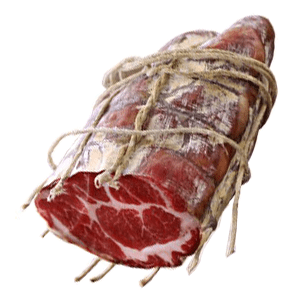
Marbled meat is meat, especially red meat, which contains various amounts of intramuscular fat, giving it an appearance similar to a marble pattern. Marbling can be influenced by selective breeding. Cattle breeds such as Angus, Murray Grey, Shorthorns, and Wagyū type cattle and dairy breeds, such as the Jersey, Holstein-Friesian, and Braunvieh have higher marbling scores on average versus other cattle such as Simmentals, Charolais, or Chianina. Veal has little to no marbling since young cattle develop subcutaneous fat first, kidney, pelvic and heart fat second, intermuscular (between the muscle, or ‘seam fat’) third and then intramuscular fat – ‘marbling’ – last.
Marbling can also be influenced by time on feed and type of feed. The longer a pen of beef cattle are on feed in the feedlot, the higher the chance they will grade higher on quality scores, but will have much lower yield grades (percentage of carcass lean to fat ratio). Feeding a high amount of cereal grains, such as corn or barley, will change the color of the carcass fat from a yellowish to a white, plus increase the chance of obtaining a higher quality grade according to the USDA. But cows evolved to feed on low calorie grasses not energy rich cereal grains and can be made ill by overfeeding.
Posted in Food |
Leave a Comment »
December 17, 2011

A cat café is a theme café whose attraction is cats that can be watched and played with. Patrons pay a cover fee, generally hourly, and thus cat cafés can be seen as a form of supervised indoor pet rental. The world’s first cat café opened in Taiwan in 1998. In Japan, the first cat café opened in Osaka in 2004. The popularity of cat cafés in Japan is attributed to many apartments forbidding pets, and to cats providing relaxing companionship in what may otherwise be a stressful and lonesome urban life; other forms of pet rental are also common in Japan.
There are various cat cafés. Some cat cafés feature specific categories of cat such as black cats, fat cats, rare breed cats, or ex-stray cats. A cat café must obtain a license and comply with the strict requirements and regulations of the Animal Treatment/Protection Law. Japanese cat cafés feature strict rules to ensure cleanliness and animal welfare, in particular seeking to ensure that the cats are not disturbed by excessive and unwanted attention, such as by young children or when sleeping. Many cat cafés also seek to raise awareness of cat welfare issues, such as abandoned and stray cats.
Posted in Food, World |
Leave a Comment »
December 15, 2011
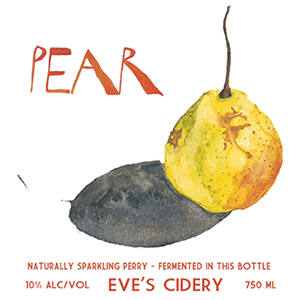
Perry is an alcoholic beverage made from fermented pears. Perry has been common for centuries in Britain, and in parts of south Wales; and France, especially Normandy and Anjou. In more recent years, commercial perry has also been referred to as ‘pear cider.’ Perry pears often have higher levels of sugar than cider apples, including unfermentable sugars such as sorbitol, which can give the finished drink a residual sweetness. They also have a very different tannin content to cider apples, with a predominance of astringent over bitter flavors. The presence of sorbitol can give perry a mild laxative effect, seen in the names of some perry pear varieties such as the ‘Lightning Pear’; reputed to go straight through ‘like lightning.’
As with apples specifically grown to make cider, special pear cultivars are used: in the UK the most commonly used variety of perry pear is the Blakeney Red. They produce fruit that is not of eating quality, but that produces superior perry. Like commercial pale lager and commercial cider, commercial perry is highly standardized, and today often contains large quantities of cereal adjuncts such as corn syrup or invert sugar. It is also generally of lower strength, and sweeter, than traditional perry, and is artificially carbonated to give a sparkling finish. However, unlike traditional perry it is a consistent product: the nature of perry pears means that it is very difficult to produce traditional perry in commercial quantities. Traditional perry was overwhelmingly a drink made on farms for home consumption, or to sell in small quantities either at the farm gate or to local inns.
Posted in Drugs, Food, Money |
Leave a Comment »
December 15, 2011

Quadrupel [kwo-droo-puhl] is the brand name of a strong seasonal beer La Trappe Quadrupel brewed by De Koningshoeven Brewery in the Netherlands, the only Trappist brewing abbey not in Belgium. In other countries, particularly the United States, ‘quadrupel’ or ‘quad’ may refer to an especially strong style of dark ale, with a characteristic spicy, ripe fruit flavor.
A quadrupel is intended to be stronger than a Tripel, so the ABV strength will be 10% or more. Beyond that, there is little agreement on the status of Quadrupel as a style. Beer writer Tim Webb notes that similar beers are also called ‘Grand Cru’ (French: ‘Great Growth’) in Belgium and Holland, a term borrowed from winemaking.
Posted in Drugs, Food, World |
Leave a Comment »
December 15, 2011


A Trappist [trap-ist] beer is a beer brewed by or under control of Trappist monks. There are a total of 174 Trappist monasteries worldwide; only seven (six in Belgium, one in the Netherlands) produce Trappist beer and are authorized to label their beers with the Authentic Trappist Product logo that indicates a compliance to the various rules of the International Trappist Association.
The Trappist order originated in the Cistercian monastery of La Trappe, France. Various Cistercian congregations existed for many years, and by 1664 the Abbot of La Trappe felt that the Cistercians were becoming too liberal. He introduced strict new rules in the abbey and the Strict Observance was born. Since this time, many of the rules have been relaxed. However, a fundamental tenet, that monasteries should be self-supporting, is still maintained by these groups.
read more »
Posted in Food, Philosophy, World |
Leave a Comment »
December 15, 2011
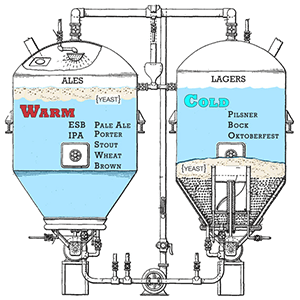
Beer style is a term used to differentiate and categorize beers by various factors such as colour, flavour, strength, ingredients, production method, recipe, history, or origin. The modern concept of beer style is largely based on the work of writer Michael Jackson in his 1977 book ‘The World Guide To Beer’ in which he categorized a variety of beers from around the world into local style groups according to local customs and names. In 1989, Fred Eckhardt furthered Jackson’s work publishing ‘The Essentials of Beer Style.’ Although the systematic study of beer styles is a modern phenomenon, the practice of distinguishing between different varieties of beer is ancient, dating to at least 2000 BCE.
The study of what constitutes a beer’s style may involve provenance, local tradition, ingredients, and/or empirical impression, which is conventionally broken down into several elements; typically – aroma, appearance, flavor and mouthfeel. The flavor may include the degree of bitterness of a beer due to bittering agents such as hops, roasted barley, or herbs; and the sweetness from the sugar present in the beer.
read more »
Posted in Food |
Leave a Comment »


 The Daily Omnivore