July 11, 2011
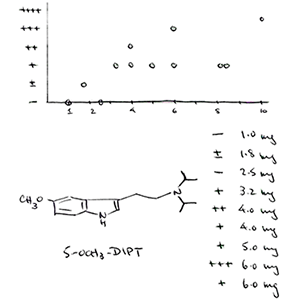
The Shulgin Rating Scale is a simple scale for reporting the subjective effect of psychoactive substances at a given dosage, and at a given time.
The system was developed for research purposes by the American biochemist Alexander Shulgin and detailed in his book ‘PiHKAL’ (‘Phenethylamines I Have Known And Loved: A Chemical Love Story’).
read more »
Posted in Drugs, Health, Science |
Leave a Comment »
July 11, 2011


Alexander Shulgin (b. 1925), known as Sasha, is an American pharmacologist. Shulgin is credited with the popularization of MDMA, commonly known as ecstasy, in the late 1970s and early 1980s, especially for psychopharmaceutical use and the treatment of depression and post-traumatic stress disorder. In subsequent years, Shulgin discovered, synthesized, and bioassayed over 230 psychoactive compounds.
In 1991 and 1997, he and his wife Ann Shulgin authored the books ‘PiHKAL’ and ‘TiHKAL’ on the topic of psychoactive drugs. Shulgin discovered many noteworthy phenethylamines including the 2C family. Additionally, Shulgin performed seminal work into the descriptive synthesis of compounds based on the organic compound tryptamine.
read more »
Posted in Drugs, Health, Politics |
1 Comment »
July 11, 2011

Designer drug is a term used to describe drugs which are created (or marketed, if they had already existed) to get around existing drug laws, usually by modifying the molecular structures of existing drugs to varying degrees, or less commonly by finding drugs with entirely different chemical structures that produce similar subjective effects to illegal recreational drugs.
The term ‘designer drug’ was first coined by law enforcement in the 1980s, and has gained widespread use. However the first appearance of what would now be termed designer drugs occurred well before this, in the 1920s. Following the passage of the second International Opium Convention in 1925 which specifically banned morphine and the diacetyl ester of morphine, heroin, a number of alternative esters of morphine quickly started to be manufactured and sold.
read more »
Posted in Drugs, Health, Politics |
Leave a Comment »
July 11, 2011

Synthetic cannabis is a psychoactive herbal and chemical product which, when consumed mimics the effects of cannabis. It is best known by the brand names K2 and Spice, both of which have largely become genericized trademarks used to refer to any synthetic cannabis product. A type of synthetic cannabis sold in Australasia is known as Kronic.
Professor John W. Huffman who first synthesized many of the cannabinoids used in synthetic cannabis is quoted as saying, ‘People who use it are idiots. You don’t know what it’s going to do to you.’ Heavy Spice users who cut back are known to experience withdrawal symptoms, similar to those associated with withdrawing from the use of narcotics. The lack of an antipsychotic chemical, similar to cannabidiol found in natural cannabis, may make synthetic cannabis more likely to induce psychosis than natural cannabis.
read more »
Posted in Drugs, Health, Politics |
Leave a Comment »
July 11, 2011

Telepsychiatry is the application of Telemedicine to the field of Psychiatry. It has been the most successful of all the telemedicine applications so far, because of its need for only a good videoconferencing facility between the patient and the psychiatrist, especially for follow-up. There are sub-specialties like forensic telepsychiatry, in which the patient is typically an inmate accessing the psychiatrist who is from a supporting institution, and home-based telepsychiatry, whereby the patient is in his own home or office, accessing the physician via webcam and high-speed internet. Another common application is for patients in rural or under served areas, and there are a large number of grassroots telepsychiatry programs springing up in the United States and elsewhere to address this problem.
A recent innovation is the development of the subspecialty of emergency psychiatry via telemedicine. Research is currently on-going to develop the unique guidelines required to provide consultation for emergency psychiatric patients such as the evaluation of the suicidal, homidical, violent, psychotic, depressed, manic, and acutely anxious patient. Emergency telepsychiatry services are being provided to hospital emergency departments, jails, community mental health centers, substance abuse treatment facilities, and schools.
Posted in Health, Technology |
1 Comment »
July 4, 2011

In endurance sports such as cycling and running, hitting the wall (or the bonk) describes a condition caused by the depletion of glycogen stores in the liver and muscles, which manifests itself by sudden fatigue and loss of energy. Milder instances can be remedied by brief rest and the ingestion of food or drinks containing carbohydrates. The condition can usually be avoided by ensuring that glycogen levels are high when the exercise begins, maintaining glycogen levels during exercise by eating or drinking carbohydrate-rich substances, or by reducing exercise intensity.
The term bonk for cycling fatigue is presumably derived from the original meaning ‘to hit,’ and dates back at least half a century. The term is used colloquially both as a noun (‘hitting the bonk’) and a verb (‘to bonk halfway through the race’). The British may refer to it as ‘hunger knock,’ while ‘hunger bonk’ or ‘bunger honk’ was used by South African cyclists in the 1960s.
Posted in Food, Games, Health |
Leave a Comment »
June 30, 2011

‘100,000,000 Guinea Pigs: Dangers in Everyday Foods, Drugs, and Cosmetics’ is a book written by Arthur Kallet and F.J. Schlink first released in 1933. Its central argument propounds that the American population is being used as guinea pigs in a giant experiment undertaken by the American producers of food stuffs and patent medicines and the like. Kallet and Schlink premise the book as being ‘written in the interest of the consumer, who does not yet realize that he is being used as a guinea pig…’
The book’s key proposition is that a great deal of products sold to the public – particularly pharmaceuticals and food products – are released with little regard or knowledge of how these products adversely impact the consumer. Corporations, often knowingly, release products which either do not do what they purport to, or have dangerous side effects or defects. Furthermore, many officials and government departments, namely the U.S. Food and Drug Administration, have fallen victim to regulatory capture (control by industry it is charged with regulating).
read more »
Posted in Health, Money, Politics |
Leave a Comment »
June 29, 2011

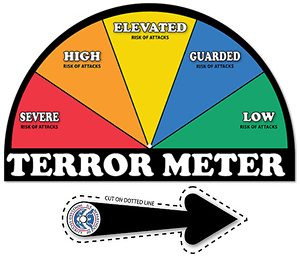
Hypervigilance is an enhanced state of sensory sensitivity accompanied by an exaggerated intensity of behaviors whose purpose is to detect threats. Hypervigilance is also accompanied by a state of increased anxiety which can cause exhaustion. Other symptoms include: abnormally increased arousal, a high responsiveness to stimuli and a constant scanning of the environment for threats. Hypervigilance can be a symptom of posttraumatic stress disorder (PTSD) and various types of anxiety disorder. It is distinguished from paranoid states, such as in schizophrenia, which can seem superficially similar, but are characteristically different.
Hypervigilance is differentiated from dysphoric hyperarousal in that the person remains cogent and aware of his or her surroundings. In dysphoric hyperarousal the PTSD victim may lose contact with reality and re-experience the traumatic event verbatim. Where there have been multiple traumas, a person may become hypervigilant and suffer severe anxiety attacks intense enough to induce a delusional state where the effect of the traumas overlap: e.g., one remembered firefight may seem too much like another for the person to maintain calm. This can result in the ‘thousand yard stare’ (a phrase originally coined to describe the limp, unfocused gaze of a battle-weary warrior).
Posted in Health, Language, War |
1 Comment »
June 29, 2011
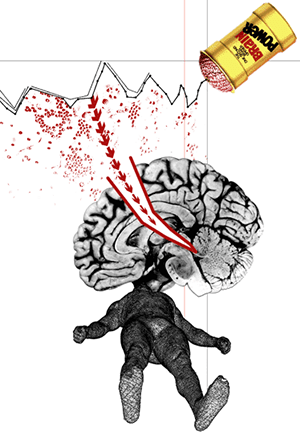
Latent inhibition (LI) is a technical term used in Classical conditioning (Pavlovian reinforcement) that refers to the natural tendency to tune out familiar stimuli. Individuals take longer to become aware of common stimuli than novel ones. It is ‘a measure of reduced learning about a stimulus to which there has been prior exposure without any consequence.’ Latent inhibition occurs when voluntarily trying to ignore an ongoing sound (like an air conditioner) or not hear the conversation of others.
This tendency to disregard or even inhibit formation of memory (by preventing associative learning of observed stimuli) is an unconscious response, and is assumed to prevent sensory and cognitive overload. Latent inhibition is observed in many species, and is believed to be an integral part of learning, enabling an organism to interact successfully in an environment.
read more »
Posted in Drugs, Health, Science |
Leave a Comment »
June 28, 2011

Kombu [kohm-boo], called dashima in Korean and haidai in Chinese, is the Japanse word for edible kelp widely eaten in East Asia. Most kombu is extensively cultivated on ropes in the seas of Japan and Korea.
Over 90 percent of Japanese kombu is cultivated, mostly in Hokkaidō, but also as far south as the Seto Inland Sea.
read more »
Posted in Food, Health, World |
Leave a Comment »
June 28, 2011

The Demon Core was the nickname given to a 6.2-kilogram (14 lb) subcritical mass of plutonium that accidentally went briefly critical in two separate accidents at the Los Alamos laboratory in 1945 and 1946. Both incidents resulted in the acute radiation poisoning and the subsequent death of a scientist.
After these incidents, the sphere of plutonium was referred to as the Demon Core. The core was used in an atomic bomb test in 1946, five weeks after the second fatal accident, and proved in practice to have a slightly increased yield over similar cores which had not been subjected to criticality excursions.
read more »
Posted in Health, Technology, War |
1 Comment »
June 28, 2011

The iBOT is a very stable and mobile powered wheelchair developed by Dean Kamen in a partnership between DEKA and Johnson and Johnson’s Independence Technology division. It is a medical technology, made to help people with severe mobility problems.
As of 2006 the iBOT retailed for approximately $26,100 and required a prescription in the U.S. As of 2009, it is no longer available for sale from Independence Technology, but support for existing units will be available until the end of 2013.
read more »
Posted in Health, Technology |
1 Comment »



 The Daily Omnivore