April 15, 2013
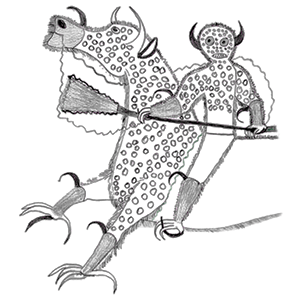
Heyoka [hay-oh-kah] is a spirit in Lakota Mythology that is seen as a trickster. It speaks, moves and reacts in an opposite fashion to the people around it. It is not a spirit that people wish to meet at any time; it usually appears to people when it wishes to take something from you or cause some sort of mayhem.
The Lakota people have learned to respect it enough to leave it be, avoiding it as much as possible. The word refers to the Lakota concept of a contrarian, jester, satirist, or sacred clown. The Heyoka are healers and have many functions, for example healing through laughter and awakening people to deeper meaning and concealed truth and to prepare the people for oncoming disaster with laughter.
read more »
Posted in Humor, Philosophy |
Leave a Comment »
April 15, 2013

Ritual clowns, also called sacred clowns, are a characteristic feature of the ritual life of many traditional religions, and they typically employ scatology and sexual obscenities. Ritual clowning is where comedy and satire originated; in Ancient Greece, ritual clowning, phallic processions (or penis parades) and aischrologia (ritual insults) found their literary form in the plays of Aristophanes.
Two famous examples of ritual clowns in North America are the Koyemshis (also known as Koyemshi, Koyemci or Mudheads) and the Newekwe (also spelled Ne’wekwe or Neweekwe). French sociologist Jean Cazeneuve is particularly renowned for elucidating the role of ritual clowns; reprising Ruth Benedict’s famous distinction of societies into Apollonian and Dionysian, he said that precisely because of the strictly repressive (apollonian) nature of the Zuñi society, the ritual clowns are needed as a dionysian element, a safety valve through which the community can give symbolic satisfaction to the antisocial tendencies. The Koyemshis clowns are characterized by a saturnalian (riotously merry) symbolism.
Posted in Humor, Philosophy, World |
3 Comments »
April 10, 2013

The Joker is a special type of playing card found in most modern decks, or else a type of tile in some Mahjong game sets, specifically used in the American version of Mahjong. It is believed that the term ‘Joker’ comes from ‘Jucker,’ the original German spelling of ‘Euchre,’ (a trick-taking card game for which the Joker card was invented).
The card was originally introduced in about 1860 to be used as the highest trump. Catherine Perry Hargrave documents jokers from 1862 and 1865 in her book ‘A History of Playing Cards.’ The 1862 card has a tiger on it and the label ‘Highest Trump,’ while the one from 1865 is inscribed ‘This card takes either Bower’ and ‘Imperial Bower,’ or ‘Highest Trump Card.’
read more »
Posted in Games, Humor, Language |
1 Comment »
April 9, 2013

Franklin Christenson Ware (b. 1967), known professionally as Chris Ware, is an American comic book artist and cartoonist, notable for his ‘Acme Novelty Library’ series and the graphic novels ‘Jimmy Corrigan, the Smartest Kid on Earth,’ and ‘Building Stories.’ His works explore themes of social isolation, emotional torment and depression.
His works tend to use a vivid color palette and are full of realistic, meticulous detail. His lettering and images are often elaborate and sometimes evoke the ragtime era or another early 20th-century American design style. Ware often refers to himself in the publicity for his work in self-effacing, even withering tones. He is considered by some critics and fellow notable illustrators and writers, such as Dave Eggers, to be among the best currently working in the medium.
read more »
Posted in Art, Humor, Language |
1 Comment »
April 9, 2013

‘Tastes like chicken‘ is a common declaration used when trying to describe the flavor of a food. The expression has been used so often that it has become somewhat of a cliché. As a result, the phrase also sometimes gets used for incongruous humor by being deployed for foods or situations to which it has no real relevance. As an explanation of why unusual meats would taste more like chicken than common alternatives such as beef or pork, different possibilities have been offered.
One idea is that chicken has a bland taste because fat contributes more flavor than muscle (especially in the case of a lean cut such as a skinless chicken breast), making it a generic choice for comparison. Also, chicken reportedly has lower levels of glutamates that contribute to the ‘savory’ aspect of taste known as umami; processing or tenderizing other meats also lowers glutamate levels and makes them taste more like chicken.
read more »
Posted in Food, Humor, Science |
Leave a Comment »
April 8, 2013


One aspect of how women are portrayed in popular culture is a purported rivalry between blonde and brunettes. The rivalry in American society dates back to at least 1875 when the first female professional baseball players were assigned to teams according to their hair color.
Baseball historian John Thorn notes that blonde and brunette baseball teams barnstormed the country in the late 1800s. A more contemporary example is the gridiron football game called ‘blondes vs. brunettes powderpuff football,’ a charity event that raises money for the Alzheimer’s Association. The annual contests were started in the fall of 2005, in Washington D.C.
read more »
Posted in Humor, Love |
Leave a Comment »
April 2, 2013
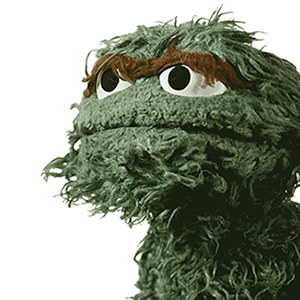
Oscar the Grouch is a Muppet character on the television program ‘Sesame Street.’ He has a green body (during the first season he was orange), has no visible nose, and lives in a trash can. His favorite thing in life is trash, as evidenced by the song ‘I Love Trash.’ A running theme is his compulsive hoarding of seemingly useless items.
‘The Grouch’ aptly describes his misanthropic interaction with the other characters, but also refers to his species. The character is performed by Caroll Spinney, and has been performed by him since the show’s first episode.
read more »
Posted in Education, Humor |
Leave a Comment »
March 31, 2013
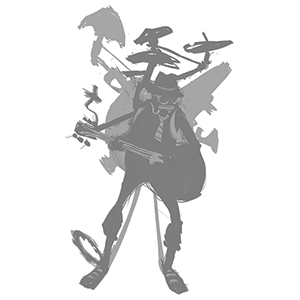
The fotdella was an instrument invented and constructed by Jesse ‘The Lone Cat’ Fuller, an American one-man band musician, who needed an accompaniment instrument beyond the usual high-hat (foot-operated cymbal) or bass drum favored by street musicians. Dreaming it up in the early 1950s, while lying in bed, he set about constructing a foot-operated bass instrument. It ended up as a large upright box with a rounded top, vaguely shaped like the top of a double bass, with a short neck on top. Six bass strings were attached to the neck and stretched over the body.
To play the instrument, there was a homemade set of foot pedals, each one bringing a padded hammer to strike a string when depressed, like the action of a piano. With these six bass notes, Fuller could accompany himself on the 12-string guitar in several keys. The name ‘fotdella’ was given to the instrument by Fuller’s wife, who took to calling it a ‘foot-diller’ (as in the then-current expression, ‘killer-diller,’ meaning ‘exceedingly good’); later, it became shortened to just fotdella.
Posted in Art, Humor |
Leave a Comment »
March 31, 2013
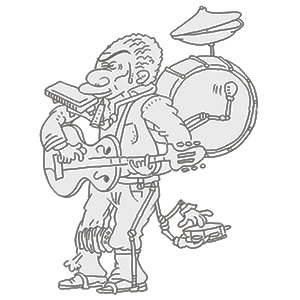
A one-man band is a musician who plays a number of musical instruments simultaneously using their hands, feet, limbs, and various mechanical contraptions. The simplest type of ‘one-man band’ — a singer accompanying themselves on acoustic guitar and harmonica mounted in a metal ‘harp rack’ below the mouth — is often used by buskers.
More complicated setups may include wind instruments strapped around the neck, a large bass drum mounted on the musician’s back with a beater which is connected to a foot pedal, cymbals strapped between the knees or triggered by a pedal mechanism, tambourines and maracas tied to the limbs, and a stringed instrument strapped over the shoulders (e.g., a banjo, ukulele or guitar). Since the development of Musical Instrument Digital Interface (MIDI) in the 1980s, musicians have also incorporated chest-mounted MIDI drum pads, foot-mounted electronic drum triggers, and electronic pedal keyboards into their set-ups.
read more »
Posted in Art, Humor, Technology |
1 Comment »
March 31, 2013

Patrice O’Neal (1969 – 2011) was an American stand-up comedian, radio personality, and actor. He was born in New York City and grew up in the Roxbury neighborhood of Boston. His mother named him after Patrice Lumumba, the leader of the Congolese independence movement. He was raised by his mother and never met his father. At the age of 17, Oneal was convicted of statutory rape of a 15 year old girl and sentenced to 60 days in prison, served during his summer break, so as not to disrupt his schooling.
The act, which occurred when Oneal was still 16, would have been legal in most states, but Massachusetts lacks a close-in-age exception, and has an age of consent of 16. Oneal said his humor helped him to negotiate the harsh realities of prison. Oneal was a star football player at West Roxbury High School, ending his career with 3 letters in varsity football and a state championship his senior year. He turned down football scholarships in order to attend Northeastern University on a public housing grant, majoring in Performing Arts.
read more »
Posted in Humor |
1 Comment »
March 29, 2013

Superfolks is a 1977 novel by Robert Mayer, which satirizes the superhero and comic book genres, and was aimed at a more adult audience than those genres typically attracted. Superfolks examines comic book conventions and clichés from a more serious, ‘literary’ perspective.
The novel was influential on many writers of superhero comic books in the 1980s and 1990s, notably Alan Moore and Kurt Busiek. Although the book’s pop culture references clearly date it to the 1970s, its influence on the deconstruction of the superhero genre is still felt through Moore’s ‘Watchmen,’ ‘Marvelman,’ and ‘Superman: Whatever Happened to the Man of Tomorrow?’
read more »
Posted in Humor, Language |
Leave a Comment »
March 28, 2013
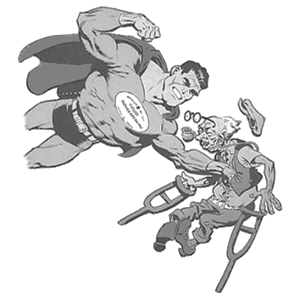
‘Superduperman‘ is a satirical story by cartoonists Harvey Kurtzman and Wally Wood that was published in the fourth issue of ‘Mad’ in 1953. Lampooning both Superman and Captain Marvel, it revolutionized the types of stories seen in ‘Mad,’ leading to greatly improved sales. Writers such as Alan Moore have cited this story as an influence.
The plot parallels the Superman scenario of the period: ‘Clark Bent’ is a lowly assistant to the copy boy at ‘The Daily Dirt’ newspaper, where he tries, unsuccessfully, to woo the narcissistic and indifferent ‘Lois Pain.’
read more »
Posted in Humor, Money |
1 Comment »


 The Daily Omnivore