February 21, 2012

Everybody Draw Mohammed Day was an event held on 20 May 2010 in support of free speech and freedom of artistic expression of those threatened by violence for drawing representations of the Islamic Prophet Muhammad. It began as a protest against censorship of an American television show, ‘South Park,’ ‘201’ by its distributor, Comedy Central, in response to death threats against some of those responsible for two segments broadcast in April. Observance of the day began with a drawing posted on the Internet on April 20, 2010, accompanied by text suggesting that ‘everybody’ create a drawing representing Muhammad, on May 20, 2010, as a protest against efforts to limit freedom of speech. U.S. cartoonist Molly Norris of Seattle created the artwork. Depictions of Muhammad are explicitly forbidden by a few hadiths (sayings of and about Muhammad), though not by the Qur’an.
South Park episodes ‘200’ and ‘201,’ broadcast in April 2010, featured a character in a bear costume, who various other characters stated was Muhammad. The ‘South Park’ episode sparked statements from the extremist website Revolution Muslim, which posted a picture of the partially decapitated body of the Dutch filmmaker, Theo van Gogh, with a statement declaring that Parker and Stone could meet a similar fate. Comedy Central self-censored the episode when it was broadcast by removing the word ‘Muhammad’ and a speech about intimidation and fear from the episode.
Posted in Humor, Philosophy, Politics |
1 Comment »
February 20, 2012
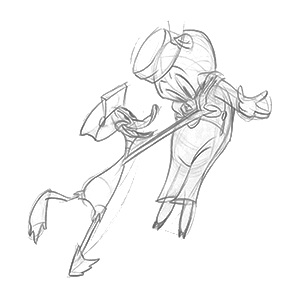
Baby Bottleneck is a 1945 Warner Brothers Looney Tunes theatrical cartoon short released in 1946 and directed by Bob Clampett and written by Warren Foster. In the short, there is a baby boom in the postwar US; an overworked stork (a clear Jimmy Durante reference) gets drunk in the ‘Stork Klub.’ A mix up results in babies getting sent to the wrong parents (such as a baby Hippopotamus to a Scottish Terrier).
To clear up the confusion, Porky Pig is brought in to manage the factory, with Daffy Duck as his assistant. The babies are seen going through a conveyor belt (to the tune of Raymond Scott’s famous ‘Powerhouse’) and getting sent by various animals, while Daffy mans the phones, making quick references to Bing Crosby, Eddie Cantor, and the Dionne Quintuplets.
read more »
Posted in Art, Humor |
Leave a Comment »
February 20, 2012


The Ren & Stimpy Show, often simply referred to as Ren & Stimpy, is an American animated television series, created by Canadian animator John Kricfalusi for Nickelodeon. The series focuses on the titular characters: Ren Höek, a psychotic chihuahua, and Stimpson J. Cat, a good-natured, dimwitted cat. The show premiered in 1991, on the same day as the debut of ‘Rugrats’ and ‘Doug,’ the three of which comprised the original Nicktoons. The show ran for five seasons on the network.
Throughout its run, the show was controversial for its off-color humor, black comedy, toilet humor, sexual innuendo, and violence, all of which contributed to the production staff’s altercations with Nickelodeon’s Standards and Practices department. The show developed a cult following during and after its run. It was pioneering for satirical animated shows like ‘Beavis and Butt-head’ and ‘South Park.’
read more »
Posted in Art, Humor, Money |
1 Comment »
February 20, 2012
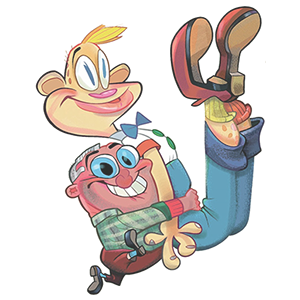
George Liquor (often taking his epithet as George Liquor, American), most famous for his appearances on ‘The Ren and Stimpy Show,’ is a cartoon character created by John Kricfalusi and is a mascot for Kricfalusi’s defunct animation studio, Spümcø. Kricfalusi portrayed George Liquor as a patriotic, outspoken, politically conservative blowhard. Kricfalusi described Liquor as his favorite character to animate.
Kricfalusi described George Liquor as ‘the greatest American’ who is so conservative ‘that he thinks the Republicans are Commies.’ George harbors a deep antipathy for the political left; in one issue of Spümcø’s ‘Comic Book,’ George Liquor becomes enraged after a fish calls him a Democrat. George is a middle-aged, crass, religious, ultra-patriotic American who favors his nephew, Jimmy The Idiot Boy, and tries to teach Jimmy how to be ‘a Real Man.’
read more »
Posted in Art, Humor, Money |
Leave a Comment »
February 20, 2012


Michael John Kricfalusi [kris-fuh-loo-see] better known as John K., is a Canadian animator. He is creator of ‘The Ren & Stimpy Show,’ its adults-only spin-off ‘Ren & Stimpy ‘Adult Party Cartoon,” ‘The Ripping Friends’ animated series, and ‘Weekend Pussy Hunt,’ an interactive web-based cartoon, as well as the founder of animation studio Spümcø.
He spent his early childhood in Germany and Belgium, while his father served in the Canadian air force. At age seven he returned with his family to Canada. Having moved in the middle of a school season, he spent much of his time that year at home, watching Hanna-Barbera cartoons and drawing them. Kricfalusi’s interest in Golden Age animation crystallized during his stay at Sheridan College, where an acquaintance of his held weekly screenings of old films and cartoons, among them the cartoons of Bob Clampett and Tex Avery, which left a deep impression on him.
read more »
Posted in Art, Humor, Money |
Leave a Comment »
February 14, 2012
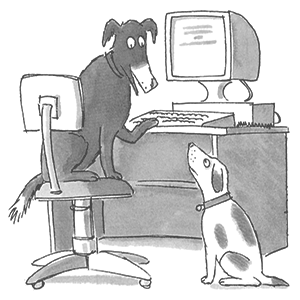
On the Internet, nobody knows you’re a dog‘ is an adage which began as the caption of a cartoon by Peter Steiner published by ‘The New Yorker’ in 1993. Steiner, a cartoonist and contributor to ‘The New Yorker’ since 1979, said the cartoon initially did not get a lot of attention, but later took on a life of its own, and that he felt similar to the person who created the ‘smiley face.’ In fact, Steiner was not that interested in the Internet when he drew the cartoon, and although he did have an online account, he recalled attaching no ‘profound’ meaning to the cartoon; it was just something he drew in the manner of a ‘make-up-a-caption’ cartoon.
In response to the comic’s popularity, he stated, ‘I can’t quite fathom that it’s that widely known and recognized.’ The cartoon marks a notable moment in Internet history. Once the exclusive domain of government engineers and academics, the Internet was now a subject of discussion in general interest magazines like ‘The New Yorker.’ Lotus 1-2-3 founder and early Internet activist Mitch Kapor commented in a ‘Time’ magazine article in 1993 that ‘the true sign that popular interest has reached critical mass came this summer when the ‘New Yorker printed a cartoon showing two computer-savvy canines.’
read more »
Posted in Humor, Politics, Technology |
1 Comment »
February 13, 2012

Bathos [bey-thos] (Greek: ‘depth’) is an abrupt transition in style from the exalted to the commonplace, producing a ludicrous effect. While often unintended, bathos may be used deliberately to produce a humorous effect. If bathos is overt, it may be described as Burlesque or mock-heroic.
As used in English bathos originally referred to a particular type of bad poetry, but it is now used more broadly to cover any seemingly ridiculous artwork or bad performance. It should not be confused with pathos, a mode of persuasion within the discipline of rhetoric, intended to arouse emotions of sympathy and pity.
read more »
Posted in Art, Humor, Language |
Leave a Comment »
February 13, 2012

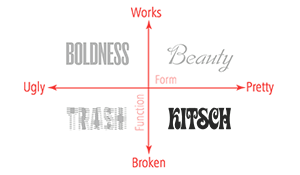
Camp is an aesthetic sensibility that regards something as appealing or humorous because of its deliberate ridiculousness. The concept is closely related to kitsch, and things with camp appeal may also be described as being ‘cheesy.’
When the usage appeared, in 1909, it denoted: ostentatious, exaggerated, affected, theatrical, and effeminate behaviour, and, by the middle of the 1970s, the definition comprised: banality, artifice, mediocrity, and ostentation so extreme as to have perversely sophisticated appeal. American writer Susan Sontag’s essay ‘Notes on ‘Camp” (1964) emphasised its key elements as: artifice, frivolity, naïve middle-class pretentiousness, and ‘shocking’ excess. Camp as an aesthetic has been popular from the 1960s to the present.
read more »
Posted in Art, Humor, Language |
Leave a Comment »
February 13, 2012
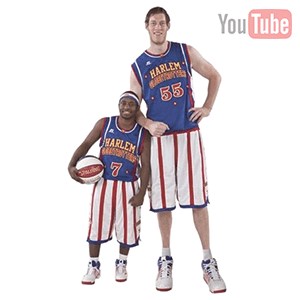
Paul Sturgess is an English-born basketball player for the Harlem Globetrotters. At 7 ft 7.82 in (2.3322 m) and 320 lb (150 kg), Sturgess was the tallest ever college basketball player in the US, is the tallest professional basketball player in the world, and is taller than any basketballer ever to play for the NBA. He joined the team in 2011 with fellow rookie, Jonte ‘Too Tall’ Hall, who at 5 ft 2 in (1.57 m) is the shortest ever player and is 2.5 ft (77 cm) shorter than Sturgess.
Sturgess wears a size 21 shoe. Examinations as a teenager revealed that his growth is healthy and not the result of disorder, rather he possesses familial tall stature, that is to say his height is genetic. His biological father is 6 ft 9 in (2.06 m) and there are other tall members in his family although his mother is 5 ft 5 in (1.65 m) and his younger sister is 5 ft 6 in (1.68 m). Sturgess was always tall but a growth spurt between the ages of 16-17 resulted in a foot (30 cm) of height added within a single year. Sturgess enjoys playing many other sports and before concentrating on basketball also played golf and soccer.
Posted in Games, Humor |
Leave a Comment »
February 10, 2012

Reality distortion field (RDF) is a term coined by Bud Tribble (who still works at Apple) at Apple Computer in 1981, to describe company co-founder Steve Jobs’ charisma and its effects on the developers working on the Mac project. Tribble claimed that the term came from ‘Star Trek.’ Later the term has also been used to refer to perceptions of his keynote speeches (or ‘Stevenotes’) by observers and devoted users of Apple computers and products.
The RDF was said by Andy Hertzfeld (member of the original Apple team) to be Steve Jobs’ ability to convince himself and others to believe almost anything with a mix of charm, charisma, bravado, hyperbole, marketing, appeasement, and persistence. RDF was said to distort an audience’s sense of proportion and scales of difficulties and made them believe that the task at hand was possible. While RDF has been criticized as anti-reality, those close to Jobs have also illustrated numerous instances in which creating the sense that the seemingly impossible was possible led to the impossible being accomplished. Similarly, the optimism which Jobs sowed in those around him contributed to the loyalty of his colleagues and fans.
Posted in Humor, Money, Technology |
1 Comment »
February 9, 2012

An egg of Columbus refers to a brilliant idea or discovery that seems simple or easy after the fact. The expression refers to a popular story of how Christopher Columbus, having been told that discovering the Americas was no great accomplishment, challenged his critics to make an egg stand on its tip.
After his challengers gave up, Columbus did it himself by tapping the egg on the table so as to flatten its tip. The story is often alluded to when discussing creativity.
read more »
Posted in Games, Humor, Language |
Leave a Comment »
February 6, 2012
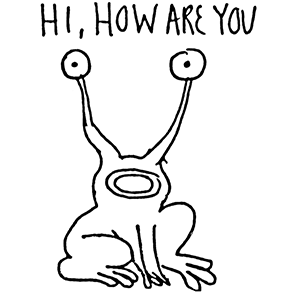
New sincerity is a term that has been used in music, aesthetics, film criticism, poetry, literary criticism and philosophy, generally to describe art or concepts that run against prevailing modes of postmodernist irony or cynicism. ‘New Sincerity’ was used as a collective name for a loose group of alternative rock bands, centered in Austin, Texas in the years from about 1985 to 1990, who were perceived as reacting to the ironic outlook of then-prominent music movements like punk rock and New Wave.
The use of ‘New Sincerity’ in connection with these bands began with an off-handed comment by Austin punk rocker/author Jesse Sublett to his friend, local music writer Margaret Moser: ‘All those new sincerity bands, they’re crap.’
read more »
Posted in Art, Humor, Language |
Leave a Comment »



 The Daily Omnivore