November 19, 2011

Truck nuts, also known as truck balls, BumperNuts, BumperBalls, or Trucksticles, are accessories for pickup trucks and other vehicles. This trend began in the United States in 1998 and first sold on the internet in 1999. Truck nuts are used as a statement by the car, truck, ATV, and/or motorcycle owner to boast/amuse/shock him/her self and others. Truck nuts are installed to hang under the bumper area of the vehicle so they are conspicuous to those viewing the vehicle from the rear. Manufacturers use HDPE, ABS, and PVC plastics to create truck nuts, though hollow aluminum and solid brass can also be found. They can be many different colors, as well as metallic chrome coating and a brass-colored reflective metallic coating.
In 2007, a proposal was made in Maryland to ‘prohibit motorists from displaying anything resembling or depicting ‘anatomically correct’ or ‘less than completely and opaquely covered’ human or animal genitals, human buttocks or female breasts.’ The bill’s sponsor, delegate LeRoy E. Myers Jr., referred to the testicles as ‘vulgar and immoral,’ and stated that his proposal was made at the request of a constituent who was offended by the accessories. Similar legislature is being advocated in several other states including Virginia, South Carolina, and Florida.
Posted in Humor, Politics, Sex |
Leave a Comment »
November 19, 2011
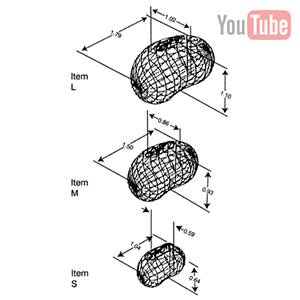
Neuticles are prosthetic testicular implants for neutered dogs and other domestic animals. Creator Gregg Miller won the 2005 Ig Nobel Prize in Medicine, a parody of the real Nobel Prize, for his invention. As of 2007, more than 240,000 pairs of the patented product had been sold, in all 50 U.S. states and 49 countries. Miller developed the idea for Neuticles in 1993, after his bloodhound Buck caught the scent of a bitch in heat, disappeared and turned up days later 30 miles away. Miller had Buck neutered to stop his wandering. Following the procedure, when Buck went to clean himself, he realized something was wrong and acted ‘extremely depressed’ for three days.
The first commercial Neuticles were implanted in 1995. Neuticles are made from Food and Drug Administration–approved materials and are designed to replicate the weight and feel of the animal’s natural testicles. They are made of solid silicone and are not gel-filled and therefore cannot leak. Several companies have tried to copy the patented prosthetic. CTI Corporation, which manufactures Neuticles, cited an investigation revealing that companies in New York and California were pirating Neuticles. CTI warned of health risks to the animals getting the pirate product.
Posted in Humor, Money, Sex |
1 Comment »
November 19, 2011

Drunk dialing is a pop-culture term denoting an instance in which an intoxicated individual places phone calls that he or she would not likely place if sober. The term often refers to a lonely individual calling former or current love interests. Kurt Vonnegut once said, ‘I have this disease late at night sometimes, involving alcohol and the telephone. I get drunk, and I drive my wife away with breath like mustard gas and roses.
And then, speaking gravely and elegantly into the telephone, I ask the telephone operators to connect me with this friend or that one, from whom I have not heard in years.’ ‘Drunk texting’ is a related phenomenon, and potentially yet more embarrassing for the sender as, once the message is sent, it cannot be retrieved; the message will most likely be misspelled (due to being drunk), and it might be reviewed and shared among many.
read more »
Posted in Drugs, Humor, Technology |
Leave a Comment »
November 19, 2011

Hacktivism (a portmanteau of hack and activism) is the use of computers and computer networks as a means of protest to promote political ends. The term was first coined in 1998 by a member of the Cult of the Dead Cow hacker collective. If hacking as ‘illegally breaking into computers’ is assumed, then hacktivism could be defined as ‘the nonviolent use of illegal or legally ambiguous digital tools in pursuit of political ends.’ These tools include web site defacements, redirects, denial-of-service (DoS) attacks, information theft, web site parodies, virtual sit-ins, typosquatting, and virtual sabotage.
If hacking as ‘clever computer usage/programming’ is assumed, then hacktivism could be understood as the writing of code to promote political ideology: promoting expressive politics, free speech, human rights, and information ethics through software development. Acts of hacktivism are carried out in the belief that proper use of code will be able to produce similar results to those produced by regular activism or civil disobedience.
read more »
Posted in Humor, Politics, Technology |
Leave a Comment »
November 19, 2011

A lip dub is a type of music video that combines lip synching and audio dubbing. It is made by filming individuals or a group of people lip synching while listening to a song or any recorded audio then dubbing over it in post editing with the original audio of the song. There is often some form of mobile audio device used such as an MP3 player. Often they look like simple music videos, although many involve a lot of preparation and production. Lip dubs can be done in a single unedited shot that often travels through different rooms and situations within a building. They have become popular with the advent of mass participatory video content sites like YouTube.
Jake Lodwick, the co-founder of video sharing website Vimeo, coined the term in 2006, in a video entitled ‘Lip Dubbing: Endless Dream.’ In the video’s description, he wrote, ‘I walked around with a song playing in my headphones, and recorded myself singing. When I got home I opened it in iMovie and added an MP3 of the actual song, and synchronized it with my video. Is there a name for this? If not, I suggest ‘lip dubbing’.’ Lodwick also directed the ‘Flagpole Sitta’ ‘office lip dub’ in 2007.
Posted in Art, Humor, Technology |
Leave a Comment »
November 18, 2011

‘The Man‘ is a slang phrase that may refer to the government or to some other authority in a position of power. In addition to this derogatory connotation, it may also serve as a term of respect and praise. The phrase ‘the Man is keeping me down’ is commonly used to describe oppression. The phrase ‘stick it to the Man’ encourages resistance to authority, and essentially means ‘fight back’ or ‘resist,’ either openly or via sabotage.
The term ‘the Man’ in the American sense dates back to the late 19th Century. In the Southern U.S. states, the phrase came to be applied to any man or any group in a position of authority, or to authority in the abstract. From about the 1950s the phrase was also an underworld code word for police, the warden of a prison or other law enforcement or penal authorities.
read more »
Posted in Humor, Language, Politics |
Leave a Comment »
November 18, 2011
Polybius is a supposed arcade game featured in an Internet urban legend. According to the story, the Tempest-style game was released to the public in 1981, and drove its players insane, causing them to suffer from intense stress, horrific nightmares, and even suicidal tendencies. A short time after its release, it supposedly disappeared without a trace. Not much evidence for the existence of such a game has ever been discovered. Polybius gets its name from the Greek historian who’s works are are relevant to modern cryptography.
According to the story, an unheard-of new arcade game appeared in several suburbs of Portland, Oregon in 1981, something of a rarity at the time. The game, ‘Polybius,’ proved to be incredibly popular, to the point of addiction, and lines formed around the machines, often resulting in fighting over who played next. This was followed by clusters of visits from men in black. Rather than the usual marketing data collected by company visitors to arcade machines, they collected some unknown data, allegedly testing responses to the psychoactive machines. The players themselves suffered from a series of unpleasant side-effects, including amnesia, insomnia, nightmares, night terrors, and even suicide in some versions of the legend.
read more »
Posted in Games, Humor |
Leave a Comment »
November 17, 2011

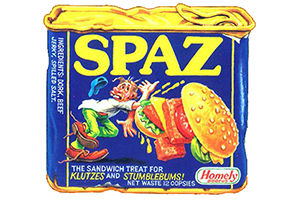
A euphemism is the substitution of an uncontroversial phrase for a more frank expression that might offend or otherwise suggest something unpleasant to the audience. Euphemisms often evolve over time into taboo words, through a process described by American philosopher W.V.O. Quine, and more recently dubbed the ‘euphemism treadmill‘ by cognitive scientist Steven Pinker, and discussed in his books ‘The Blank Slate’ (2003) and ‘The Stuff of Thought’ (2007).
This is the well-known linguistic process known as ‘pejoration’ or ‘semantic change.’ Words originally intended as euphemisms may lose their euphemistic value, acquiring the negative connotations of their referents. In some cases, they may be used mockingly and become the opposite of euphemisms, ‘dysphemisms.’ Euphemisms related to disabilities have been prone to this. In his remarks on the ever-changing London slang, made in ‘Down and Out’ in Paris and London, George Orwell mentioned both the euphemism treadmill and the dysphemism treadmill. He did not use these now-established terms, but observed and commented on the respective processes as early as in 1933.
Posted in Humor, Language, Politics |
Leave a Comment »
November 9, 2011
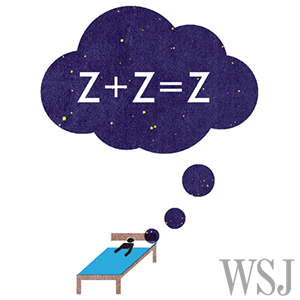
Sleep-learning (also known as hypnopædia [hip-noh-pee-dee-uh]) attempts to convey information to a sleeping person, typically by playing a sound recording to them while they sleep. This now-discredited technique was supposed to be moderately effective at making people remember direct passages or facts, word for word. Since the electroencephalography studies by Charles W. Simon and William H. Emmons in 1956, learning by sleep has not been taken seriously. The researchers concluded that learning during sleep was ‘impractical and probably impossible.’ They reported that stimulus material presented during sleep was not recalled later when the subject awoke unless alpha wave activity occurred at the same time the stimulus material was given. Since alpha activity during sleep indicates the subject is about to awake, the researchers felt that any learning occurred in a waking state.
In Aldous Huxley’s 1932 novel ‘Brave New World,’ hypnopaedia is used for the conditioning of children by future culture. In the novel, sleep-learning was discovered by accident when a Polish boy named Reuben Rabinovitch was able to recite an entire radio broadcast in English after a radio receiver was left on in his sleep. The boy was unable to comprehend what he had heard via hypnopædia, but it was soon realized that it could be used to effectively make suggestions about morality.
Posted in Education, Humor, Language |
1 Comment »
November 9, 2011

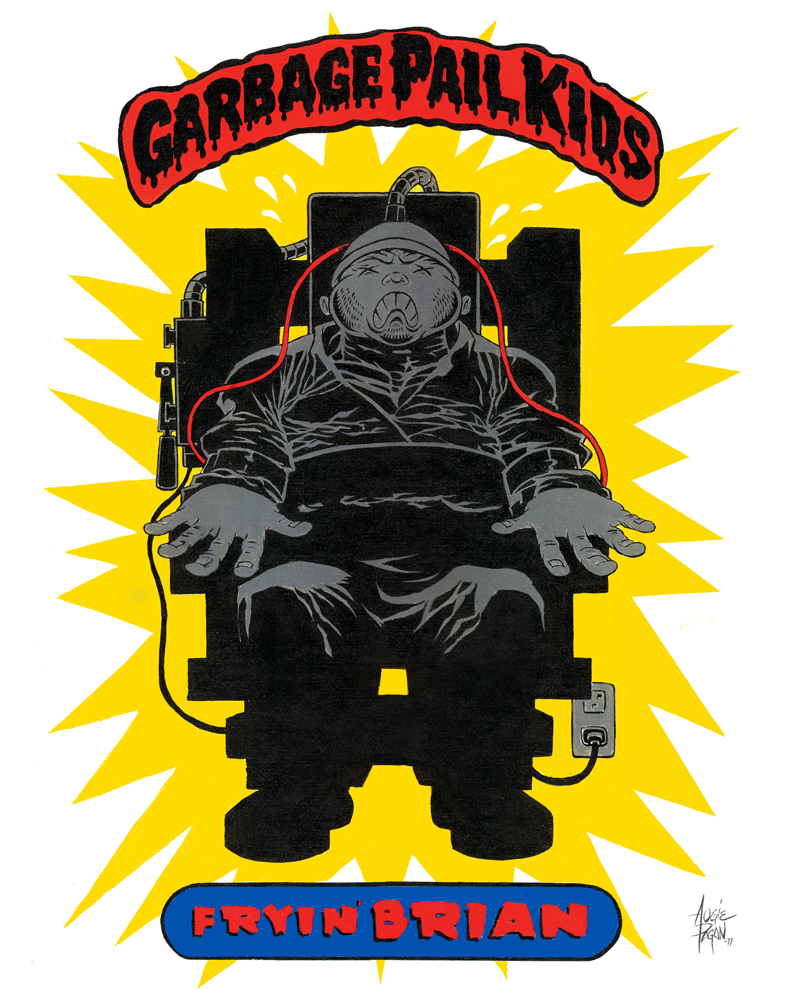
Garbage Pail Kids (also known as ‘Basuritas’ in Latin America, ‘Gang do Lixo’ in Brazil, ‘Sgorbions’ in Italy, ‘Les Crados’ in France and ‘Die total kaputten Kids’ in Germany) is a series of trading cards produced by the Topps Company, originally released in 1985 and designed to parody the Cabbage Patch Kids dolls, which were immensely popular at the time.
Each sticker card features a character with a comical abnormality and/or suffering some terrible fate, and punning name, such as ‘Glandular Angela’ or ‘Half-Nelson.’ Fifteen series of regular trading cards were released in the United States, with various sets released in other countries.
read more »
Posted in Art, Humor, Language |
Leave a Comment »
November 9, 2011

A body swap is a storytelling device seen in a variety of fiction, most often in television shows and movies, in which two people (or beings) exchange minds and end up in each other’s bodies. Alternatively, their minds may stay where they are as their bodies adjust. The two people usually keep their voices in cartoons, for purposes of knowing who is who. There are three distinct types of body swapping. Switches can be caused by magic items such as amulets, heartfelt wishes, or just strange quirks of the universe. The switches typically reverse after the subjects have expanded their world views, gained a new appreciation for each other’s troubles by literally ‘walking in another’s shoe’ and/or caused sufficient amounts of farce. Notable examples include the books ‘Vice Versa’ (1882) and ‘Freaky Friday’ (1972), as well as the film versions of both.
Switches accomplished by technology, exempting gadgets advanced sufficiently to appear as magic, are the fare of mad scientists. Body-swapping devices are characterized by highly experimental status, straps, helmets with complicated cables that run to a central system and a tendency to direly malfunction before their effects can be reversed. Those without such means may resort to brain transplants. Such experiments can have overtones of horror; evil mad scientists seldom use willing test subjects.
Posted in Art, Humor, Language |
Leave a Comment »
November 8, 2011
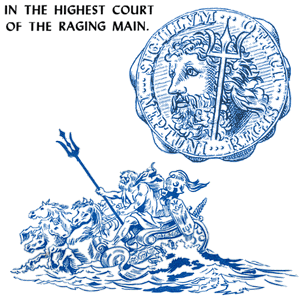
The ceremony of Crossing the Line is an initiation rite in several navies that commemorates a sailor’s first crossing of the Equator. Originally, the tradition was created as a test for seasoned sailors to ensure their new shipmates were capable of handling long rough times at sea. Sailors who have already crossed the Equator are nicknamed (Trusty) Shellbacks, often referred to as Sons of Neptune; those who have not are nicknamed (Slimy) Pollywogs. Equator-crossing ceremonies, typically featuring King Neptune, are also sometimes carried out for passengers’ entertainment on civilian ocean liners and cruise ships. They are also performed in the merchant navy and aboard sail training ships.
The two-day event (evening and day) is a ritual of reversal in which the older and experienced enlisted crew essentially takes over the ship from the officers. Physical assaults in keeping with the spirit of the initiation are tolerated, and even the inexperienced crew is given the opportunity to take over. The transition flows from established order to the controlled ‘chaos’ of the Pollywog Revolt, the beginnings of re-order in the initiation rite as the fewer but experienced enlisted crew converts the Wogs through physical tests, then back to, and thereby affirming, the pre-established order of officers and enlisted.
read more »
Posted in Humor, War, World |
Leave a Comment »



 The Daily Omnivore