February 3, 2011

Divination [div-uh-ney-shuhn] (from Latin divinare ‘to foresee,’ or ‘to be inspired by a god’) is an attempt to get information through rituals, omens or supernatural things. Divining the outcome of things has been done by many different methods, such as astrology, which attempts to predict the future based on the movement of celestial bodies. Divination is not supported by empirical evidence and is dismissed by the scientific community, as mere superstition.
In ancient Rome augers divined the future by the flight patterns of birds. Tarot and other forms of cartomancy divine cards. Palmistry is palm reading. Extispicy is a particularly old tradition where the future is divined from the entrails of scarified animals. Graphology makes predictions based on handwriting analysis, and numerology analyses number systems. Phrenology is a bygone system of ‘reading’ the shape of a person’s head.
Posted in Language, Philosophy |
Leave a Comment »
February 3, 2011

Vice is a free magazine and media conglomerate founded in Montreal and currently based in New York City. It is available in 19 countries. It supports itself primarily through advertising. Founded by Suroosh Alvi, Shane Smith, and Gavin McInnes, it was launched as the ‘Voice of Montreal’ in 1994 with government funding to provide work and a community service. When the editors wanted to break free of their commitments with the original publisher, Alix Laurent, they bought him out and changed the name to ‘Vice’ in 1996.
Vice’s content has shifted from dealing mostly with independent arts and pop cultural matters to covering more serious news topics, although both are often treated with the same spirit of blithe and caustic irreverence. Vice has championed the ‘Immersionist’ school of journalism, which it regards as something of a DIY antithesis to the big-office methods practiced by traditional news outlets. There have been issues dedicated to concerns facing Iraqi people, Native Americans, Russian people, people with mental disorders, and people with mental disabilities.
Posted in Art, Language, Money |
Leave a Comment »
February 3, 2011

Defenestration [dee-fen-uh-strey-shuhn] is the act of throwing someone or something out of a window. The term originates from two incidents in history, both occurring in Prague. In 1419, seven town officials were thrown from the Town Hall, precipitating the Hussite War. In 1618, two Imperial governors and their secretary were tossed from Prague Castle, sparking the Thirty Years War. These incidents, particularly in 1618, were referred to as the Defenestrations of Prague and gave rise to the term and the concept. The word comes from the Latin de- (down or away from) and fenestra (window or opening).
The act carries the connotation of forcibly or peremptorily removing an adversary, and the term is sometimes used in just that sense; it also suggests breaking the windows in the process (de- also means removal). Although defenestrations can be fatal due to the height of the window through which a person is thrown or throws oneself or due to lacerations from broken glass, the act of defenestration need not carry the intent or result of death. Self-defenestration (autodefenestration) is the act of jumping, propelling oneself, or causing oneself to fall, out of a window.
Posted in Language, War |
Leave a Comment »
February 2, 2011
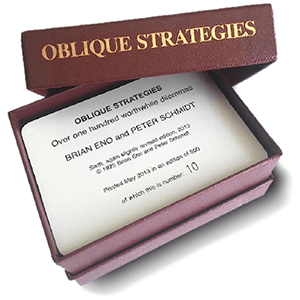
Oblique Strategies (subtitled ‘over one hundred worthwhile dilemmas’) is a set of published cards created by Brian Eno and Peter Schmidt first published in 1975, and is now in its fifth, open ended, edition. Each card contains a phrase or cryptic remark which can be used to break a deadlock or dilemma situation. Some are specific to music composition; others are more general. Examples include: Use an old idea / State the problem in words as clearly as possible / What would your closest friend do? / Are there sections? Consider transitions / Try faking it!
Posted in Humor, Language |
Leave a Comment »
February 2, 2011
The fainting game refers to intentionally cutting off oxygen to the brain with the goal of inducing temporary syncope (loss of consciousness) and euphoria. There are two distinct methods used to achieve oxygen deprivation: strangulation and rapid breathing (self-induced hypocapnia). The fainting game is pursued primarily by children and teens to get a high without taking drugs. It is frequently confused with erotic asphyxiation, which is oxygen deprivation for sexual arousal.
The practice goes by many other names in different parts of the world, such as: Riding a Rocket, Airplaning, America Dream Game, Black Out Game, Breath Play, Bum Rushing, California Choke, California Headrush, Choking Out, Cloud Nine, Dying game, Dream Game, Elevator, Flatline Game, Funky Chicken, Harvey Wallbanger, Hyperventilation Game, Indian Headrush, Knockout Game, Pass-out Game, Natural High, Sleeper Hold, Space Cowboy, Space Monkey, Suffocation Roulette, Rising Sun, High Riser, Tingling Game, Trip to Heaven, Speed Dreaming, Wall-Hit, and Purple Dragon.
Posted in Health, Language, Sex |
Leave a Comment »
February 1, 2011

A script doctor is a highly-skilled screenwriter, hired by a film or television production, to rewrite or polish specific aspects of an existing screenplay, including structure, characterization, dialogue, pacing, theme, and other elements. Script doctors generally do their work uncredited, for a variety of commercial and artistic reasons. Script doctors are usually brought in during the development and pre-production phases of a film, to address specific issues with the script, as identified by the financiers, production team, and cast. They may also be employed during post production, to help address narrative problems that crop up during the editing process.
The use of script doctors was first revealed at the 1973 Academy Awards when Francis Ford Coppola thanked Robert Towne for his work on The Godfather. Since then, the use of script doctors has been downplayed within the industry, to avoid overshadowing the work of the original writers. Under the WGA screenwriting credit system, a screenwriter must contribute 50 percent to the story and/or characterization in order to qualify for credit. Uncredited screenwriters are not eligible to win the Academy Award for Best Screenplay or the Writers Guild of America Awards.
Posted in Art, Language, Money |
Leave a Comment »
January 31, 2011

Exquisite corpse is a method by which a collection of words or images is collectively assembled. Each collaborator adds to a composition in sequence, either by following a rule (e.g. ‘The adjective noun adverb verb the adjective noun’) or by being allowed to see the end of what the previous person contributed. The name is derived from a phrase that resulted when the game was first played, ‘Le cadavre exquis boira le vin nouveau.’ (‘The exquisite corpse will drink the new wine.’) The technique was invented by Surrealists and is similar to an old parlor game called ‘Consequences’ in which players write in turn on a sheet of paper, fold it to conceal part of the writing, and then pass it to the next player for a further contribution.
Surrealist André Breton reported that it started in fun, but became playful and eventually enriching. Breton said the diversion started about 1925, but Pierre Reverdy wrote that it started much earlier, at least before 1918. Later the game was adapted to drawing and collage, producing a result similar to children’s books in which the pages were cut into thirds, the top third pages showing the head of a person or animal, the middle third the torso, and the bottom third the legs, with children having the ability to ‘mix and match’ by turning pages.
Posted in Art, Games, Language |
Leave a Comment »
January 29, 2011

Lifeloggers wear cameras and recording devices in order to capture their entire lives, or large portions of their lives. The first person to capture continuous physiological data together with live first-person video from a wearable camera, was computer scientist Steve Mann in 1994. Mann continuously transmitted his everyday life 24 hours a day, 7 days a week to his website for the world to watch.
Posted in Language, Technology |
Leave a Comment »
January 29, 2011

The multiverse is the hypothetical set of multiple possible universes (including the historical universe we consistently experience) that together comprise everything that exists: the entirety of space, time, matter, and energy as well as the physical laws and constants that describe them. The term was coined in 1895 by the American philosopher and psychologist William James. The various universes within the multiverse are sometimes called parallel universes.
The structure of the multiverse, the nature of each universe within it and the relationship between the various constituent universes, depend on the specific multiverse hypothesis considered. Multiverses have been hypothesized in cosmology, physics, astronomy, religion, and philosophy. In these contexts, parallel universes are also called ‘alternative universes,’ ‘quantum universes,’ and ‘alternative realities,’ among others.
read more »
Posted in Language, Philosophy, Science |
Leave a Comment »
January 29, 2011

The Metaverse is our collective online shared space, created by the convergence of virtually enhanced physical reality and physically persistent virtual space, including the sum of all virtual worlds, augmented reality, and the internet. The term was coined in Neal Stephenson’s 1992 science fiction novel Snow Crash, where humans, as avatars, interact with each other and software agents, in a three-dimensional space that uses the metaphor of the real world. Stephenson coined the term to describe a virtual reality-based successor to the Internet.
Posted in Language, Technology |
Leave a Comment »
January 29, 2011

The universe is commonly defined as the totality of everything that exists, including all physical matter and energy, the planets, stars, galaxies, and the contents of intergalactic space. The term universe may be used in slightly different contextual senses, denoting such concepts as the cosmos, the world, or nature. Observations of earlier stages in the development of the universe, which can be seen at great distances, suggest that the universe has been governed by the same physical laws and constants throughout most of its extent and history.
The word universe derives from the Old French word Univers, which in turn derives from the Latin word universum. The Latin word was used by Cicero and later Latin authors in many of the same senses as the modern English word is used. The Latin word derives from the poetic contraction Unvorsum — first used by Roman poet, Lucretius, to describe ‘everything rolled into one,’ or ‘everything combined into one.’
Posted in Language, Philosophy, Science |
Leave a Comment »
January 29, 2011


The ‘magnitude’ of a mathematical object is its size: a property by which it can be larger or smaller than other objects of the same kind. If two things, an elephant and a rhinoceros for example, have the same order of magnitude they are similar in size. Conversely, an elephant is many orders of magnitude smaller than, for example, a planet.
Orders of magnitude are generally used to make very approximate comparisons. If two numbers differ by one order of magnitude, one is about ten times larger than the other. If they differ by two orders of magnitude, they differ by a factor of about 100. The ‘orders’ describe exponential change (by powers of ten).
Posted in Language, Science |
Leave a Comment »



 The Daily Omnivore