February 17, 2015
Cyberspace is ‘the notional environment in which communication over computer networks occurs.’ The word became popular in the 1990s when the uses of the internet, networking, and digital communication were all growing dramatically. The parent term is ‘cybernetics,’ derived from an Ancient Greek word meaning ‘steersman,’ ‘governor,’ ‘pilot,’ or ‘rudder’ (coined by American mathematician Norbert Wiener for his pioneering work in electronic communication and control science).
According to programmer Chip Morningstar and game developer F. Randall Farmer, cyberspace is defined more by the social interactions involved rather than its technical implementation. In their view, the computational medium in cyberspace is an augmentation of the communication channel between real people; the core characteristic of cyberspace is that it offers an environment that consists of many participants with the ability to affect and influence each other. They derive this concept from the observation that people seek richness, complexity, and depth within a virtual world.
read more »
Posted in Language, Technology |
Leave a Comment »
February 14, 2015
Winter storm naming in the United States has been used by The Weather Channel (TWC) since 2011, when the cable network informally used the previously-coined name ‘Snowtober’ for a 2011 Halloween nor’easter. In November 2012, TWC began systematically naming winter storms, starting with the November 2012 nor’easter it named ‘Winter Storm Athena.’ TWC compiled a list of winter storm names for the 2012–13 winter season. It would only name those storms that are ‘disruptive’ to people, said Bryan Norcross, a TWC senior director. TWC’s decision was met with criticism from other weather forecasters, who called the practice self-serving and potentially confusing to the public.
The U.S. government-operated National Oceanic and Atmospheric Administration (NOAA) (a division of which–the National Hurricane Center–has named hurricanes for many years) and its main division–the National Weather Service (NWS)–did not acknowledge TWC’s winter storm names and asked its forecast offices to refrain from using them. The NWS spokesperson Susan Buchanan stated, ‘The National Weather Service does not name winter storms because a winter storm’s impact can vary from one location to another, and storms can weaken and redevelop, making it difficult to define where one ends and another begins.’
Posted in Language, Money, Science |
Leave a Comment »
February 2, 2015
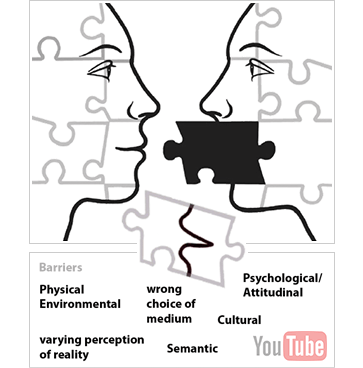
Effective communication occurs when information sharing results in a desired effect, such as eliciting change, generating action, creating understanding, or communicating a certain idea or point of view. This effect also ensures that messages are not distorted during the communication process. When the desired effect is not achieved, factors such as barriers to communication are explored, with the intention being to discover how the communication has been ineffective.
Barriers to effective communication can retard or distort the message and intention of the message being conveyed which may result in failure of the communication process or an effect that is undesirable. They include filtering, selective perception, information overload, emotions, language, silence, communication apprehension, gender differences and political correctness. Another common barrier is a lack of ‘knowledge-appropriate’ communication, which occurs when a person uses ambiguous or complex legal words, medical jargon, or descriptions of a situation or environment that is not understood by the recipient.
read more »
Posted in Language |
Leave a Comment »
January 31, 2015

To see a man about a dog (or see a man about a horse) is an English language colloquialism, usually used as a way to say one needs to apologize for one’s imminent departure or absence – generally euphemistically to conceal one’s true purpose, such as going to use the toilet or going to buy a drink (particularly during Prohibition). The original, non-facetious meaning was probably to place or settle a bet on a racing dog.
The earliest confirmed publication is the 1866 Dion Boucicault play ‘Flying Scud’ in which a character knowingly breezes past a difficult situation saying, ‘Excuse me Mr. Quail, I can’t stop; I’ve got to see a man about a dog.’ In a listing for a 1939 revival on the NBC Radio program ‘America’s Lost Plays,’ ‘Time’ magazine observed that the phrase was the play’s ‘claim to fame.’
Posted in Humor, Language |
Leave a Comment »
January 30, 2015
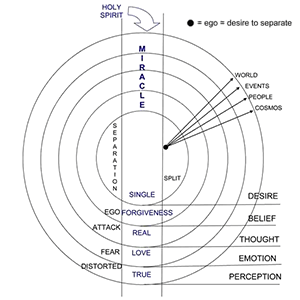
‘A Course in Miracles‘ (ACIM or simply the ‘Course’) is a book written and edited by psychologist Helen Schucman, with portions transcribed and edited by psychologist William Thetford, containing a self-study curriculum of spiritual transformation. It consists of three sections entitled ‘Text,’ ‘Workbook,’ and ‘Manual for Teachers.’ Written from 1965 to 1972, some distribution occurred via photocopies before a hardcover edition was published in 1976. The copyright and trademarks, which had been held by two foundations, were revoked in 2004 after a lengthy litigation because the earliest versions had been circulated without a copyright notice.
Schucman believed that an ‘inner voice,’ which she identified as Jesus, guided her writing. Throughout the 1980s annual sales of the book steadily increased each year, however the largest growth in sales occurred in 1992 after spiritual teacher Marianne Williamson discussed the book on ‘The Oprah Winfrey Show,’ with more than two million volumes sold. The book has been called everything from ‘a Satanic seduction’ to ‘The New Age Bible.’
read more »
Posted in Language, Philosophy |
1 Comment »
December 17, 2014

An argot [ahr-goh] is a secret language used by various groups — e.g. schoolmates, outlaws, colleagues, among many others — to prevent outsiders from understanding their conversations. The term is also used to refer to the informal specialized vocabulary from a particular field of study, occupation, or hobby, in which sense it overlaps with jargon (non-standard definitions). French author Victor Hugo was one of the first to research argot extensively. He describes it in his 1862 novel ‘Les Misérables’ as the language of the dark; at one point, he says, ‘What is argot; properly speaking? Argot is the language of misery.’ The earliest known record of the term in this context was in a 1628 document. The word was probably derived from the contemporary name, ‘les argotiers,’ given to a group of thieves at that time.
Under the strictest definition, an argot is a proper language, with its own grammar and style. But such complete secret languages are rare, because the speakers usually have some public language in common, on which the argot is largely based. Such argots are mainly versions of another language, with a part of its vocabulary replaced by words unknown to the larger public; argot used in this sense is synonymous with cant language, such as verlan and louchébem (similar to Pig Latin), which retain French syntax and apply transformations only to individual words (and often only to a certain subset of words, such as nouns, or semantic content words). Such systems are examples of ‘argots à clef,’ or ‘coded argots.’ Specific words can go from argot into common speech or the other way. For example, modern French ‘loufoque’ (‘crazy, goofy’), now common usage, originates in the louchébem transformation of ‘fou'(‘crazy’). ‘Piaf’ is a Parisian argot word for ‘bird, sparrow’ taken up by the singer Edith Piaf as her stage name.
Posted in Games, Language, World |
Leave a Comment »
December 17, 2014

Louchébem [loo-shuh-behm] is Parisian and Lyonnaise butchers’ (French boucher) slang, similar to Pig Latin and Verlan. It originated in the mid-19th century and was in common use until the 1950s. Each word is transformed by moving the first consonant to the end; and suffixes such as -ème, -ji, -oc, -muche are added at the end; the letter ‘L’ is placed at the beginning of the new word. Note that spelling often becomes phoneticized.
Even today, Louchébem is still well-known and used among those working at point-of-sale in the meat retail industry. Some words have even leaked into common, everyday use by the masses; an example is the word ‘loufoque,’ meaning unsound of mind. In 1937, English novelist E.C. Bentley used the language as a plot point in his short story, ‘The Old-Fashioned Apache.’
Posted in Games, Language, World |
Leave a Comment »
December 16, 2014

Jargon [jahr-guhn], or term of art, is ‘the technical terminology or characteristic idiom of a special activity or group.’ The word ‘jargon’ is French and is believed to have been derived from the Latin ‘gaggire,’ meaning ‘to chatter,’ which was used to describe something in which the speaker did not understand.
An ‘industry term’ is jargon that is associated with one particular industry. Jargon is similar to slang, both are non-standard definitions often created by and for subcultures. It is also common for each generation to create their own jargon. Whether this is because they want to identify with each other and thus create a language of their own, or conversely, if they deliberately do not want to be understood by anybody else (e.g. texting slang used by teens to communicate messages their parents won’t be able to translate).
read more »
Posted in Language, Money, Technology |
Leave a Comment »
December 15, 2014

Creolization [kree-uh-lahy-zey-shuhn] is the process of two or more cultures mixing, as happened in in the Americas between people of indigenous, African, and European descent. Creolization is traditionally used to refer to the Caribbean but can be extended to represent other diasporas. The mixing of populations creates a cultural melting pot which ultimately leads to the formation of new identities. Creolization also is the mixing of the ‘old’ and ‘traditional,’ with the ‘new’ and ‘modern.’
Furthermore, creolization occurs when participants actively select cultural elements that may become part of or inherited culture. Social scientist Robin Cohen states that Creolization is a condition in which ‘the formation of new identities and inherited culture evolve to become different from those they possessed in the original cultures,’ and then creatively merge these to create new varieties that supersede the prior forms.
read more »
Posted in Language, Politics, World |
1 Comment »
December 12, 2014

Knocking on wood, or to touch wood, refers to the apotropaic tradition (a ritual intended to ward off evil) of literally touching, tapping, or knocking on wood, or merely stating that you are doing or intend same, in order to avoid ‘tempting fate’ after making a favorable observation, a boast, or declaration concerning one’s own death or other situation beyond one’s control. The origin of this may be in Germanic folklore, wherein dryads (forest spirits) are thought to live in trees, and can be invoked for protection.
In Italy, ‘tocca ferro’ (‘touch iron’) is used, especially after seeing an undertaker or something related to death. In Iran, ‘bezan be takhteh’ (‘knock on the wood’) is said. The ‘evil eye,’ and being jinxed are common phobias and superstitions in Iranian culture. In old English folklore, ‘knocking on wood’ also referred to when people spoke of secrets – they went into the isolated woods to talk privately and ‘knocked’ on the trees when they were talking to hide their communication from evil spirits who would be unable to hear when they knocked. Another version holds that the act of knocking was to perk up the spirits to make them work in the requester’s favor. Yet another version holds that a sect of Monks who wore large wooden crosses around their necks would tap or ‘knock’ on them to ward away evil.
Posted in Language, Philosophy, World |
Leave a Comment »
December 10, 2014

Handedness [han-did-nis] is a better (faster or more precise) performance or individual preference for use of a hand. It is not a discrete variable (right or left), but a continuous one that can be expressed at levels between strong left and strong right. While in an ordinary disclosure the terms left and right are used to define handedness, there are actually four types: left-handedness, right-handedness, mixed-handedness (favoring one hand for some tasks and the other hand for others), and ambidexterity (equally adept with both hands). Left-handedness is somewhat more common among men.
Global studies indicate that 10% of people are left-handed, 30% are mixed-handed, and the remainder are right-handed. Ambidexterity is exceptionally rare, although it can be learned. However, a truly ambidextrous person is able to do any task equally well with either hand, whereas those who learn it still tend to favor their originally dominant hand. Ambilevous or ambisinister people demonstrate awkwardness with both hands. Parkinson’s disease in particular is associated with a loss of dexterity.
read more »
Posted in Health, Language, Science |
Leave a Comment »
December 9, 2014

Lumpers and splitters are opposing factions in any discipline which has to place individual examples into rigorously defined categories. The lumper-splitter problem occurs when there is the need to create classifications and assign examples to them, for example schools of literature, biological taxa and so on. ‘Lumpers’ take a gestalt view (looking at the whole rather than the parts) and assign examples broadly, assuming that differences are not as important as signature similarities. ‘Splitters’ prefer precise definitions, and create new categories to classify things that don’t fit perfectly within an existing group.
The earliest use of these terms was by Charles Darwin, in a letter to botanist J. D. Hooker in 1857: ‘Those who make many species are the ‘splitters,’ and those who make few are the ‘lumpers.’ They were introduced more widely by paleontologist George G. Simpson in his 1945 work ‘The Principles of Classification and a Classification of Mammals.’ As he put it, ‘splitters make very small units – their critics say that if they can tell two animals apart, they place them in different genera … and if they cannot tell them apart, they place them in different species. … Lumpers make large units – their critics say that if a carnivore is neither a dog nor a bear, they call it a cat.’
read more »
Posted in Language, Philosophy, Science |
Leave a Comment »


 The Daily Omnivore