April 17, 2013
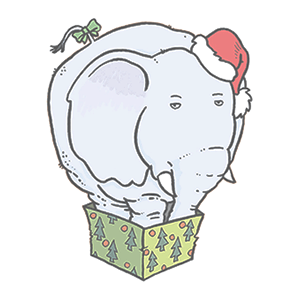
A white elephant is an idiom for a valuable but burdensome possession of which its owner cannot dispose and whose cost (particularly cost of upkeep) is out of proportion to its usefulness or worth. The term derives from the story that the kings of Siam (now Thailand) were accustomed to make a present of one of these animals to courtiers who had rendered themselves obnoxious, in order to ruin the recipient by the cost of its maintenance. In modern usage, it is an object, scheme, business venture, facility, etc., considered to be without use or value.
The term derives from the sacred white elephants kept by Southeast Asian monarchs in Burma, Thailand, Laos, and Cambodia. To possess a white elephant was regarded (and is still regarded in Thailand and Burma) as a sign that the monarch reigned with justice and power, and that the kingdom was blessed with peace and prosperity.
read more »
Posted in Language, Philosophy |
Leave a Comment »
April 16, 2013
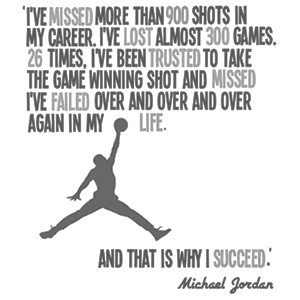
Failure is the state or condition of not meeting a desirable or intended objective, and may be viewed as the opposite of success. Product failure ranges from failure to sell the product to fracture of the product, in the worst cases leading to personal injury, the province of forensic engineering. Former IBM CEO Thomas J. Watson is attributed with saying ‘If you want to succeed, double your failure rate.’ ‘
Wired Magazine’ editor Kevin Kelly likewise explains that a great deal can be learned from things going unexpectedly, and that part of science’s success comes from keeping blunders ‘small, manageable, constant, and trackable.’ He uses the example of engineers and programmers who push systems to their limits, breaking them to learn about them. Kelly also warns against creating a culture (e.g. school system) that punishes failure harshly, because this inhibits a creative process, and risks teaching people not to communicate important failures with others (e.g. Null results).
read more »
Posted in Language, Money, Science |
Leave a Comment »
April 16, 2013
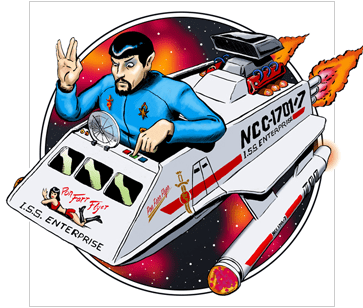
The evil twin is an antagonist found in many different fictional genres. They are physical copies of protagonists, but with radically inverted moralities. In filmed entertainment, they can have obvious physical differences with the protagonist—such as facial hair (often a goatee), eyepatches, scars or distinctive clothing—that make it easy for the audience to visually identify the two characters. Sometimes, however, the physical differences between the characters will be minimized, so as to confuse the audience. Both roles are almost always played by either the same actor or the actor’s actual twin (if the actor has one).
Though there may be moral disparity between actual biological twins, the term is more often a misnomer. In many cases, the two look-alikes are not actually twins, but rather physical duplicates produced by other phenomena (e.g. alternate universes). In others, the so-called ‘evil’ twin is more precisely a dual opposite to their ‘good’ counterpart, possessing at least some commonality with the value system of the protagonist.
read more »
Posted in Humor, Language, Philosophy |
Leave a Comment »
April 16, 2013
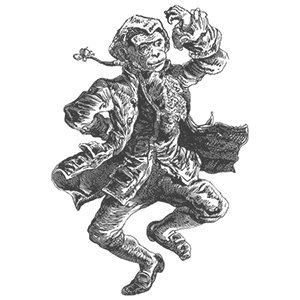
Signifyin’ (vernacular) is a practice in African-American culture, involving a verbal strategy of indirection that exploits the gap between the denotative and figurative meanings of words. According to African-American literary scholar Henry Louis Gates Jr., the practice derived from the Trickster archetype found in much African mythology, folklore, and religion: a god, goddess, spirit, man, woman, or anthropomorphic animal who plays tricks or otherwise disobeys normal rules and societal norms. In practice, signifyin’ often takes the form of quoting from subcultural vernacular, while extending the meaning at the same time through a rhetorical figure.
The expression itself derives from the numerous tales about the Signifying Monkey, a folk trickster figure said to have originated during slavery in the United States. In most of these narratives, the Monkey manages to dupe the powerful Lion by signifying. Signifyin(g) directs attention to the connotative, context-bound significance of words, which is accessible only to those who share the unique cultural values of a given speech community.
read more »
Posted in Humor, Language, Politics |
Leave a Comment »
April 15, 2013

The Signifying Monkey is a character of African-American folklore that derives from the trickster figure of Yoruba mythology, Esu Elegbara. This character was transported with Africans to the Americas under the names of Exu, Echu-Elegua, Papa Legba, and Papa Le Bas. Esu and his variants all serve as messengers who mediated between the gods and men by means of tricks. The Signifying Monkey is ‘distinctly Afro-American’ but is thought to derive from Yoruban mythology, which depicts Echu-Elegua with a monkey at his side.
Numerous songs and narratives concern the Signifying Monkey and his interactions with his friends, the Lion and the Elephant. In general the stories depict the Signifying Monkey insulting the Lion, but claiming that he is only repeating the Elephant’s words. The Lion then confronts the Elephant, who soundly beats the Lion. The Lion later comes to realize that the Monkey has been signifyin(g) and has duped him and returns angrily. The Signifying Monkey is a classic routine originally on a comedy album by Rudy Ray Moore.
Posted in Humor, Language |
Leave a Comment »
April 15, 2013
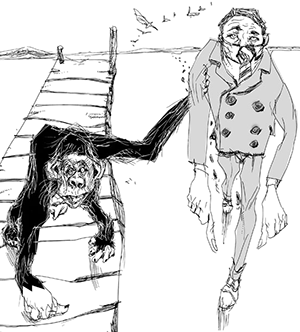
‘The Signifying Monkey: A Theory of African-American Literary Criticism’ is a work of literary criticism and theory by American scholar Henry Louis Gates Jr. first published in 1988. The book traces the folkloric origins of the African-American cultural practice of ‘signifying” and uses the concept to analyze the interplay between texts of prominent African American writers, specifically Richard Wright, Ralph Ellison, Zora Neale Hurston and Ishmael Reed.
Signifyin(g) is closely related to double-talk and trickery of the type used by the Monkey of these narratives, but, as Gates himself admits, ‘It is difficult to arrive at a consensus of definitions of signifyin(g).’ Bernard W. Bell defines it as an ‘elaborate, indirect form of goading or insult generally making use of profanity.’ Roger D. Abrahams writes that to signify is ‘to imply, goad, beg, boast by indirect verbal or gestural means.’ Signifyin(g) is a homonym with the concept of signification put forth by Semiotician Ferdinand de Saussure wherein the signifier (sound image) interacts with the signified (concept) to form one whole linguistic sign. Gates plays off this homonym and incorporates the linguistic concept of signifier and signified with the vernacular concept of signifyin(g).
read more »
Posted in Humor, Language, Politics |
Leave a Comment »
April 11, 2013
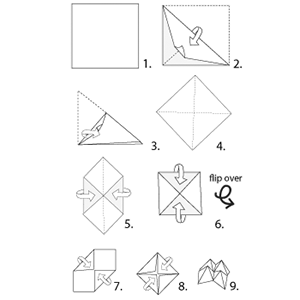
Querent [kweer-ent] as ‘one who seeks’ is derived, according to the Oxford English Dictionary, from the Latin word for ‘to seek, gain, ask.’ Querent denotes ‘a person who questions an Oracle,’ usually for otherworldly advice. This oracle may simply be a divinatory technique, such as the I Ching, that is manipulated by the Querent themselves without recourse to any other human agency. Alternatively it may involve another person, someone perhaps seen as a ‘fortune teller’ — particularly a Practitioner of Tarot reading or other form of Mediumship — from whom advice is sought.
The mindset of a Querent plays a significant role in a reading. Those who approach a reading with heavy skepticism, especially if they are dealing with a human oracle, are often unwilling to engage the Reader at all, which can result in a stifling of the prophetic flow that is required for divination. Conversely, some approach with great respect, as if they predetermine that the Diviner or the system of divination is influence by some kind of higher, even divine, power and thereby will believe virtually anything they are told. A third ideal group will talk freely with a human oracle and accept their advice with a healthy dose of skepticism, yet still remain open minded to the possibility of revelation.
Posted in Language, Philosophy |
Leave a Comment »
April 10, 2013
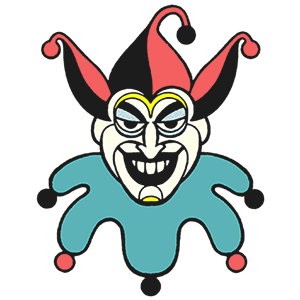
The Joker is a special type of playing card found in most modern decks, or else a type of tile in some Mahjong game sets, specifically used in the American version of Mahjong. It is believed that the term ‘Joker’ comes from ‘Jucker,’ the original German spelling of ‘Euchre,’ (a trick-taking card game for which the Joker card was invented).
The card was originally introduced in about 1860 to be used as the highest trump. Catherine Perry Hargrave documents jokers from 1862 and 1865 in her book ‘A History of Playing Cards.’ The 1862 card has a tiger on it and the label ‘Highest Trump,’ while the one from 1865 is inscribed ‘This card takes either Bower’ and ‘Imperial Bower,’ or ‘Highest Trump Card.’
read more »
Posted in Games, Humor, Language |
1 Comment »
April 9, 2013

Building Stories is a 2012 graphic novel by American cartoonist Chris Ware. The unconventional work is made up of fourteen printed works—cloth-bound books, newspapers, broadsheets and flip books—packaged in a boxed set.
The work took a decade to complete, and was published by Pantheon Books. The intricate, multilayered stories pivot around an unnamed female protagonist with a missing leg. It mainly focuses on her time in a three-story brownstone apartment building in Chicago, but follows her later in her life as a mother. The parts of the work can be read in any order.
read more »
Posted in Art, Language |
Leave a Comment »
April 9, 2013

Franklin Christenson Ware (b. 1967), known professionally as Chris Ware, is an American comic book artist and cartoonist, notable for his ‘Acme Novelty Library’ series and the graphic novels ‘Jimmy Corrigan, the Smartest Kid on Earth,’ and ‘Building Stories.’ His works explore themes of social isolation, emotional torment and depression.
His works tend to use a vivid color palette and are full of realistic, meticulous detail. His lettering and images are often elaborate and sometimes evoke the ragtime era or another early 20th-century American design style. Ware often refers to himself in the publicity for his work in self-effacing, even withering tones. He is considered by some critics and fellow notable illustrators and writers, such as Dave Eggers, to be among the best currently working in the medium.
read more »
Posted in Art, Humor, Language |
1 Comment »
April 9, 2013

Culinary name is the name of an ingredient when used in the kitchen for preparing food, as opposed to their names in agriculture or in scientific nomenclature. Some are used because they sounds more attractive than the real name, or because a cheaper ingredient can be linked with a more expensive one. The culinary name may also refer to a way of cooking or to a region, or using a particular ingredient.
Additionally, name given on a menu may be different from the culinary name. For example, from the 19th until the mid-20th century, many restaurant menus were written in French and not in the local language. Examples include veal (calf), calamari (squid), scampi (Italian-American name for shrimp), and sweetbreads (pancreas or thymus gland). Culinary names are especially common for fish and seafood, where multiple species are marketed under a single familiar name.
read more »
Posted in Food, Language, Money |
Leave a Comment »
April 3, 2013
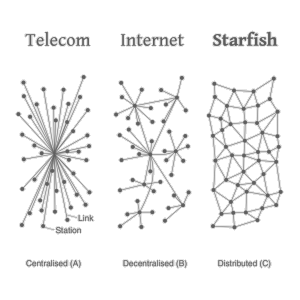
‘The Starfish and the Spider: The Unstoppable Power of Leaderless Organizations’ is a 2006 book by Ori Brafman (author of the 2010 book ‘Click: The Magic of Instant Connections’) and Rod Beckstrom (President of ICANN); it is an exploration of the implications of the recent rise of decentralized organizations such as Wikipedia, Grokster and YouTube.
The book contrasts them to centralized organizations, such as Encyclopædia Britannica. The spider and starfish analogy refers to the contrasting biological nature of the respective organisms, starfish have a decentralized neural structure permitting regeneration, whereas spiders have in a hierarchical nervous system.
read more »
Posted in Language, Money, Technology |
Leave a Comment »


 The Daily Omnivore