January 23, 2013
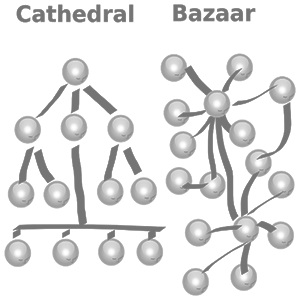
‘The Cathedral and the Bazaar: Musings on Linux and Open Source by an Accidental Revolutionary’ is an essay by Eric S. Raymond on software engineering methods, based on his observations of the Linux kernel development process and his experiences managing an open source project, fetchmail. It examines the struggle between top-down and bottom-up design. It was first presented by the author at the Linux Kongress in 1997 in Germany and was published as part of a book of the same name in 1999.
The essay contrasts two different free software development models: the Cathedral model, in which source code is available with each software release, but code developed between releases is restricted to an exclusive group of software developers. And, the Bazaar model, in which the code is developed over the Internet in view of the public. Raymond credits Linus Torvalds, leader of the Linux kernel project, as the inventor of this process. Raymond also provides anecdotal accounts of his own implementation of this model for the Fetchmail project.
read more »
Posted in Language, Technology |
Leave a Comment »
January 21, 2013

JSTOR (short for Journal Storage) is a digital library founded in 1995. Originally containing digitized back issues of academic journals, it now also includes books and primary sources, and current issues of journals. It provides full-text searches of more than a thousand journals. More than 7,000 institutions in more than 150 countries have access to JSTOR. Most access is by subscription, but some old public domain content is freely available to anyone, and in 2012 JSTOR launched a program providing limited no-cost access to old articles for individual scholars and researchers who register.
JSTOR’s founder was William G. Bowen the president of Princeton University from 1972 to 1988. JSTOR was originally conceived as a solution to one of the problems faced by libraries, especially research and university libraries, due to the increasing number of academic journals in existence. Most libraries found it prohibitively expensive in terms of cost and space to maintain a comprehensive collection of journals. By digitizing many journal titles, JSTOR allowed libraries to outsource the storage of these journals with the confidence that they would remain available for the long term. Online access and full-text search ability improved access dramatically.
read more »
Posted in Education, Language, Technology |
Leave a Comment »
January 19, 2013

Stuff You Should Know, often abbreviated as SYSK, is a free podcast published by Discovery Communications via its HowStuffWorks website and hosted by Josh Clark and Chuck Bryant, both writers at HowStuffWorks. Clark has been a mainstay on the podcast since it began in 2008. The podcast, released every Tuesday and Thursday, educates listeners on a wide variety of topics, often using popular culture as a reference giving the podcast comedic value.
Episodes are normally around 30 minutes in length, although for more in-depth topics the show has run as long as an hour. Initial episodes were much shorter in duration, often less than 10 minutes. The podcast covers a variety of odd questions and topics, like ‘How Twinkies Work,’ ‘Do Zombies Exist?,’ ‘How Tickling works,’ and ‘How Albert Einstein’s Brain Worked.’
read more »
Posted in Education, Humor, Language |
Leave a Comment »
January 17, 2013

The phrase ‘mind’s eye‘ refers to the human ability for visualization, i.e., for the experiencing of visual mental imagery; in other words, one’s ability to ‘see’ things with the mind. The biological foundation of the mind’s eye is not fully understood. fMRI studies have shown that the lateral geniculate nucleus (in the thalamus) and the V1 area of the visual cortex are activated during mental imagery tasks.
Harvard Medical School psychiatrist John Ratey writes: ‘The visual pathway is not a one-way street. Higher areas of the brain can also send visual input back to neurons in lower areas of the visual cortex… As humans, we have the ability to see with the mind’s eye – to have a perceptual experience in the absence of visual input. For example, PET scans have shown that when subjects, seated in a room, imagine they are at their front door starting to walk either to the left or right, activation begins in the visual association cortex, the parietal cortex, and the prefrontal cortex – all higher cognitive processing centers of the brain.’
read more »
Posted in Health, Language, Philosophy |
Leave a Comment »
January 10, 2013

Bicameralism [bahy-kam-er-uhl-iz-uhm] (the philosophy of ‘two-chamberedness’) is a hypothesis in psychology that argues that the human brain once assumed a state in which cognitive functions were divided between one part of the brain which appears to be ‘speaking,’ and a second part which listens and obeys—a bicameral mind.
The term was coined by psychologist Julian Jaynes, who presented the idea in his 1976 book ‘The Origin of Consciousness’ in the Breakdown of the Bicameral Mind,’ wherein he made the case that a bicameral mentality was the normal and ubiquitous state of the human mind only as recently as 3000 years ago. Jaynes saw bicamerality as primarily a metaphor. He used governmental bicameralism to describe a mental state in which the experiences and memories of the right hemisphere of the brain are transmitted to the left hemisphere via auditory hallucinations.
read more »
Posted in Health, Language, Philosophy |
Leave a Comment »
January 10, 2013

Piphilology [pahy-fi-lol-uh-jee] comprises the creation and use of mnemonic techniques to remember a span of digits of the mathematical constant π. The word is a play on the word ‘pi’ itself and of the linguistic field of philology (the study of written language).
There are many ways to memorize π, including the use of piems (a portmanteau, formed by combining pi and poem), which are poems that represent π in a way such that the length of each word (in letters) represents a digit.
read more »
Posted in Education, Games, Language |
Leave a Comment »
January 10, 2013

‘Moonwalking with Einstein: The Art and Science of Remembering Everything’ is a nonfiction book by Joshua Foer, first published in 2011. Foer describes his book as participatory journalism in the world of competitive memorization and attempts to delineate the capacity of the human mind. He sets out to investigate the underpinnings of those with enhanced memory, soon finding himself at the 2005 U.S. Memory Championship.
He covers the scientific basis of memory creation and historical attitudes towards memory, including its negative reputation in the Western educational system, a perception which Foer is largely opposed to. He explores common mnemonic tools for improving memory: the techniques of Roman rhetoricians and the tannaim (‘reciters’) of Sri Lanka, the Major System and the PAO System for memorizing numbers and cards, and Mind Mapping, a note-taking technique developed by educational consultant Tony Buzan. These methods are all a form of the method of loci, in which data is stored in a sequence of memorable images that are decomposable into their original form.
read more »
Posted in Education, Games, Language |
Leave a Comment »
January 9, 2013

‘Burning Chrome‘ is a short story, written by William Gibson and first published in ‘Omni’ in 1982. Gibson first read the story at a science fiction convention in Denver in the autumn of 1981, to an audience of four people, among them Bruce Sterling (who Gibson later said ‘completely got it’). It was collected with the rest of Gibson’s early short fiction in a 1986 volume of the same name.
‘Burning Chrome’ tells the story of two hackers who breaking into computer systems for profit. The two main characters are Bobby Quine who specializes in software and Automatic Jack whose field is hardware. A third character in the story is Rikki, a girl with whom Bobby becomes infatuated and for whom he wants to become wealthy. Automatic Jack acquires a piece of Russian hacking software that is very sophisticated and hard to trace. The rest of the story unfolds with Bobby deciding to break into the system of a notorious and vicious criminal called Chrome, who handles money transfers for organized crime, and Automatic Jack reluctantly agreeing to help.
read more »
Posted in Art, Language, Technology |
Leave a Comment »
January 9, 2013

‘Neuromancer‘ is a 1984 novel by William Gibson, a seminal work in the cyberpunk genre and winner of the science-fiction ‘triple crown’ — the Nebula Award, the Philip K. Dick Award, and the Hugo Award. It was Gibson’s first novel and the beginning of the ‘Sprawl’ trilogy (which takes place in a near-future world dominated by corporations and ubiquitous technology, after a limited World War III).
The novel tells the story of a washed-up computer hacker hired by a mysterious employer to work on a dangerous hack. ‘Neuromancer’ is considered the archetypal cyberpunk work. Gibson himself coined the term ‘cyberspace’ in his novelette ‘Burning Chrome,’ published in 1982 by ‘Omni’ magazine.
read more »
Posted in Art, Language, Technology |
Leave a Comment »
January 8, 2013

Fear and Loathing: On the Campaign Trail ’72 is a collection of articles covering the 1972 presidential campaign written by Hunter S. Thompson and illustrated by Ralph Steadman. The articles were first serialized in ‘Rolling Stone’ magazine throughout 1972 and later released as a book in early 1973. The book focuses almost exclusively on the Democratic Party’s primaries and the breakdown of the party as it splits between the different candidates.
Of particular focus is the manic maneuvering of the George McGovern campaign during the Miami convention as they sought to ensure the Democratic nomination despite attempts by the Hubert Humphrey campaign and other candidates to block McGovern. Thompson began his coverage of the campaign in December 1971, just as the race toward the primaries was beginning, from a rented apartment in Washington, DC (a situation he compared to ‘living in an armed camp, a condition of constant fear’). Over the next 12 months, in voluminous detail, he covered every aspect of the campaign, from the smallest rally to the raucous conventions.
read more »
Posted in Humor, Language, Politics |
Leave a Comment »
January 8, 2013
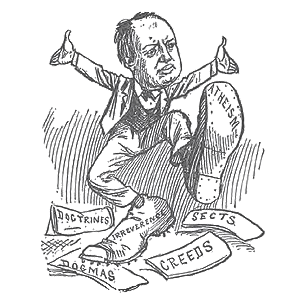
Robert Ingersoll (1833 – 1899) was a Civil War veteran, American political leader, and orator during the Golden Age of Freethought, noted for his broad range of culture and his defense of agnosticism. He was nicknamed ‘The Great Agnostic.’ He was born in upstate New York.
His father, John, was an abolitionist-leaning Congregationalist preacher, whose radical views forced his family to move frequently. For a time, Rev. Ingersoll filled the pulpit for American revivalist Charles G. Finney while Finney was on a tour of Europe. Upon Finney’s return, Rev. Ingersoll remained for a few months as co-pastor/associate pastor under Finney.
read more »
Posted in Language, Philosophy, Politics |
Leave a Comment »
January 8, 2013

Mottainai is a Japanese term meaning ‘a sense of regret concerning waste when the intrinsic value of an object or resource is not properly utilized.’
The expression can be uttered alone as an exclamation when something useful, such as food or time, is wasted, meaning roughly ‘Oh, what a waste!’ In addition to its primary sense of ‘wasteful,’ the word is also used to mean ‘impious; irreverent’ or ‘more than one deserves.’
read more »
Posted in Language, Money, World |
1 Comment »


 The Daily Omnivore