April 26, 2012

Vocaloid is a singing synthesizer. Its signal processing part was developed through a joint research project led by Kenmochi Hideki at the Pompeu Fabra University in Spain in 2000. Backed by the Yamaha Corporation it was developed into a commercial product, which was first released in 2004. The software enables users to synthesize singing by typing in lyrics and melody. It uses synthesizing technology with specially recorded vocals of voice actors or singers. A piano roll type interface is used to input the melody and the lyrics can be entered on each note. The software can change the stress of the pronunciations, add effects such as vibrato, or change the dynamics and tone of the voice.
Each Vocaloid is sold as ‘a singer in a box’ designed to act as a replacement for an actual singer. The software was originally only available in English and Japanese, but as of Vocaloid 3, Spanish, Chinese, and Korean have been added. The software is intended for professional musicians as well as light computer music users and has so far sold on the idea that the only limits are the users’ own skills. Japanese musical groups Livetune and Supercell have released their songs featuring Vocaloid as vocals. Japanese record label Exit Tunes of Quake Inc. also have released compilation albums featuring Vocaloids. Artists such as Mike Oldfield have also used Vocaloids within their work for back up singer vocals and sound samples.
read more »
Posted in Language, Money, Technology |
Leave a Comment »
April 26, 2012

Foreign Accent Syndrome is a rare medically recognised condition which is a speech impediment that usually occurs as a resulting side effect of brain injury, such as a stroke or head trauma. As a result of the speech impediment those suffering from the Foreign Accent Syndrome pronounce their native language with an accent that to the ear of the listeners may be mistaken as foreign or dialectical.
It has many other impacts and effects, including poor memory and concentration span, as well as a feeling of loss of identity, potentially causing those affected to go through a bereavement process. Two cases have been reported of individuals with the condition as a development problem and one associated with severe migraine. Between 1941 and 2009 there have been sixty recorded cases.
read more »
Posted in Health, Language, World |
Leave a Comment »
April 26, 2012

Clay Shirky (b. 1964) is an American writer, consultant, and teacher on the social and economic effects of Internet technologies. He has a joint appointment at NYU as a Distinguished Writer in Residence at the Arthur L. Carter Journalism Institute and Assistant Arts Professor in the New Media focused graduate Interactive Telecommunications Program (ITP). His courses address, among other things, the interrelated effects of the topology of social networks and technological networks, how our networks shape culture and vice-versa.
Shirky divides his time between consulting, teaching, and writing on the social and economic effects of Internet technologies. His consulting practice is focused on the rise of decentralized technologies such as peer-to-peer, web services, and wireless networks that provide alternatives to the wired client–server infrastructure that characterizes the World Wide Web. He is a member of the Wikimedia Foundation’s Advisory Board. In 2010, Kevin Kelly (founding executive editor of ‘Wired’ magazine) cited the phrase ‘Institutions will try to preserve the problem to which they are the solution,’ and called it the ‘Shirky Principle,’ as the phrasing reminded him of the clarity of the Peter Principle.
read more »
Posted in Language, Politics, Technology |
Leave a Comment »
April 24, 2012

Automated essay scoring (AES) is the use of specialized computer programs to assign grades to essays written in an educational setting. It is a method of educational assessment and an application of natural language processing. Its objective is to classify a large set of textual entities into a small number of discrete categories, corresponding to the possible grades—for example, the numbers 1 to 6. Therefore, it can be considered a problem of statistical classification.
Several factors have contributed to a growing interest in AES. Among them are cost, accountability, standards, and technology. Rising education costs have led to pressure to hold the educational system accountable for results by imposing standards. The advance of information technology promises to measure educational achievement at reduced cost.
read more »
Posted in Education, Language, Technology |
Leave a Comment »
April 23, 2012

Élan vital [ey-lahn vee-tal] was coined by French philosopher Henri Bergson in his 1907 book ‘Creative Evolution,’ in which he addresses the question of self-organization and spontaneous morphogenesis of things in an increasingly complex manner. Elan vital was translated in the English edition as ‘vital impetus,’ but is usually translated by his detractors as ‘vital force.’ It is a hypothetical explanation for evolution and development of organisms, which Bergson linked closely with consciousness.
It was believed by others that this essence (élan vital) could be harvested and embedded into an inanimate substance and activated with electricity, perhaps taking literally another of Bergson’s metaphorical descriptions, the ‘current of life.’ British biologist Julian Huxley remarked that Bergson’s élan vital is no better an explanation of life than is explaining the operation of a railway engine by its ‘élan locomotif’ (‘locomotive driving force’). The same epistemological fallacy is parodied in Molière’s ‘Le Malade imaginaire,’ where a quack ‘answers’ the question of ‘Why does opium cause sleep?’ with ‘Because of its soporific [sleep-inducing] power.’
read more »
Posted in Language, Politics |
Leave a Comment »
April 23, 2012

In William Gibson’s fiction, the Sprawl is a colloquial name for the Boston-Atlanta Metropolitan Axis (BAMA), an urban sprawl environment on a massive scale, and a fictional extension of the real Northeast Megalopolis. The novels ‘Neuromancer’ (1984), ‘Count Zero’ (1986), and ‘Mona Lisa Overdrive’ (1988) (collectively known as the Sprawl trilogy) take place in this environment, as do the short stories ‘Johnny Mnemonic,’ ‘New Rose Hotel,’ ‘Burning Chrome,’ and ‘Fragments of a Hologram Rose.’
The Sprawl is a visualization of a future where virtually the entire East Coast of the United States, from Boston to Atlanta, has melded into a single mass of urban sprawl. It has been enclosed in several geodesic domes and merged into one megacity. The city has become a separate world with its own climate, no real night/day cycle, and an artificial sky that is always grey. It is said of the Sprawl that ‘the actors change but the play remains the same.’
Posted in Art, Language, Technology |
Leave a Comment »
April 23, 2012
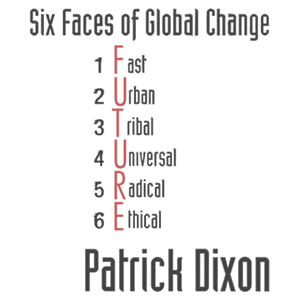
Futurewise is a book on global trends written by the futurist Patrick Dixon in 1998, with new editions in 2001, 2003, and 2007. ‘Futurewise’ contains over 500 expectations about what future life will be like, and divides future trends into six dimensions, which spell the word FUTURE: Fast (combinations of events bring new opportunities for agile leaders—and risks); Urban (demographics and lifestyle issues including megacities); Tribal (the most powerful force in the world today is tribalism—basis of culture, belonging, teams, brands); Universal (globalization at cost of local identity, risking international tensions, and the impact of the digital age); Radical (the rise of single issue activism and the death of left-right politics); and Ethical (the passions people have and personal values, including spirituality– the glue holding our future together)
A key thesis of ‘Futurewise’ is that the future is about emotion, and that emotional reactions to events are usually more important than the events themselves. Therefore a deep understanding is needed of how people are likely to feel in the future. The book also focuses on managing uncertainty. Risk management is a major challenge for all large corporations, including responding to wild cards – low probability but potentially high impact events.
Posted in Language, Politics, World |
Leave a Comment »
April 19, 2012

Rubyfruit Jungle is the first novel (1973) by Rita Mae Brown, remarkable, in its day, for its explicit lesbianism. The novel is a semi-autobiographical (some have suggested picaresque) account of Brown’s youth and emergence as a lesbian author. The term ‘ruby fruit jungle’ is slang for the female genitals. The novel focuses on Molly Bolt, the adopted daughter of a poor family, who possesses remarkable beauty and who is aware of her lesbianism from early childhood. The work is notable for being an early literary lesbian novel, as well as for Brown’s own activism in lesbian and feminist causes. Many lesbian readers have found in it a reflection of their own experiences and observations. While some now refer to it as ‘just another lesbian coming of age novel’ (Bildungsroman), its success is part of why the genre is now often considered a cliché.
In 1955, when Brown was 11 years old, her family moved to Fort Lauderdale where she attended high school and experimented sexually with boys and girls. When Brown was 16, her girlfriend’s father found her love letters, and Brown was dismissed from the student council. In the 1960s, Brown attended Broward Community College and the University of Florida, but she was expelled from UF for participating in a civil rights rally. She later moved to New York City, attended New York University, and received a degree in Classics and English. Later, she received another degree in Cinematography from the New York School of Visual Arts, and, in 1976, she received a doctorate in political science.
Posted in Language, Politics, Sex |
Leave a Comment »
April 17, 2012

Eric Klinenberg is an American sociologist and a scholar of urban studies, culture, and media. He is best known for his contributions as a public sociologist. He is currently Professor of Sociology, Public Policy, and Media, Culture, and Communications at New York University, as well as the editor of the journal ‘Public Culture.’ Klinenberg’s first book, ‘Heat Wave: A Social Autopsy of Disaster in Chicago,’ was published by the University of Chicago Press in 2002.
It was praised as ‘trenchant, persuasive tale of slow murder by public policy.’ Klinenberg’s second book, ‘Fighting for Air: The Battle to Control America’s Media,’ was called ‘a must-read for those who wonder what happened to good radio, accurate reporting and autonomous public interest.’ Since its publication, he has testified before the FCC and briefed Congress on his findings. His latest book, ‘Going Solo: The Extraordinary Rise and Surprising Appeal of Living Alone,’ was published in 2012.
Posted in Language, Politics, Science |
Leave a Comment »
April 17, 2012

The terms empathogen [em-path-uh-jen] and entactogen are used to describe a class of psychoactive drugs that produce distinctive emotional and social effects similar to those of MDMA (‘Ecstasy’) characterized by increased empathy (the ability to understand and share the feelings of another). Putative members of this class include 2C-B, 2C-I, MDMA, MDA, MDEA, MBDB, 2C-T-7, and 2C-T-2, among others.
The chemical structure of many entactogens contains a substituted amphetamine core, and most belong to the phenethylamine class of psychoactive drugs, although several (AET and AMT) are tryptamines. When referring to MDMA and its counterparts, the term ‘MDxx’ is often used with the exception of MDPV.
read more »
Posted in Drugs, Health, Language |
Leave a Comment »
April 14, 2012

Chironomia is the art of using gesticulations or hand gestures to good effect in traditional rhetoric or oratory. Effective use of the hands, with or without the use of the voice, is a practice of great antiquity, which was developed and systematized by the Greeks and the Romans. Various gestures had conventionalized meanings which were commonly understood, either within certain class or professional groups, or broadly among dramatic and oratorical audiences.
Gilbert Austin was a well-known author on chironomia, in the preface to his book on the subject, Austin writes: ‘…it is a fact, that we do not possess from the ancients, nor yet from the labors of our own countrymen, any sufficiently detailed and precise precepts for the fifth division of the art of rhetoric, namely rhetorical delivery, called by the ancients ‘actio’ and ‘pronuntiatio.”
read more »
Posted in Language, Philosophy, Science |
Leave a Comment »
April 13, 2012

A.C.A.B. stands for ‘All Cop[per]s Are Bastards.’ Dating from at least the 1940s, and used as a slogan during the UK miners’ strike, A.C.A.B. is an abbreviation often integrated into prison tattoos in the United Kingdom, it is most commonly rendered with one letter between the knuckle and first joint of each finger, alternatively sometimes seen as symbolic small dots across each knuckle.
The British Oi! punk band, the 4-Skins, popularized the acronym in their 1980s song of the same name. It is currently in common usage as a phrase and tattoo amongst some ultras ( a type of sports fans renowned for their fanatical and elaborate displays of ‘support’) groups in Europe, particularly in Eastern Europe where most groups are more akin to hooligans than ultras.
Posted in Language, Politics, World |
Leave a Comment »



