April 21, 2011

A diagnosis of exclusion (per exclusionem) is a medical condition whose presence cannot be established with complete confidence from examination or testing. Diagnosis is therefore by elimination of other reasonable possibilities. Perhaps the largest category of diagnosis by exclusion is seen among psychiatric disorders where the presence of physical or organic disease must be excluded as a prerequisite for making a functional diagnosis.
Diagnosis by exclusion tends to occur where scientific knowledge is scarce, specifically where the means to verify a diagnosis by an objective method is absent. As a specific diagnosis cannot be confirmed a fall back position is to exclude that group of known causes that may cause a similar clinical presentation.
read more »
Posted in Health, Language, Science |
Leave a Comment »
April 21, 2011

Mens rea [mens ray-uh] is Latin for ‘guilty mind.’ In jurisdictions with due process, there must be an actus reus (‘guilty act’) accompanied by some level of mens rea to constitute the crime with which the defendant is charge. As a general rule, criminal liability does not attach to a person who acted with the absence of mental fault. The exception is strict liability crimes.
In civil law, it is usually not necessary to prove a subjective mental element to establish liability for breach of contract or tort. However, if a tort is intentionally committed or a contract is intentionally breached, such intent may increase the scope of liability as well as the measure of damages payable to the plaintiff.
read more »
Posted in Language, Politics |
Leave a Comment »
April 21, 2011

The humanzee (or chuman) is a hypothetical chimpanzee/human hybrid. The chromosomal similarity of humans and chimps is roughly equivalent to that found in equines (horses, zebras, donkeys, etc.), leading to contested speculation that a hybrid is possible, though no specimen has ever been confirmed.
Geneticists adhere to the portmanteau word convention to indicate which species is the sire (e.g. tigon/liger) For geneticists, ‘Chuman’ therefore refers to a hybrid of male chimpanzee and female human, while ‘Humanzee’ refers to a hybrid of male human and female chimpanzee.
read more »
Posted in Language, Science, Sex |
1 Comment »
April 21, 2011

Transitional fossils are the fossilized remains of intermediary forms of life that illustrate an evolutionary transition. They can be identified by their retention of certain primitive traits in comparison with their more derived relatives. Numerous examples exist, including those of primates and early humans.
read more »
Posted in Language, Science |
Leave a Comment »
April 18, 2011

Genie is the pseudonym for Susan M. Wiley, a feral child who spent nearly all of the first thirteen years of her life locked inside a bedroom strapped to a potty chair. She was a victim of one of the most severe cases of social isolation in American history. Genie was discovered by Los Angeles authorities in 1970.
Genie’s discovery was compared extensively with that of Victor of Aveyron, about whom a film was made, ‘The Wild Child.’ Psychologists, linguists and other scientists exhibited great interest in the case due to its perceived ability to reveal insights into the development of language and linguistic critical periods.
read more »
Posted in Health, Language |
Leave a Comment »
April 13, 2011

Mod (from modernist) is a subculture that originated in London in the late 1950s and peaked in the early-to-mid 1960s. Significant elements include: fashion (often tailor-made suits), pop music (including African American soul, Jamaican ska, and British beat music and R&B), and Italian motor scooters.
The original scene was also associated with amphetamine-fueled all-night dancing at clubs. From the mid-to-late 1960s onwards, the mass media often used the term in a wider sense to describe anything that was believed to be popular, fashionable, or modern. There was a mod revival in the United Kingdom in the late 1970s, which was followed by a mod revival in North America in the early 1980s, particularly in Southern California.
read more »
Posted in Art, Drugs, Language |
Leave a Comment »
April 12, 2011

The Anthropocene [an-thruh-poh-seen] is a proposed geological epoch that marks the impact of human activities on the Earth’s ecosystems. The term was coined in 2000 by the Nobel Prize-winning atmospheric chemist Paul Crutzen, who regards the influence of human behavior on the Earth’s atmosphere in recent centuries as so significant as to constitute a new geological era for its lithosphere (the rigid outermost shell of a rocky planet). As early as 1873, the Italian geologist Antonio Stoppani acknowledged the increasing power and impact of humanity on the Earth’s systems and referred to the ‘anthropozoic era’
The Anthropocene has no precise start date, but based on atmospheric evidence may be considered to start with the Industrial Revolution (late 18th century). Other scientists link it to earlier events, such as the rise of agriculture. Human influence on land use, ecosystems, biodiversity and species extinctions, may have begun as early as 10,000 years before present. This period (10,000 years to present) is usually referred to as the Holocene by geologists. For the majority of the Holocene, human populations were relatively low and their activities considerably muted relative to that of the last few centuries. Nonetheless, many of the processes currently altering the Earth’s environment were already occurring.
Posted in Language, Science, Technology |
Leave a Comment »
April 12, 2011

Highway hypnosis, also popularly known as ‘driving without attention mode’ or ‘white line fever,’ is a mental state in which a person can drive a motor vehicle great distances, responding to external events in the expected manner with no recollection of having consciously done so. In this state the driver’s conscious mind is apparently fully focused elsewhere, with seemingly direct processing of the masses of information needed to drive safely. Highway hypnosis is just one manifestation of a relatively commonplace experience, where the conscious and unconscious minds appear to concentrate on different things.
Building on the theories of American psychologist, Ernest Hilgard (1904 – 2001), that hypnosis is an altered state of awareness, some theorists hold that the consciousness can develop hypnotic dissociation. In the example of highway hypnosis, one stream of consciousness is driving the car while the other stream of consciousness is dealing with other matters. Amnesia can even develop for the dissociated consciousness that drove the automobile. The phenomenon is an example of automaticity in cognitive psychology.
Posted in Health, Language, Science |
Leave a Comment »
April 12, 2011

Automaticity [aw-tuh-mah-tis-i-tee] is the ability to do things without occupying the mind with the low-level details required, allowing it to become an automatic response pattern or habit. It is usually the result of learning, repetition, and practice. Examples of automaticity are common activities such as speaking, bicycle-riding, assembly-line work, and driving a car.
After an activity is sufficiently practiced, it is possible to focus the mind on other activities or thoughts while undertaking an automaticized activity (for example, holding a conversation or planning a speech while driving a car). Walking is not an example of automaticity as it is not a cortical function. It is a medullary function, with specific medullary circuits, which can be learnt to be inhibited or altered by higher-order ones.
Posted in Health, Language, Science |
Leave a Comment »
April 11, 2011

A jinx [jingks], in popular superstition and folklore, is: a type of curse placed on a person that makes them prey to many minor misfortunes and other forms of bad luck; a person afflicted with a similar curse, who, while not directly subject to a series of misfortunes, seems to attract them to anyone in his vicinity; and an object/ person that brings bad luck.
Jinx is also a children’s game (although not necessarily played only by children) with myriad rules and penalties that occurs when two people unintentionally or intentionally speak (or type) the same word or phrase simultaneously.
read more »
Posted in Games, Humor, Language |
Leave a Comment »
April 11, 2011

Beginner’s luck refers to the supposed phenomenon of novices experiencing disproportionate frequency of success or succeeding against an expert in a given activity. One would expect experts to outperform novices – when the opposite happens it is counter-intuitive, hence the need for a term to describe this phenomenon.
The term is most often used in reference to a first attempt in sport or gambling, but is also used in many other diverse contexts. The term is also used when no skill whatsoever is involved, such as a first-time slot machine player winning the jackpot.
read more »
Posted in Games, Language, Philosophy |
Leave a Comment »
April 11, 2011
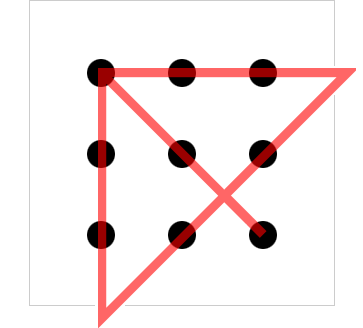
‘Thinking outside the box‘ is to think differently, unconventionally or from a new perspective. This is sometimes called a process of lateral thought. As catchphrase, or cliché, it has become widely used in business environments, especially by management consultants and executive coaches, and has spawned a number of advertising slogans. To think outside the box is to look further and to try not thinking of the obvious things, but to try thinking beyond them.
The origins of the phrase are obscure; but it was popularized in part because of a nine-dot puzzle, which British author, John Adair claims to have introduced in 1969. The puzzle proposed an intellectual challenge—to connect the dots by drawing four straight, continuous lines that pass through each of the nine dots, and never lifting the pencil from the paper. The conundrum is easily resolved, but only if you draw the lines outside the confines of the square area defined by the nine dots themselves.
Posted in Games, Language, Money |
Leave a Comment »



 The Daily Omnivore