February 16, 2011

Charles Saatchi (b. 1943) is the co-founder with his brother Maurice of the global advertising agency Saatchi & Saatchi, and led that business – the world’s largest advertising agency in the 1980s – until they were forced out in 1995. Later that year the Saatchi brothers formed a new agency called M&C Saatchi. Charles is the second of four sons born to a wealthy Iraqi Jewish family in Baghdad. The name ‘Saatchi’ means ‘Watchmaker’ in Turkish. He attended Christ’s College, a secondary school in North London. During this time he developed an obsession with U.S. pop culture, including the music of Elvis Presley, Little Richard, and Chuck Berry. He also manifested an enthusiasm for collections, from cigarette cards and jukeboxes to ‘Superman’ comics and nudist magazines.
Charles is known worldwide as an art collector and owner of the Saatchi Gallery, and in particular for his sponsorship of the Young British Artists (YBAs), including Damien Hirst and Tracey Emin. He is a notorious recluse, even hiding from clients when they visited his agency’s offices, and has only ever granted two newspaper interviews. He does not attend his own exhibition openings; when asked why by the Sunday Telegraph, he replied: ‘I don’t go to other people’s openings, so I extend the same courtesy to my own.’
Posted in Art, Money, World |
Leave a Comment »
February 16, 2011

A wildcat strike is a strike action taken by workers without the authorization of their trade union officials. This is sometimes termed unofficial industrial action. Wildcat strikes were the key fighting strategy during the events of May 1968 in France, during which the country saw its largest general strike, resulting in the economy coming to a virtual standstill.
The strike involved eleven million workers for a continuous two weeks, and its impact was such that it almost caused the collapse of President Charles de Gaulle’s government. Groups revolted against modern consumer and technical society and embraced left-wing positions that were critical of authoritarianism and Western capitalism.
Posted in Language, Money, Politics |
Leave a Comment »
February 16, 2011

Steal This Book is a book written by Abbie Hoffman in 1970 and published in 1971, which includes advice on growing cannabis, starting a pirate radio station, living in a commune, stealing food, shoplifting, stealing credit cards, preparing a legal defense, making pipe bombs, and obtaining a free buffalo from the Department of the Interior. It discusses various tactics of fighting as well as giving a detailed list of affordable and easy ways to find weapons and armor that can be used in the event of a confrontation with law enforcement. The book advocates rebelling against authority in all forms, governmental and corporate.
In the book, Hoffman referred to America as the ‘Pig Empire’ and stated that it was not immoral to steal from it. In fact, Hoffman wrote, it was immoral not to do so. The term was picked up by the Yippies, and was widely used by what became known as the ‘Woodstock Nation.’ As the book ages, the specific details of the various techniques and advice Hoffman gives have become largely obsolete for technological or regulatory reasons.
Posted in Money, Politics, War |
Leave a Comment »
February 16, 2011

Recuperation [ri-koo-puh-rey-shuhn] is the process by which socially radical ideas are commodified and incorporated into mainstream society. It is the opposite of détournement, in which conventional ideas and images are commodified with radical intentions. Recuperation was first proposed by Marxist theorist Guy Debord and the Situationists. The term sometimes carries a negative connotation among radicals because recuperation often bears the consequence (whether intended or unintended) of fundamentally altering the meanings behind ideas and symbols due to their appropriation into mainstream culture, often to the dismay of the radical groups who originated them.
A dynamic similar to recuperation often occurs in the sphere of the punk rock subculture: many musical styles developed from punk rock (such as Grunge, Thrash metal, Metalcore, Post-punk, Indie rock, New Wave, Emo, and Pop punk) have garnered mainstream popularity; artists of these genres have signed to major labels, and have become household names in the mainstream culture. Kurt Cobain, in his journals, often expressed resentment at how his own band played into this situation. The formerly punk-rock group Chumbawumba, has attempted to subvert the recuperation concept by intentionally ‘selling out’ but then using their earned money to donate to the radical causes.
Posted in Art, Money, Politics |
Leave a Comment »
February 16, 2011

Buy Nothing Day (BND) is an international day of protest against consumerism observed by social activists. Typically celebrated the Friday after American Thanksgiving in North America and the following day internationally. It was founded by Vancouver artist Ted Dave and subsequently promoted by ‘Adbusters’ magazine in Canada. The first Buy Nothing Day was organized in Vancouver in September 1992. In 1997, it was moved to the Friday after American Thanksgiving, also called ‘Black Friday,’ which is one of the 10 busiest shopping days in the United States.
Outside North America and Israel, Buy Nothing Day is the following Saturday. Adbusters was denied advertising time by almost all major television networks except for CNN, which was the only one to air their ads. Soon, campaigns started appearing in the United States, the United Kingdom, Israel, Austria, Germany, New Zealand, Japan, the Netherlands, France, and Norway. Participation now includes more than 65 nations.
Posted in Humor, Money, Politics |
Leave a Comment »
February 14, 2011
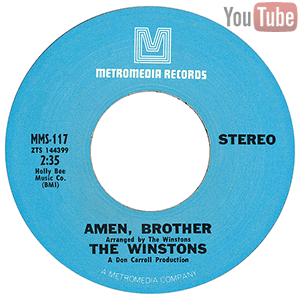
The ‘Amen break‘ was a brief drum solo performed in 1969 by G. C. Coleman in the song ‘Amen, Brother’ performed by the 1960s funk and soul outfit The Winstons. It gained fame from the 1980s onwards when four bars (5.2 seconds) sampled from the drum-solo (or imitations thereof) became very widely used as sampled drum loops in hip hop and other music. The full song is an up-tempo instrumental rendition of Jester Hairston’s ‘Amen,’ which he wrote for the Sidney Poitier film Lilies of the Field (1963) and which was subsequently popularized by The Impressions in 1964.
The Winstons’ version was released as a B-side of the 45 RPM 7-inch vinyl single ‘Color Him Father’ in 1969 on Metromedia. The Amen Break was used extensively in early hiphop and sample-based music, and became the basis for drum-and-bass and jungle music—’a six-second clip that spawned several entire subcultures.’
Posted in Art, Money, Technology |
Leave a Comment »
February 14, 2011
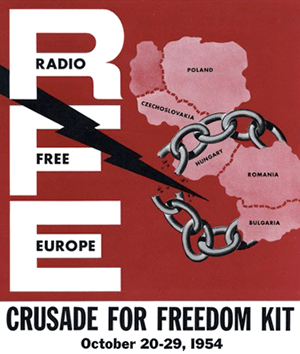
Radio Free Europe/Radio Liberty (RFE/RL) is a broadcaster funded by the U.S. Congress that provides news, information, and analysis to countries in Eastern Europe, Central Asia, and the Middle East where the free flow of information is either banned by government authorities or not fully developed. Founded as an anti-communist source of information during the Cold War, RFE/RL was headquartered at Englischer Garten in Munich from 1949 until 1995 when they were moved to Prague.
It maintains 20 local bureaus, but authoritarian governments often attempt to obstruct the radios’ activities through a range of tactics, including extensive jamming, shutting down local re-broadcasting affiliates, or finding legal excuses to close down offices. In many of these countries, RFE/RL is often the first and most reliable source of domestic news for citizens. The safety of RFE/RL’s journalists and freelancers, who often risk their lives to broadcast information to their listeners and readers, has been a major concern throughout its broadcast history.
Posted in Money, Politics, World |
Leave a Comment »
February 14, 2011

The Marshall Plan (officially the European Recovery Program, ERP) was a large-scale economic program, from 1947–51 by the US to rebuild post-war Europe. The initiative was named after Secretary of State George Marshall and was largely the creation of State Department officials. The same aid was offered to the Soviet Union and its allies, but they did not accept it. $13 billion ($124 billion in 2009 dollars) in economic and technical assistance were given to help the recovery of the European countries that had joined in the Organization for European Economic Co-operation. This $13 billion was in the context of a U.S. GDP of $258 billion in 1948, and was on top of $12 billion in American aid to Europe between the end of the war and the start of the Plan that is counted separately from the Marshall Plan.
By 1952 as the funding ended, the economy of every participant state had surpassed pre-war levels; for all Marshall plan recipients, output in 1951 was 35% higher than in 1938. Over the next two decades, Western Europe enjoyed unprecedented growth and prosperity, but economists are not sure what proportion was due directly to the ERP, what proportion indirectly, and how much would have happened without it. The Marshall Plan was one of the first elements of European integration, as it erased trade barriers and set up institutions to coordinate the economy on a continental level—that is, it stimulated the total political reconstruction of western Europe.
Posted in Money, Politics, War |
Leave a Comment »
February 14, 2011

Weathering steel, also known as COR-TEN steel, is a group of steel alloys which were developed to obviate the need for painting, and form a stable rust-like appearance if exposed to the weather for several years. Weathering steel is popularly used in outdoor sculptures and as exterior facades, for its rustic antique appearance. It is very widely used in marine transportation, in the construction of Intermodal containers.
Using weathering steel in construction presents several challenges. Ensuring that weld-points weather at the same rate as the other materials may require special welding techniques or material. Weathering steel is not rustproof in itself. If water is allowed to accumulate in pockets, those areas will experience higher corrosion rates, so provision for drainage must be made. Weathering steel is sensitive to salt-laden air environments. In such environments, it is possible that the protective patina may not stabilize but instead continue to corrode.
Posted in Art, Money, Technology |
Leave a Comment »
February 14, 2011
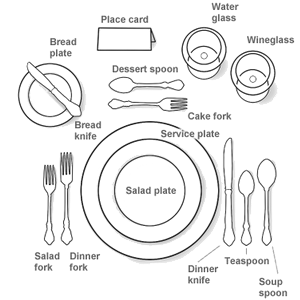
Emily Post (1872 – 1960) was an American author on etiquette. She wrote in various styles, including humorous travel books, early in her career. In 1922 her book Etiquette (full title Etiquette in Society, in Business, in Politics, and at Home) was a best seller, and updated versions continued to be popular for decades. In 1946, she founded The Emily Post Institute which continues her work. She died in 1960 in her New York City apartment at the age of 87.
Today, The Emily Post Institute, located in Burlington, Vermont, provides etiquette experts and advice to news outlets and other corporations. The authors at the Emily Post Institute write books and columns, conduct seminars and workshops, give speeches, and act as spokespeople for select corporations. They give media interviews each year on a variety of topics. Emily Post’s name has become synonymous, at least in North America, with proper etiquette and manners. Nearly half a century after her death, her name is still used in titles of etiquette books.
Posted in Language, Money |
Leave a Comment »
February 14, 2011
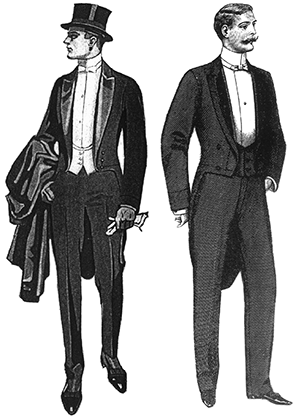
Tuxedo Park is a village in New York, about 50 miles north of New York City in Orange County from which the formal attire of the same name originates. The population was 731 at the 2000 census.The name is derived from a Native American word of the Lenape language, tucsedo, which means either ‘place of the bear’ or ‘clear flowing water.’ Tuxedo Park is a village within the southern part of the Town of Tuxedo (pop. 3,334).
read more »
Posted in Art, Language, Money |
Leave a Comment »
February 13, 2011

SkyReel is a Canadian company that builds and operates unmanned aerial vehicles (UAV) outfitted with camera systems for the motion picture industry.
Posted in Art, Money, Technology |
Leave a Comment »




 The Daily Omnivore