June 6, 2016

Product placement is form of advertising where brands appear in media such as film, television, and video games. Product placement stands out as a marketing strategy because it is the most direct attempt to derive commercial benefit from ‘the context and environment within which the product is displayed or used.’ The technique can be beneficial for viewers, since interruptive advertising removes them from the entertainment.
According to PQ Media, a consulting firm that tracks alternative media spending, 2014 product placement expenditures were estimated at $10.58 billion, rising 13.6% year-over-year, and global branded entertainment growth reached $73.27 billion. The firm noted that brand marketers are seeking improved methods to engage younger audiences used to ad-skipping and on-demand media usage, and branded entertainment provides omnichannel possibilities to more effectively engage post-boomers, particularly Millennials.
read more »
Posted in Money |
Leave a Comment »
June 5, 2016

Divide and choose (or ‘I cut, you choose‘) is a procedure for envy-free cake-cutting between two partners. It involves a heterogeneous good or resource (‘the cake’) and two partners which have different preferences over parts of the cake. The protocol proceeds as follows: one person cuts the cake into two pieces, and the other person chooses his piece first.
Divide-and-choose is mentioned in the Bible. In Genesis, when Abraham and Lot come to the land of Canaan, Abraham suggests that they divide it among them. Then Abraham, coming from the south, divides the land to a ‘left’ (western) part and a ‘right’ (eastern) part, and lets Lot choose. Lot chooses the eastern part which contains Sodom and Gomorrah.
read more »
Posted in Games, Money, Science |
Leave a Comment »
May 20, 2016
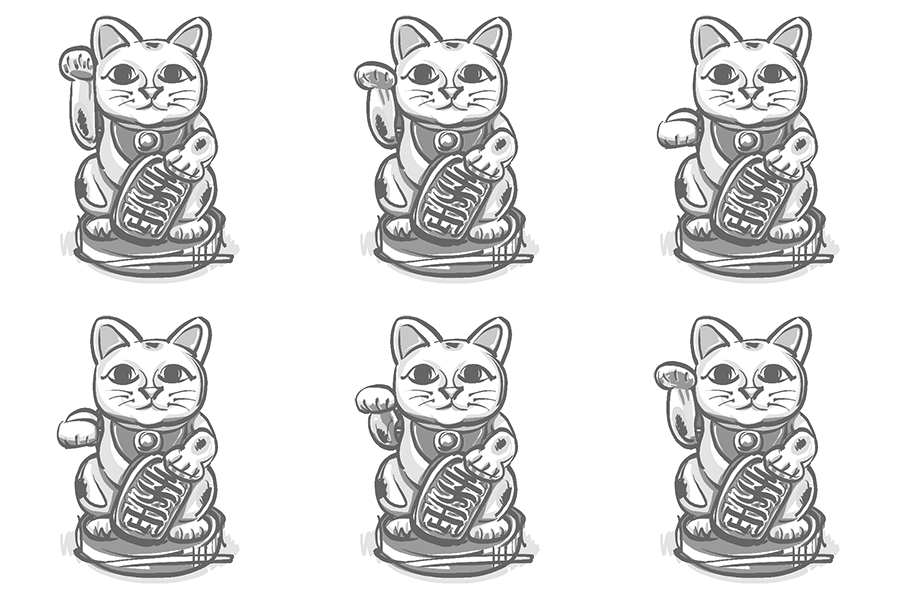
The maneki-neko (Japanese: ‘beckoning cat’) is a common Japanese figurine (lucky charm, talisman) which is often believed to bring good luck to the owner. In modern times, they are usually made of ceramic or plastic. The figurine depicts a cat (traditionally a calico Japanese Bobtail) beckoning with an upright paw, and is usually displayed in—often at the entrance of—shops, restaurants, pachinko parlors, and other businesses. Some of the sculptures are electric or battery-powered and have a slow-moving paw beckoning. The maneki-neko is sometimes also called the ‘welcoming cat,’ ‘lucky cat,’ ‘money cat,’ ‘happy cat,’ or ‘fortune cat’ in English.
Maneki-neko come in different variations. Common colors are white, black, gold and sometimes red. In addition to figurines, maneki-neko can be found as keychains, piggy banks, air fresheners, house-plant pots, and miscellaneous ornaments, as well as large statues. It is also sometimes called the ‘Chinese lucky cat’ due to its popularity among Chinese merchants.
read more »
Posted in Money, World |
1 Comment »
May 9, 2016


Guerrilla marketing is an advertisement strategy concept designed for businesses to promote their products or services in an unconventional way with little budget to spend. This involves high energy and imagination focusing on grabbing the attention of the public in more personal and memorable level. Some large companies use unconventional advertising techniques, proclaiming to be guerrilla marketing but those companies will have larger budget and the brand is already visible. The main point of guerrilla marketing is that the activities are done exclusively on the streets or other public places, such as shopping centers, parks or beaches with maximum exposure.
The term and concept were first described by Jay Conrad Levinson in his 1984 book ‘Guerrilla Marketing.’ Traditional advertising media channels such as print, radio, television, and direct mail are falling out of fashion, forcing marketers and advertisers to look for new strategies to get their commercial messages to the consumer. Guerrilla marketing tries to create surprising and memorable experiences for potential consumer, to increases the likelihood that will tell their friends about it and via word of mouth.
read more »
Posted in Money |
Leave a Comment »
April 28, 2016

The Pepsi Challenge is an ongoing marketing promotion run by PepsiCo since 1975. It is also the name of a cross country ski race at Giant’s Ridge Ski Area in Biwabik, Minnesota, an event sponsored by Pepsi. The challenge originally took the form of a single blind taste test. At malls, shopping centers, and other public locations, a Pepsi representative set up a table with two white cups: one containing Pepsi and one with Coca-Cola. Shoppers were encouraged to taste both colas, and then select which drink they prefer. The results of the test leaned toward a consensus that Pepsi was preferred by more Americans.
The Pepsi Challenge taste test ad campaign is frequently credited for Coca-Cola’s decision to introduce New Coke in 1985. In his book ‘Blink: The Power of Thinking Without Thinking’ (2005), author Malcolm Gladwell presents evidence that suggests Pepsi’s success over Coca-Cola is a result of the flawed nature of the ‘sip test’ method. His research shows that tasters will generally prefer the sweeter of two beverages based on a single sip, even if they prefer a less sweet beverage over the course of an entire can. Additionally, many participants recalled a difference in temperature between the two drinks. According to these claims, Pepsi was served chilled, while Coca-Cola was served at room temperature, thus making the Pepsi more appealing.
Posted in Food, Money |
1 Comment »
April 27, 2016

‘Buyology: Truth and Lies About Why We Buy’ (2008) is a bestselling book by Danish marketing expert Martin Lindstrom, in which he analyzes buying decisions. The author attempts to identify the factors that influence buyers’ decisions in a world cluttered with messages such as advertisements, slogans, jingles, and celebrity endorsements. Lindstrom, through a study of the human psyche, examines the subconscious mind and its role in deciding what the buyer will buy. He debunks some myths about advertising and promotion.
‘Buyology’ is claimed to be a result of the author’s three year neuromarketing study on 2,081 people to identify the effect of brands, logos, commercials, advertisements and products on them. Neuromarketing investigates the sensorimotor, cognitive, and affective response to marketing stimuli. The study was funded by seven corporations, including GlaxoSmithKline, Hakuhodo, Fremantle – and Lindstrom himself. The study evaluates the effectiveness of logos, product placement and subliminal advertising, the influence of our senses and the correlation between religion and branding.
Posted in Language, Money |
Leave a Comment »
April 14, 2016

Fuerdai is a Chinese term that means ‘the second generation of the rich.’ This term is used to describe social and moral problems that are associated with modern China’s recent economic ascendency. Fuerdai are sons and daughters of the Chinese nouveau riche of the early years of China’s reform era (from the late 1970s onward). During the new era, in which private initiative could be rewarded by wealth, many new rich Chinese emerged in the former-socialist society. Their children often enjoy a comfortable lifestyle and have a much easier and obstacle-free life path.
Most wealthy Chinese send their children abroad to get a better education. This especially true in the US and Canada where it is common to see well-off Chinese students attending driving cars that are out of reach for the vast majority of American students. Universities look favorably to this kind of international student as they generate more revenue and tend to pay more fees. Places like Los Angeles, San Francisco, Seattle, Vancouver, West Lafayette, Indiana (home to Purdue University), Toronto, Boston, New York, and Dallas tend to have high numbers of Fuerdai, who will often attend university for four years and sell their cars right after graduation.
Posted in Money, Politics, World |
1 Comment »
April 11, 2016

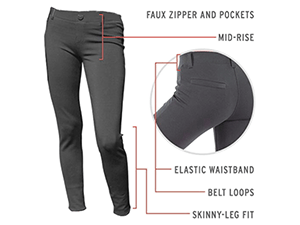
Athleisure is a trend in fashion in which clothing designed for athletic workouts (sometimes termed ‘activewear) is worn outside of the gym to go to the office or shopping or other social occasions. Athleisure outfits are ‘yoga pants, tights and leggings’ that ‘look like athletic wear’ characterized as ‘fashionable, dressed up sweats and exercise clothing.’ The idea is that ‘gym clothes are making their way out of the gym and becoming a larger part of people’s everyday wardrobes.’
One account suggests that the trend came about because people could wear them for multiple occasions without having to change, which meant greater convenience, since people did not have to carry an extra gym outfit on the way to the office, for example. Reports in the Wall Street Journal describe the athleisure market as growing, displacing typical workwear styles, and cutting into sales of jeans. While the trend was started by women, men are increasingly turning to athleisure wear as well. For men’s fashion, athleisure wear began with luxury sweatpants (‘joggers’) and then moved to the upper torso region with ‘dressy/sporty versions of men’s blazers, varsity jackets, pea coats and sweaters.’
Posted in Games, Money |
Leave a Comment »
March 29, 2016


In advertising, a hard sell is an advertisement or campaign that uses a more direct, forceful, and overt sales message. The term is also used to describe aggressive sales techniques used by company representatives, particularly in the context of doorstep selling.
The concepts that distinguish a hard sell from a ‘soft sell’ (subtle, casual, or friendly sales message) have to do with directness of an advertiser or seller, rational appeal, and the amount of information given to the buyer about a product. A hard sell is extremely direct in nature. An advertisement will contain a forceful, loud slogan in order to grab buyers’ attention, or a salesperson will be very persistent, cornering their buyer into purchasing the product they are selling.
read more »
Posted in Money |
Leave a Comment »
March 26, 2016
A shared universe is a set of creative works where more than one writer (or other artist) independently contributes a work that can stand alone but fits into the joint development of the storyline, characters, or world of the overall project. It is common in genres like science fiction. It differs from ‘collaborative writing’ where multiple artists are working together on the same work, and from ‘crossovers’ where the works and characters are independent except for a single meeting.
The term shared universe is also used within comics to reflect the overall milieu created by the comic book publisher in which characters, events, and premises from one product line appear in other product lines in a media franchise. The term has also been used in a wider, non-literary sense to convey interdisciplinary or social commonality, often in the context of a ‘shared universe of discourse.’
read more »
Posted in Art, Money |
Leave a Comment »
March 24, 2016

Fika [fee-kah] is a concept in Swedish culture with the basic meaning ‘to have coffee,’ often accompanied with pastries or sandwiches. A more contemporary generalized meaning of the word, where the coffee may be replaced by tea or even juice, lemonade or squash for children, has become widespread. In some social circles, even just a sandwich or a small meal may be denoted a fika similar to the English concept of afternoon tea. In Sweden pastries in general (for example cinnamon buns) are often referred to as ‘fikabröd’ (‘fika bread’).
Fika is a common practice at workplaces in Sweden where it constitutes at least one break during a normal workday. Often, two fikas are taken in a day at around 9:00 in the morning and 3:00 in the afternoon. The work fika is an important social event where employees can gather and socialize to discuss private and professional matters. It is not uncommon for management to join employees and to some extent it can even be considered impolite not to join one’s colleagues at fika. The practice is not limited to any specific sector of the labor market and is considered normal practice even in government administration.
read more »
Posted in Food, Money, World |
Leave a Comment »
March 20, 2016

‘You have two cows‘ is a joke comparing political systems that circulated throughout the US since around 1936 under the title ‘Parable of the Isms.’ A column in ‘The Chicago Daily Tribune’ in 1938 attributes a version involving socialism, communism, fascism and New Dealism to an address by lawyer Silas Strawn to the Economic Club of Chicago in 1935.
The joke always begins with ‘You have two cows…’ followed by a political system and its effect on the cows. For example, ‘socialism’ (the government takes one and gives it to your neighbor), ‘communism’ (you give them to the government, and the government then gives you some milk), fascism (you give them to the government, and the government then sells you some milk), and capitalism (you sell one and buy a bull).
Posted in Humor, Money, Politics |
1 Comment »



