January 14, 2016

The ADE 651 is a fake bomb detector produced by ATSC (UK), which claimed that the device could effectively and accurately, from long range, detect the presence and location of various types of explosives, drugs, ivory, and other substances. The device has been sold to 20 countries in the Middle East and Asia, including Iraq and Afghanistan, for as much as US$60,000 each. The Iraqi government is said to have spent £52 million on the devices.
Investigations by the BBC and other organizations found that the device is little more than a ‘glorified dowsing rod’ with no ability to perform its claimed functions. In 2010, export of the device was banned by the British government and the managing director of ATSC was arrested on suspicion of fraud. The company was dissolved in 2013, and the founder, Jim McCormick, was sentenced to ten years’ imprisonment. Similar ‘bomb sniffing’ devices, which are still widely used, have also come under scrutiny in the wake of the revelations about the ADE 651.
read more »
Posted in Money, Technology, War |
Leave a Comment »
January 11, 2016

The Knee Defender is a device that an airplane passenger can place on the struts that support his/her drop-down airplane seat tray table to limit the extent to which the seat directly in front of him/her can be reclined. The device was invented by Ira Goldman, and it was first sold to the public in 2003.
In August 2014, on a United Airlines flight from Newark to Denver, an argument developed between a passenger using a Knee Defender and the passenger seated in front of him who wanted to recline. Ultimately the pilot diverted the flight to Chicago and both of those passengers were deplaned.
Posted in Money, Politics, Technology |
Leave a Comment »
January 1, 2016

Visual brand language is the unique ‘alphabet’ of design elements – such as shape, color, materials, finish, typography and composition – which directly and subliminally communicate a company’s values and personality through compelling imagery and design style. This ‘alphabet,’ properly designed, results in an emotional connection between the brand and the consumer. Visual brand language is a key ingredient necessary to make an authentic and convincing brand strategy that can be applied uniquely and creatively in all forms of brand communications to both employees and customers.
For example, the BMW ‘split grill’ has come to represent the brand. While the grill size and design details evolve over time, the underlying idea is constant and memorable. The use of color is also a powerful associative element for consistent imagery, as exemplified by the comprehensive application of orange by The Home Depot across all its brand materials.
read more »
Posted in Art, Language, Money |
Leave a Comment »
December 15, 2015


Phreaking is a slang term coined to describe the activity of hobbyists who study, experiment with, or explore, telecommunication systems, such as equipment and systems connected to public telephone networks. ‘Phreak,’ ‘phreaker,’ or ‘phone phreak’ are names used for and by individuals who participate in phreaking. The term first referred to groups who had reverse engineered the system of tones used to route long-distance calls. By re-creating these tones, phreaks could switch calls from the phone handset, allowing free calls to be made around the world.
Electronic tone generators known as ‘blue boxes’ became a staple of the phreaker community, including future Apple Inc. cofounders Steve Jobs and Steve Wozniak. The blue box era came to an end with the ever increasing use of computerized phone systems, which sent dialling information on a separate, inaccessible channel. By the 1980s, much of the system in the US and Western Europe had been converted. Phreaking has since become closely linked with computer hacking.
read more »
Posted in Money, Politics, Technology |
Leave a Comment »
December 14, 2015
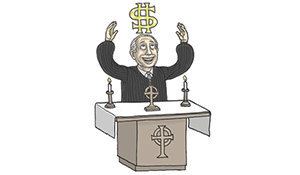

Almighty dollar is an idiom often used to satirize an individual or cultural obsession with material wealth, or with capitalism in general. The phrase implies that money is a kind of deity. Although the phrase was not popularized until the 19th century, similar expression were used much earlier. For example, British writer Ben Jonson wrote in 1616: ‘Whilst that for which all virtue now is sold, And almost every vice, almightie gold.’
The ‘dollar’ version of the phrase is commonly attributed to American writer Washington Irving, who used it in the story ‘The Creole Village,’ which was first published in the 1837 edition of ‘The Magnolia,’ a literary annual: ‘The almighty dollar, that great object of universal devotion throughout our land, seems to have no genuine devotees in these peculiar villages; and unless some of its missionaries penetrate there, and erect banking houses and other pious shrines, there is no knowing how long the inhabitants may remain in their present state of contented poverty.’
Posted in Money, Philosophy |
1 Comment »
December 10, 2015


Prolefeed is a Newspeak term in the novel ‘Nineteen Eighty-Four’ by George Orwell. It was used to describe the deliberately superficial literature, movies and music that were produced by Prolesec, a section of the Ministry of Truth, to keep the ‘proles’ (i.e., proletariat) content and to prevent them from becoming too knowledgeable. The ruling Party believes that too much knowledge could motivate the proles to rebel against them.
The term is used occasionally to describe shallow entertainment in the real world. For example, Theodore Dalrymple wrote in the ‘The Spectator’ that ‘France …. is less dominated by mass distraction (known here as popular culture, but in ‘Nineteen Eighty-Four’ as prolefeed) than Britain is.’ The term has also been applied to fast food, such as that of McDonald’s: ‘Once seen as the all-American corporation, ‘McDonald’s’ is now shorthand for a globalist mass culture that provides cheap, unhealthy food to lower-class people. McDonald’s is, quite literally, prolefeed. Part of this image was a deliberate choice by the corporation.’
read more »
Posted in Language, Money, Politics |
Leave a Comment »
November 23, 2015

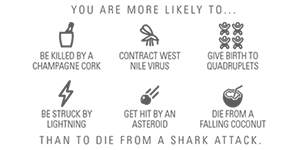
The Summer of the Shark refers to the coverage of shark attacks by American news media in the summer of 2001. The sensationalist coverage of shark attacks began in early July following the Fourth of July weekend shark attack on 8-year-old Jessie Arbogast, and continued almost unabated—despite no evidence for an actual increase in attacks—until the September 11 terrorist attacks shifted the media’s attention away from beaches. The ‘Summer of the Shark’ has since been remembered as an example of tabloid television perpetuating a story with no real merit beyond its ability to draw ratings.
In mid-August, many networks were showing footage captured by helicopters of hundreds of sharks coalescing off the southwest coast of Florida. Beach-goers were warned of the dangers of swimming, despite the fact that the swarm was likely part of an annual shark migration. The repeated broadcasts of the shark group has been criticized as blatant fear mongering, leading to the unwarranted belief of a so-called shark ‘epidemic.’
read more »
Posted in Death, Language, Money |
Leave a Comment »
November 17, 2015
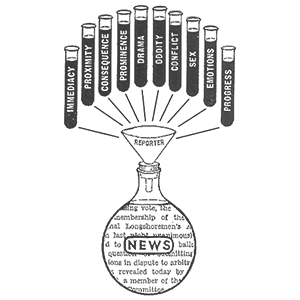
News values, or ‘news criteria,’ determine how much prominence a news story is given by a media outlet, and the attention it garners from its audience. These values are not universal and can vary widely between different cultures. In Western practice, decisions on the selection and prioritization of news are ostensibly made by editors on the basis of their experience and intuition.
However, a seminal analysis by Norwegian sociologists Johan Galtung and Mari Ruge in the ‘Journal of Peace Research’ in 1965 showed that several factors are common, such as familiarity (stories that ‘hit close to home’), negativity (‘if it bleeds, it leads’), and Unexpectedness (‘don’t report on fire in a furnace’). Basing his judgement on many years as a newspaper journalist Tim Hetherington has said that ‘anything which threatens people’s peace, prosperity, and well being is news and likely to make headlines.’
read more »
Posted in Language, Money, Politics |
1 Comment »
November 12, 2015

Jugaad [joo-gard] is a colloquial Hindi and Punjabi word that can mean an innovative fix or a simple work-around, used for solutions that bend rules, or a resource that can be used as such, or a person who can solve a complicated issue. It is used as much to describe enterprising street mechanics as for political fixers. This meaning is often used to signify creativity to make existing things work or to create new things with meagre resources.
Jugaad is similar to the Western concepts of a ‘hack’ or ‘kludge,’ or to bodge or (‘British English’), but can be thought of more as a survival tactic than a mere workaround. But all such concepts express a need to do what needs to be done, without regard to what is conventionally supposed to be possible.
Posted in Money, Technology, World |
Leave a Comment »
November 5, 2015
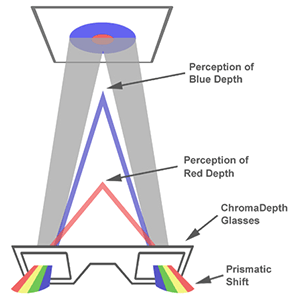
Chromadepth is a patented system from the company Chromatek (a subsidiary of American Paper Optics since 2002) that produces a stereoscopic effect based upon differences in the diffraction of color through a special prism-like holographic film. Chromadepth glasses purposely exacerbate chromatic aberration (the failure of a lens to focus all colors to the same convergence point) and give the illusion of colors taking up different positions in space, with red being in front, and blue being in back.
The effect works particularly well with the sky, sea or grass as a background, and redder objects in the foreground. From front to back the scheme follows the visible light spectrum, from red to orange, yellow, green and blue. This means any color is associated in a fixed fashion with a certain depth when viewing. As a result, ChromaDepth works best with artificially produced or enhanced pictures, since the color indicates the depth.
Posted in Money, Technology |
Leave a Comment »
November 1, 2015

Nudge theory is a concept in behavioral economics which argues that positive reinforcement and indirect suggestions promoting non-forced compliance can influence the motives, incentives, and decision making of groups and individuals, at least as effectively – if not more effectively – than direct instruction, legislation, or enforcement. The theory came to prominence with a 2008 book, ‘Nudge: Improving Decisions About Health, Wealth, and Happiness’ by behavioral economists Richard Thaler and Cass Sunstein.
They defined a ‘nudge’ as: ‘any aspect of the choice architecture that alters people’s behavior in a predictable way without forbidding any options or significantly changing their economic incentives. To count as a mere nudge, the intervention must be easy and cheap to avoid. Nudges are not mandates. Putting fruit at eye level counts as a nudge. Banning junk food does not.’ One of nudges’ most frequently cited examples is the etching of the image of a housefly into the men’s room urinals at Amsterdam’s Schiphol Airport, which is intended to ‘improve the aim.’
Posted in Money, Politics, Science |
Leave a Comment »
October 31, 2015


Pump and dump is a form of microcap stock fraud that involves artificially inflating the price of an owned stock through false and misleading positive statements, in order to sell the cheaply purchased stock at a higher price. Once the operators of the scheme ‘dump’ sell their overvalued shares, the price falls and investors lose their money. Stocks that are the subject of pump and dump schemes are sometimes called ‘chop stocks.’
While fraudsters in the past relied on cold calls made from ‘boiler rooms’ (outbound call centers selling questionable investments), the Internet now offers a cheaper and easier way of reaching large numbers of potential investors. Often the stock promoter will claim to have ‘inside’ information about impending news. They may also post messages in chat rooms or stock message boards urging readers to buy the stock quickly. Fraudsters frequently use this ploy with small, thinly traded companies—known as ‘penny stocks’ because it is easier to manipulate a stock when there is little or no independent information available about the company.
read more »
Posted in Money, Politics |
Leave a Comment »


 The Daily Omnivore