November 23, 2015

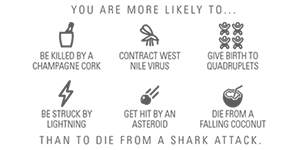
The Summer of the Shark refers to the coverage of shark attacks by American news media in the summer of 2001. The sensationalist coverage of shark attacks began in early July following the Fourth of July weekend shark attack on 8-year-old Jessie Arbogast, and continued almost unabated—despite no evidence for an actual increase in attacks—until the September 11 terrorist attacks shifted the media’s attention away from beaches. The ‘Summer of the Shark’ has since been remembered as an example of tabloid television perpetuating a story with no real merit beyond its ability to draw ratings.
In mid-August, many networks were showing footage captured by helicopters of hundreds of sharks coalescing off the southwest coast of Florida. Beach-goers were warned of the dangers of swimming, despite the fact that the swarm was likely part of an annual shark migration. The repeated broadcasts of the shark group has been criticized as blatant fear mongering, leading to the unwarranted belief of a so-called shark ‘epidemic.’
read more »
Posted in Death, Language, Money |
Leave a Comment »
November 17, 2015
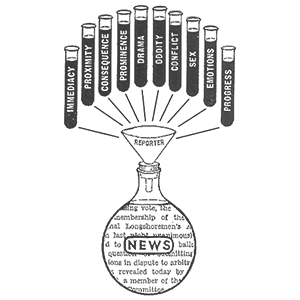
News values, or ‘news criteria,’ determine how much prominence a news story is given by a media outlet, and the attention it garners from its audience. These values are not universal and can vary widely between different cultures. In Western practice, decisions on the selection and prioritization of news are ostensibly made by editors on the basis of their experience and intuition.
However, a seminal analysis by Norwegian sociologists Johan Galtung and Mari Ruge in the ‘Journal of Peace Research’ in 1965 showed that several factors are common, such as familiarity (stories that ‘hit close to home’), negativity (‘if it bleeds, it leads’), and Unexpectedness (‘don’t report on fire in a furnace’). Basing his judgement on many years as a newspaper journalist Tim Hetherington has said that ‘anything which threatens people’s peace, prosperity, and well being is news and likely to make headlines.’
read more »
Posted in Language, Money, Politics |
1 Comment »
November 12, 2015

Jugaad [joo-gard] is a colloquial Hindi and Punjabi word that can mean an innovative fix or a simple work-around, used for solutions that bend rules, or a resource that can be used as such, or a person who can solve a complicated issue. It is used as much to describe enterprising street mechanics as for political fixers. This meaning is often used to signify creativity to make existing things work or to create new things with meagre resources.
Jugaad is similar to the Western concepts of a ‘hack’ or ‘kludge,’ or to bodge or (‘British English’), but can be thought of more as a survival tactic than a mere workaround. But all such concepts express a need to do what needs to be done, without regard to what is conventionally supposed to be possible.
Posted in Money, Technology, World |
Leave a Comment »
November 5, 2015

Chromadepth is a patented system from the company Chromatek (a subsidiary of American Paper Optics since 2002) that produces a stereoscopic effect based upon differences in the diffraction of color through a special prism-like holographic film. Chromadepth glasses purposely exacerbate chromatic aberration (the failure of a lens to focus all colors to the same convergence point) and give the illusion of colors taking up different positions in space, with red being in front, and blue being in back.
The effect works particularly well with the sky, sea or grass as a background, and redder objects in the foreground. From front to back the scheme follows the visible light spectrum, from red to orange, yellow, green and blue. This means any color is associated in a fixed fashion with a certain depth when viewing. As a result, ChromaDepth works best with artificially produced or enhanced pictures, since the color indicates the depth.
Posted in Money, Technology |
Leave a Comment »
November 1, 2015

Nudge theory is a concept in behavioral economics which argues that positive reinforcement and indirect suggestions promoting non-forced compliance can influence the motives, incentives, and decision making of groups and individuals, at least as effectively – if not more effectively – than direct instruction, legislation, or enforcement. The theory came to prominence with a 2008 book, ‘Nudge: Improving Decisions About Health, Wealth, and Happiness’ by behavioral economists Richard Thaler and Cass Sunstein.
They defined a ‘nudge’ as: ‘any aspect of the choice architecture that alters people’s behavior in a predictable way without forbidding any options or significantly changing their economic incentives. To count as a mere nudge, the intervention must be easy and cheap to avoid. Nudges are not mandates. Putting fruit at eye level counts as a nudge. Banning junk food does not.’ One of nudges’ most frequently cited examples is the etching of the image of a housefly into the men’s room urinals at Amsterdam’s Schiphol Airport, which is intended to ‘improve the aim.’
Posted in Money, Politics, Science |
Leave a Comment »
October 31, 2015


Pump and dump is a form of microcap stock fraud that involves artificially inflating the price of an owned stock through false and misleading positive statements, in order to sell the cheaply purchased stock at a higher price. Once the operators of the scheme ‘dump’ sell their overvalued shares, the price falls and investors lose their money. Stocks that are the subject of pump and dump schemes are sometimes called ‘chop stocks.’
While fraudsters in the past relied on cold calls made from ‘boiler rooms’ (outbound call centers selling questionable investments), the Internet now offers a cheaper and easier way of reaching large numbers of potential investors. Often the stock promoter will claim to have ‘inside’ information about impending news. They may also post messages in chat rooms or stock message boards urging readers to buy the stock quickly. Fraudsters frequently use this ploy with small, thinly traded companies—known as ‘penny stocks’ because it is easier to manipulate a stock when there is little or no independent information available about the company.
read more »
Posted in Money, Politics |
Leave a Comment »
October 22, 2015

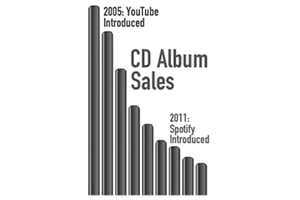
Vinyl revival refers to the renewed interest and increased sales of vinyl records since 2006. The analoge format made of polyvinyl chloride had been the main vehicle for the commercial distribution of pop music from the 1950s until the 1980s and 1990s when they were replaced by the Compact Disc. Since the early 2000s CDs have been partially replaced by digital downloads; conversely, vinyl sales have started growing. In some territories, vinyl is now more popular than it has been since the late 1980s, though vinyl records still make up only a marginal percentage (<3%) of overall music sales.
Founded in 2007, ‘Record Store Day’ is an internationally celebrated day observed the third Saturday of April each year. Its purpose, as conceived by independent record store employee Chris Brown, is to celebrate the art of music. The day brings together fans, artists, and thousands of independent record stores across the world.
Posted in Art, Money |
Leave a Comment »
October 21, 2015

Tower Records was an American retail music chain that liquidated in 2006. The brand currently exists as an international franchise and an online music store. Tower.com was purchased by a separate entity and was not affected by the retail store closings.
Tower was founded in 1960 by Russell Solomon in Sacramento, California. The store was named after his father’s drugstore, which shared a building and name with the Tower Theater, where Solomon first started selling records. The first Tower Records store was opened in 1960 on Watt Avenue in Sacramento. By 1976, Solomon had opened Tower Books, Posters, and Plants at 1600 Broadway, next door to Tower Records. It was also one of the first retailers to move online in 1995 as Tower.com.
read more »
Posted in Art, Money, World |
Leave a Comment »
October 16, 2015


Scam baiting is a form of Internet vigilantism, where the vigilante poses as a potential victim to the scammer in order to waste their time and resources, gather information that will be of use to authorities, and publicly expose the scammer. It is primarily used to thwart advance-fee fraud scams (e.g. ‘Nigerian Prince’ scams) and can be done out of a sense of civic duty (activism) by documenting scammers tools and methods, warning potential victims, or taking down fake websites.
A bait is very simply initiated, by answering a scam email, from a throwaway email account, i.e. one that is only used for baiting and untraceable back to the actual owner. The baiter then pretends to be receptive to the financial hook that the scammer is using, but requires increasingly ridiculous forms of security from the scammer before turning over funds. Scam baiters typically use jest in their attacks. However, some scam baiters have been accused of abject mockery, racism, and homophobia, and even scamming themselves.
Posted in Money, Politics, Technology |
Leave a Comment »
October 15, 2015
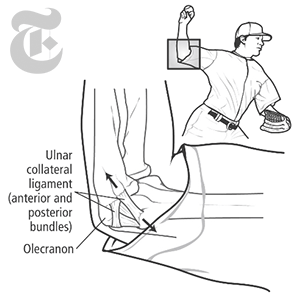
Tommy John surgery (TJS), known in medical practice as ulnar collateral ligament (UCL) reconstruction, is a surgical graft procedure in which a ligament in the elbow is replaced with a tendon from elsewhere in the body (ligaments and tendons are connective tissue; the former connects bones to each other and latter connects muscles to bone). The procedure is common among collegiate and professional athletes in several sports, particularly baseball pitchers.
The procedure was first performed in 1974 by orthopedic surgeon Dr. Frank Jobe, then a Los Angeles Dodgers team physician who served as a special advisor to the team until his death in 2014. It is named after the first baseball player to undergo the surgery, major league pitcher Tommy John, whose record of 288 career victories ranks seventh all time among left-handed pitchers.
read more »
Posted in Games, Health, Money |
Leave a Comment »
October 14, 2015

Ghetto fabulous refers to a fashion stereotype alluding to individuals living in an affluent materialistic style while not actually wealthy. It is part of a larger cultural trend of the 1990s where black, urban fashion was becoming a hot commodity through the rise of ‘hardcore’ rap. Because of the circumstances of many inner city families, poverty and consumerism became the focal point of artistic expression. With the rise of malls in the 1980s, this could be seen in the larger cultural context as well.
‘Excessive consumerism and an obsession with bling are certainly not confined to any particular demographic. We are a nation of excess and instant gratification. It has become the American way.’ For inner city youth, the ghetto fabulous life was about trying to outrun their socio-economic situations. For centuries, fashion has represented socio-economic status, so lower classes will buy outside their means in order to try and fit into an image of the upper classes.
read more »
Posted in Language, Money, Politics |
1 Comment »
October 8, 2015

Massimo [ma-see-moh] Vignelli [veen-yell-ee] (1931 – 2014) was an Italian graphic and industrial designer who worked in a number of areas including product packaging, housewares, furniture, public signage, and showrooms. He was the co-founder of Vignelli Associates, with his wife, Lella. His ethos was, ‘If you can design one thing, you can design everything,’ and this was reflected in the broad range of his work. Vignelli worked firmly within the Modernist tradition, and focused on simplicity through the use of basic geometric forms in all his work.
His educational background was in architecture, which he studied at the Politecnico di Milano and later at the Università di Architettura, Venice. From 1957 to 1960, he visited America on a fellowship, and returned to New York in 1966 to start the New York branch of a new company, Unimark International, which quickly became, in scope and personnel, one of the largest design firms in the world.
read more »
Posted in Art, Money, World |
1 Comment »



