February 11, 2013

Commodification (or commoditization) is the transformation of goods, ideas, or other entities that may not normally be regarded as goods into a commodity. American author and feminist bell hooks refers to cultural commodification [kuh-mod-uh-fi-key-shuhn] as ‘eating the other.’ By this she means that cultural expressions, revolutionary, or post modern, can be sold to the dominant culture. Any messages of social change are not marketed for their messages but used as a mechanism to acquire a piece of the ‘primitive.’ Any interests in past historical culture almost always have a modern twist.
According to Mariana Torgovnick, ‘What is clear now is that the West’s fascination with the primitive has to do with its own crises in identity, with its own need to clearly demarcate subject and object even while flirting with other ways of experiencing the universe.’ Hooks states that marginalized groups are seduced by this concept because of ‘the promise of recognition and reconciliation.’ ‘When the dominant culture demands that the Other be offered as sign that progressive political change is taking place, that the American Dream can indeed be inclusive of difference, it invites a resurgence of essentialist cultural nationalism.’
read more »
Posted in Money, Politics, World |
1 Comment »
February 7, 2013
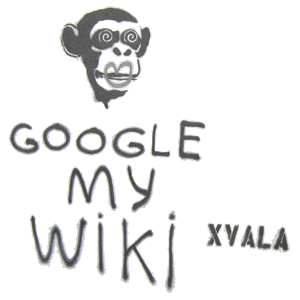
XVALA is an art project created by Jeff Hamilton (b. 1970). XVALA typically focuses on pieces that address celebrity and popular culture and he refers to this as ‘Tabloid Art.’ XVALA collaborated with sculptor Daniel Edwards on ‘The Brangelina,’ a house located in Oklahoma. In 2010, Jeff Hamilton walked away from his art and the name XVALA. Hamilton passed the name on to unnamed, upcoming artist.
‘Fear Google’ is the first street art sticker designed for the Post-PC era and was launched in 2010, the same year as Apple’s iPad and other Post-PC devices. The stickers fear message shows society’s growing inability to disconnect from the internet. First distributed by friends of the artist and some Apple Store employees the first stickers appeared on the California city streets.
read more »
Posted in Art, Money, Politics |
Leave a Comment »
February 6, 2013

Marc Quinn (b. 1964) is a British artist and one of a loose group known as the Young British Artists. He is known for ‘Alison Lapper Pregnant’ (a sculpture of Alison Lapper, an English artist who was born without arms) and ‘Self’ (a sculpture of his head made with his own frozen blood). Quinn has used blood, ice, and faeces to make sculptures; his work sometimes refers to scientific developments.
Quinn’s oeuvre displays a preoccupation with the mutability of the body and the dualisms that define human life: spiritual and physical, surface and depth, cerebral and sexual. Quinn’s sculpture, paintings and drawings often deal with the distanced relationship we have with our bodies, highlighting how the conflict between the ‘natural’ and ‘cultural’ has a grip on the contemporary psyche. In 1999, Quinn began a series of marble sculptures of amputees as a way of re-reading the aspirations of Greek and Roman statuary and their depictions of an idealized whole.
read more »
Posted in Art, Money, Philosophy |
Leave a Comment »
February 6, 2013

Daniel Edwards (born 1965) is a contemporary artist whose pieces address celebrity and popular culture in ways that have often stirred controversy. His work is generally accompanied by press releases. He includes the idea of promotion and associative fame in his own marketing of his art. His work includes a sculpture of the disembodied head of Ted Williams, a life-sized statue of Britney Spears giving birth while nude on her hands and knees on a bearskin rug (Edwards titled the piece ‘Monument to Pro-Life: The Birth of Sean Preston,’ explaining that it symbolized Spears’ decision to put childbirth ahead of her career; Britney Spears actually had a caesarean section), a bust of Senator Hillary Clinton, and a 25-foot (7.6 m) bust of Fidel Castro.
In an Associated Press interview, Edwards asserted that he incorporates celebrity stories because: ‘You’re bombarded with these stories. And there’s a thread that winds back to the art. That’s not a bad thing. People are interested in sex, and it works for art as well.’
Posted in Art, Money, Sex |
Leave a Comment »
February 6, 2013
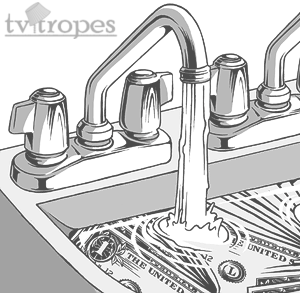
Gold sinks are economic processes by which a video game’s ingame currency (‘gold’), or any item that can be valued against it, is removed. Excess currency leads to inflation of player driven prices. Game designers must balance between scarcity of currency and ease of acquiring currency. This process is comparable to financial repression (measures that governments employ to channel funds to themselves, that, in a deregulated market, would go elsewhere). Most commonly the genres are role-playing game or massively multiplayer online game.
The term is comparable to timesink (an activity that consumes significant time), but usually used in reference to game design and balance, commonly to reduce inflation when commodities and wealth are continually fed to players through sources such as quests, looting monsters, or minigames. Gold sinks are commonly called drains or gold drains. They can also be associated with item drains. The intent of a sink is to remove added value from the overall economy. For example, in ‘Ultima Online,’ items that were placed on the ground would be gathered by the server. This form is referred to as decay or garbage collection.
read more »
Posted in Games, Money, Technology |
Leave a Comment »
February 6, 2013
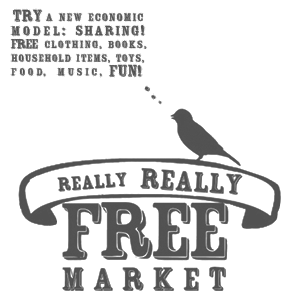
Give-away shops, swap shops, freeshops, or free stores are stores where all goods are free. They are similar to charity shops, with mostly second-hand items—only everything is available at no cost. Whether it is a book, a piece of furniture, a garment or a household item, it is all freely given away, although some operate a one-in, one-out–type policy (swap shops).
The free store is a form of constructive direct action that provides a shopping alternative to a monetary framework, allowing people to exchange goods and services outside of a money-based economy.
read more »
Posted in Money, Politics |
Leave a Comment »
February 6, 2013

‘Help at Any Cost: How the Troubled-Teen Industry Cons Parents and Hurts Kids’ is a 2006 non-fiction book by science journalist Maia Szalavitz analyzing the controversy surrounding the tough love behavior modification industry. Szalavitz focuses on four programs: Straight, Incorporated, a copy of the Straight Inc. program called KIDS, North Star wilderness boot camp, and the World Wide Association of Specialty Programs and Schools.
She discusses the background, history and methodology of the troubled teen industry, including techniques drawn from attack therapy, Erhard Seminars Training (est), and Synanon, all of which are highly controversial. She uses first-person accounts and court testimony in her research, and states that no evidence exists proving that these programs are effective. The book also includes advice for parents and an appendix with additional resources on how to get responsible help for teenagers.
read more »
Posted in Health, Money, Politics |
Leave a Comment »
February 5, 2013
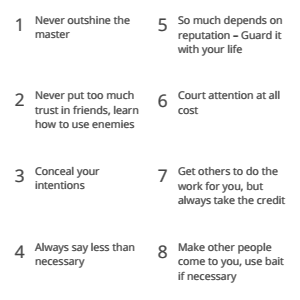
‘The 48 Laws of Power‘ (2000) is the first book by American author Robert Greene. The book, an international bestseller, is a practical guide for anyone who wants power, observes power, or wants to arm himself against power, and is popular with famous rappers, entrepreneurs, celebrities, athletes and actors including 50 Cent, Jay-Z, Kanye West, Dov Charney, Brian Grazer, Chris Bosh, and Will Smith. ‘The 48 Laws of Power’ is taught in business management classes and is one of the most requested books in American prison libraries.
The 48 Laws of Power are a distillation of 3,000 years of the history of power, drawing on the lives of strategists and historical figures like Niccolò Machiavelli, Sun Tzu, Carl von Clausewitz, Queen Elizabeth I, Henry Kissinger, and P.T. Barnum. The book is intended to show people how to gain power, preserve it, and defend themselves against power manipulators.
read more »
Posted in Language, Money, Politics |
Leave a Comment »
February 2, 2013
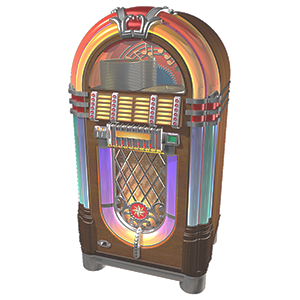
A jukebox is a partially automated music-playing device, usually a coin-operated machine, that will play a patron’s selection from self-contained media. The classic jukebox has buttons with letters and numbers on them that, when entered in combination, are used to play a specific selection. Coin-operated music boxes and player pianos were the first forms of automated coin-operated musical devices.
These instruments used paper rolls, metal disks, or metal cylinders to play a musical selection on the instrument, or instruments, enclosed within the device. In the 1890s these devices were joined by machines which used actual recordings instead of physical instruments. In 1890, Louis Glass and William S. Arnold invented the nickel-in-the-slot phonograph, the first of which was an Edison Class M Electric Phonograph retrofitted with a device patented under the name of Coin Actuated Attachment for Phonograph. The music was heard via one of four listening tubes.
read more »
Posted in Money, Technology |
Leave a Comment »
February 1, 2013

James Randi (b. 1928) is a Canadian-American stage magician and scientific skeptic best known as a challenger of paranormal claims and pseudoscience. Randi is the founder of the James Randi Educational Foundation (JREF). Randi began his career as a magician, as The Amazing Randi, but after retiring at age 60, he began investigating paranormal, occult, and supernatural claims, which he collectively calls ‘woo-woo.’ He has written about the paranormal, skepticism, and the history of magic.
JREF sponsors The One Million Dollar Paranormal Challenge offering a prize of US$1,000,000 to anyone who can demonstrate evidence of any paranormal, supernatural or occult power or event under test conditions agreed to by both parties. Although often referred to as a ‘debunker,’ Randi dislikes the term’s connotations and prefers to describe himself as an ‘investigator.’ He has written about the paranormal, skepticism, and the history of magic. He was a frequent guest on ‘The Tonight Show Starring Johnny Carson’ and was occasionally featured on the television program ‘Penn & Teller: Bullshit!’
read more »
Posted in Money, Science |
Leave a Comment »
January 31, 2013

Adolf Hitler was a painter and was deeply interested in art. He produced hundreds of works and sold his paintings and postcards to earn a living during his Vienna years (1908–1913). However, he was not successful. A number of his paintings were recovered after World War II and have sold at auction for tens of thousands of dollars. Others were seized by the U.S. Army and are still held by the U.S. government.
In his autobiography Hitler described how, in his youth, he wanted to become a painter, but his aspirations were ruined because he failed the entrance exam of the Academy of Fine Arts Vienna. Hitler was rejected twice by the institute, once in 1907 and again in 1908; the institute considered that he had more talent in architecture than in painting. One of the instructors, sympathetic to his situation and believing he had some talent, suggested that he apply to Academies School of Architecture, but that would have required returning to secondary school, from which he’d dropped out of, which he was unwilling to do.
read more »
Posted in Art, Money, War |
Leave a Comment »
January 30, 2013
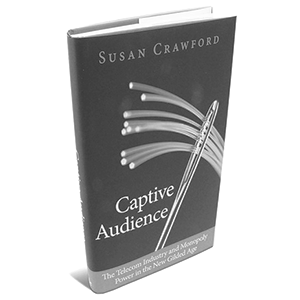
Susan P. Crawford (b. 1963) is a professor at the Benjamin N. Cardozo School of Law. She has served as President Barack Obama’s Special Assistant for Science, Technology, and Innovation Policy (2009) and is a columnist for ‘Bloomberg View.’
She is a former Board Member of ICANN (which regulates the Internet), the founder of OneWebDay (an annual day of Internet celebration and awareness held on September 22), and a legal scholar. Her research focuses on telecommunications and information law.
read more »
Posted in Money, Politics, Technology |
Leave a Comment »



