January 10, 2013

‘Don’t be evil‘ was the formal corporate motto (or slogan) of Google. It was first suggested either by Google employee Paul Buchheit at a meeting about corporate values that took place in early 2000, or by Google Engineer Amit Patel in 1999. Buchheit, the creator of Gmail, said he ‘wanted something that, once you put it in there, would be hard to take out,’ adding that the slogan was ‘also a bit of a jab at a lot of the other companies, especially our competitors, who at the time, in our opinion, were kind of exploiting the users to some extent.’
While the official corporate philosophy of Google does not contain the words ‘Don’t be evil,’ they were included in the prospectus of Google’s 2004 IPO (a letter from Google’s founders, later called the ”Don’t Be Evil’ manifesto’): ‘Don’t be evil. We believe strongly that in the long term, we will be better served — as shareholders and in all other ways — by a company that does good things for the world even if we forgo some short term gains.’
read more »
Posted in Money, Politics, Technology |
Leave a Comment »
January 8, 2013

Mottainai is a Japanese term meaning ‘a sense of regret concerning waste when the intrinsic value of an object or resource is not properly utilized.’
The expression can be uttered alone as an exclamation when something useful, such as food or time, is wasted, meaning roughly ‘Oh, what a waste!’ In addition to its primary sense of ‘wasteful,’ the word is also used to mean ‘impious; irreverent’ or ‘more than one deserves.’
read more »
Posted in Language, Money, World |
1 Comment »
January 8, 2013

The Story of Stuff is a 2007 short polemical animated documentary about the lifecycle of material goods. The documentary is critical of excessive consumerism and promotes sustainability. Filmmaker Annie Leonard wrote and narrated the film, which was funded by Tides Foundation, Funders Workgroup for Sustainable Production and Consumption, Free Range Studios and other foundations.
The video divides up the materials economy into a system composed of extraction, production, distribution, consumption, and disposal. To articulate the problems in the system, Leonard adds people, the government, and corporations. Leonard’s thesis, ‘you cannot run a linear system on a finite planet indefinitely’ is supported throughout the video by statistical data.
read more »
Posted in Money, Politics, Technology |
Leave a Comment »
January 8, 2013

Philosophy of futility is a phrase coined by Columbia University marketing professor Paul Nystrom to describe the disposition caused by the monotony of the new industrial age.
Nystrom observed the natural effect of this malaise was seeking gratification found in frivolous things, such as fashionable apparel and goods. This tendency, he theorized, could be used to increase consumption of fashionable goods and services, resulting in a vicious circle of dissatisfaction and the desire for new consumer goods.
read more »
Posted in Health, Money, Philosophy |
1 Comment »
January 8, 2013

Conspicuous consumption refers to monies spent and goods and services acquired to publicly display economic power—either the buyer’s income or the buyer’s accumulated wealth.
Sociologically, to the conspicuous consumer, such a public display of discretionary economic power is a means either of attaining or of maintaining a given social status. Moreover, ‘invidious consumption,’ a more specialized sociological term, denotes the deliberate conspicuous consumption of goods and services intended to provoke the envy of other people, as a means of displaying the buyer’s superior socio-economic status.
read more »
Posted in Money, Politics, Science |
Leave a Comment »
January 8, 2013
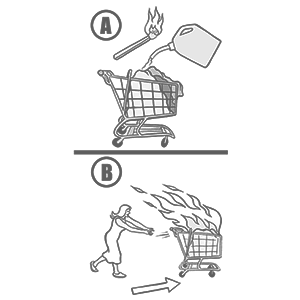
Packard Jennings (b. 1970) is an American artist who appropriates pop culture symbols and references to create new meaning using a variety of media including printmaking, sculpture, animation, video, and pamphleteering.
In his early career he modified billboards, a common practice of culture jammers. Jennings’s work often deals with the philosophy of anarchism, how it’s represented in the media, and the representation of a naive utopia primarily through primitivism, not to be confused with anarchism or anarchy.
read more »
Posted in Art, Money, Politics |
Leave a Comment »
January 7, 2013
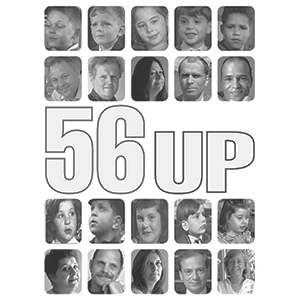
The Up Series is a series of documentary films produced by Granada Television that have followed the lives of fourteen British children since 1964, when they were seven years old. The documentary has had eight episodes spanning 49 years (one episode every seven years) and the documentary has been broadcast on both ITV and BBC.
The children were selected to represent the range of socio-economic backgrounds in Britain at that time, with the explicit assumption that each child’s social class predetermines their future. Every seven years, the director, Michael Apted, films material from those of the fourteen who choose to participate.
read more »
Posted in Art, Money, Science |
Leave a Comment »
January 6, 2013
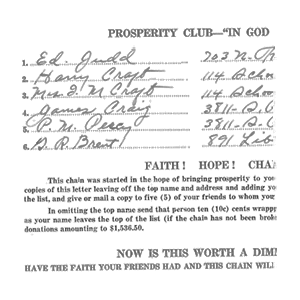
A typical chain letter consists of a message that attempts to convince the recipient to make a number of copies of the letter and then pass them on to as many recipients as possible. Common methods used in chain letters include emotionally manipulative stories, get-rich-quickly pyramid schemes, and the exploitation of superstition to threaten the recipient with bad luck or even physical violence or death if he or she ‘breaks the chain’ and refuses to adhere to the conditions set out in the letter.
Chain letters started as actual letters that one received in the mail. Today, chain letters are generally no longer actual letters. They are sent through email messages, postings on social network sites, and text messages.
read more »
Posted in Language, Money, Technology |
Leave a Comment »
January 3, 2013

Hierarchical [hahy-uh-rahr-ki-kuhl] incompetence is the often observed inability of organizations to achieve the aims set for them. This can be due to the oversimplification of issues and the loss of tacit knowledge about issues as they ascend a hierarchical organization.
There is often an inbuilt tendency for people up the hierarchy to discount information coming from those lower down, particularly if it questions conventional wisdom of the hierarchy. There is a tendency for lateral communication across the various departments, fiefdoms, etc. to be stifled either actively by management, or by self-imposed isolation.
read more »
Posted in Money |
Leave a Comment »
December 24, 2012

Reclaim the Streets (RTS) is a collective with a shared ideal of community ownership of public spaces. Participants characterize the collective as a resistance movement opposed to the dominance of corporate forces in globalization, and to the car as the dominant mode of transport. Reclaim the Streets often stage non-violent direct action street reclaiming events such as the ‘invasion’ of a major road, highway or freeway to stage a party.
While this may obstruct the regular users of these spaces such as car drivers and public bus riders, the philosophy of RTS is that it is vehicle traffic, not pedestrians, who are causing the obstruction, and that by occupying the road they are in fact opening up public space. The events are usually spectacular and colorful with sand pits for children to play in, free food and music, however they have been known to degenerate into riots and violence. A Temporary Autonomous Zone sometimes results. The style of the parties in many places has been influenced by the rave scene in the UK, with sound systems playing dance music.
read more »
Posted in Money, Politics, Technology |
Leave a Comment »
December 24, 2012

‘No Logo: Taking Aim at the Brand Bullies’ is a book by Canadian author Naomi Klein.
First published in December 1999, shortly after the 1999 WTO Ministerial Conference protests in Seattle had generated media attention around such issues, it became one of the most influential books about the alter-globalization movement. The book focuses on branding, and often makes connections with the alter-globalization movement (also known as the the global justice movement).
read more »
Posted in Language, Money, Politics |
1 Comment »
December 23, 2012

Ad-creep refers to the gradual introduction of advertising into previously ad-free spaces. The earliest verified appearance of the term is in a 1996 article ‘Creeping Commercials: Ads Worming Way Into TV Scripts’ by Steve Johnson for the ‘Chicago Tribune,’ however it may have been coined by a subscriber to ‘Stay Free!’ magazine, according to another source.
While the virtues of advertising can be debated, ad-creep often especially refers to advertising which is invasive and coercive, such as ads in schools, doctor’s offices and hospitals, restrooms, elevators, on ATM’s, on garbage cans, on vehicles, and on restaurant menus. In Johnson’s piece, he criticizes product placement and ‘creative advertising enhancements’ as ‘one more manifestation of an environment in which the commercial assault is almost nonstop.’
read more »
Posted in Money, Politics |
Leave a Comment »


 The Daily Omnivore