January 7, 2013
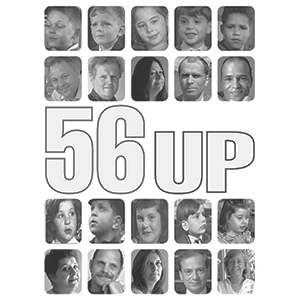
The Up Series is a series of documentary films produced by Granada Television that have followed the lives of fourteen British children since 1964, when they were seven years old. The documentary has had eight episodes spanning 49 years (one episode every seven years) and the documentary has been broadcast on both ITV and BBC.
The children were selected to represent the range of socio-economic backgrounds in Britain at that time, with the explicit assumption that each child’s social class predetermines their future. Every seven years, the director, Michael Apted, films material from those of the fourteen who choose to participate.
read more »
Posted in Art, Money, Science |
Leave a Comment »
January 6, 2013
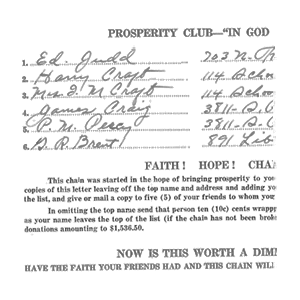
A typical chain letter consists of a message that attempts to convince the recipient to make a number of copies of the letter and then pass them on to as many recipients as possible. Common methods used in chain letters include emotionally manipulative stories, get-rich-quickly pyramid schemes, and the exploitation of superstition to threaten the recipient with bad luck or even physical violence or death if he or she ‘breaks the chain’ and refuses to adhere to the conditions set out in the letter.
Chain letters started as actual letters that one received in the mail. Today, chain letters are generally no longer actual letters. They are sent through email messages, postings on social network sites, and text messages.
read more »
Posted in Language, Money, Technology |
Leave a Comment »
January 3, 2013

Hierarchical [hahy-uh-rahr-ki-kuhl] incompetence is the often observed inability of organizations to achieve the aims set for them. This can be due to the oversimplification of issues and the loss of tacit knowledge about issues as they ascend a hierarchical organization.
There is often an inbuilt tendency for people up the hierarchy to discount information coming from those lower down, particularly if it questions conventional wisdom of the hierarchy. There is a tendency for lateral communication across the various departments, fiefdoms, etc. to be stifled either actively by management, or by self-imposed isolation.
read more »
Posted in Money |
Leave a Comment »
December 24, 2012

Reclaim the Streets (RTS) is a collective with a shared ideal of community ownership of public spaces. Participants characterize the collective as a resistance movement opposed to the dominance of corporate forces in globalization, and to the car as the dominant mode of transport. Reclaim the Streets often stage non-violent direct action street reclaiming events such as the ‘invasion’ of a major road, highway or freeway to stage a party.
While this may obstruct the regular users of these spaces such as car drivers and public bus riders, the philosophy of RTS is that it is vehicle traffic, not pedestrians, who are causing the obstruction, and that by occupying the road they are in fact opening up public space. The events are usually spectacular and colorful with sand pits for children to play in, free food and music, however they have been known to degenerate into riots and violence. A Temporary Autonomous Zone sometimes results. The style of the parties in many places has been influenced by the rave scene in the UK, with sound systems playing dance music.
read more »
Posted in Money, Politics, Technology |
Leave a Comment »
December 24, 2012

‘No Logo: Taking Aim at the Brand Bullies’ is a book by Canadian author Naomi Klein.
First published in December 1999, shortly after the 1999 WTO Ministerial Conference protests in Seattle had generated media attention around such issues, it became one of the most influential books about the alter-globalization movement. The book focuses on branding, and often makes connections with the alter-globalization movement (also known as the the global justice movement).
read more »
Posted in Language, Money, Politics |
1 Comment »
December 23, 2012

Ad-creep refers to the gradual introduction of advertising into previously ad-free spaces. The earliest verified appearance of the term is in a 1996 article ‘Creeping Commercials: Ads Worming Way Into TV Scripts’ by Steve Johnson for the ‘Chicago Tribune,’ however it may have been coined by a subscriber to ‘Stay Free!’ magazine, according to another source.
While the virtues of advertising can be debated, ad-creep often especially refers to advertising which is invasive and coercive, such as ads in schools, doctor’s offices and hospitals, restrooms, elevators, on ATM’s, on garbage cans, on vehicles, and on restaurant menus. In Johnson’s piece, he criticizes product placement and ‘creative advertising enhancements’ as ‘one more manifestation of an environment in which the commercial assault is almost nonstop.’
read more »
Posted in Money, Politics |
Leave a Comment »
December 23, 2012

The Adbusters Media Foundation is a Canadian-based not-for-profit, anti-consumerist, pro-environment organization founded in 1989 by Kalle Lasn and Bill Schmalz in Vancouver. Adbusters describes itself as ‘a global network of artists, activists, writers, pranksters, students, educators and entrepreneurs who want to advance the new social activist movement of the information age.’
Characterized by some as anti-capitalist or opposed to capitalism, it publishes the reader-supported, advertising-free ‘Adbusters,’ an activist magazine with an international circulation of 120,000 devoted to challenging consumerism. Adbusters has launched numerous international campaigns, including ‘Buy Nothing Day,’ ‘TV Turnoff Week,’ and ‘Occupy Wall Street,’ and is known for their ‘subvertisements’ that spoof popular advertisements.
read more »
Posted in Language, Money, Politics |
Leave a Comment »
December 23, 2012

Culture jamming is a tactic used by many anti-consumerist social movements to disrupt or subvert media culture and its mainstream cultural institutions, including corporate advertising. It purports to ‘expose the methods of domination’ of mass society to foster progressive change.
Culture jamming is a form of subvertising (subversive advertising. Many culture jams are intended to expose apparently questionable political assumptions behind commercial culture. Common tactics include re-figuring logos, fashion statements, and product images as a means to challenge the idea of ‘what’s cool’ along with assumptions about the personal freedoms of consumption.
read more »
Posted in Humor, Money, Politics |
Leave a Comment »
December 22, 2012

A bandwidth cap, also known as a bit cap, limits the transfer of a specified amount of data over a period of time. Internet service providers commonly apply a cap when a channel intended to be shared by many users becomes overloaded, or may be overloaded, by a few users. Implementation of a bandwidth cap is sometimes termed a Fair Access Policy or Usage-based billing. In many situations, each user of a network is expected to use high speed transmission for only a short time, for example to download a megabyte web page in less than a second.
When use is continuous, as it might be in the case of file sharing, Internet radio or streaming video, a few users who use the connection at high rates for hours at a time may seriously impair the service of others. The concept is more relevant in cable internet where both the core network and the access network are shared, than in DSL where the core network is shared but the access network is not. It is most relevant in wireless internet, particularly satellite internet, where both the core network and the access network are shared and total network bandwidth is relatively narrow.
read more »
Posted in Money, Technology, World |
Leave a Comment »
December 21, 2012
Copyright Criminals is a 2010 documentary film directed and produced by Benjamin Franzen examining the creative and the commercial value of sampling including the related debates over artistic expression, copyright law, and money. Copyright Criminals was funded by the Ford Foundation, University of Iowa, and John D. and Catherine T. MacArthur Foundation. It premiered in 2010 at the Toronto Film Festival. Sampling is when musicians make an audio montage taking a portion, or sample, of a sound recording and reusing, remixing or reworking it as a separate instrumental layer or loop into another song.
The documentary contains interviews with several sampling artist pioneers, including hip-hop groups. A longtime area of contention from a legal perspective, early sampling used portions of other artists’ recordings without permission. Once hip-hop, rap and other music incorporating sampling began generating a noticeably substantial income, the original artists began to take legal action, claiming copyright infringement and demanding high-sum royalties. Sampling artists fought back, claiming fair use (an exception in copyright law).
Posted in Art, Money, Politics |
Leave a Comment »
December 21, 2012

Eclectic Method is the name of an audio-visual remix act, originally formed in London in 2001 by Geoff Gamlen, Ian Edgar, Johnny Wilson.
They quickly developed Eclectic Method’s audio-visual style into a live performance featuring video turntables (Pioneer DVJ-1000) – mixing the visuals and audio in real time. As a live act, they have traveled around the world playing hundreds of gigs in Asia, North America, South America, Europe and the Middle East.
read more »
Posted in Art, Money, Technology |
Leave a Comment »
December 19, 2012

Autism friendly means awareness of social engagement and environmental factors affecting people on the autism spectrum, with modifications to communication methods and physical space to better suit individual’s unique and special needs. Individuals on the autism spectrum take in information from their five senses as do neurotypical people, but they are not able to process it as quickly and can become overwhelmed by the amount of information that they are receiving and withdraw as a coping mechanism.
They may experience difficulty in public settings due to inhibited communication, social interaction or flexibility of thought development. Knowing about these differences and how to react effectively helps to create a more inclusive society. It also better suits the needs of the growing number of individuals with autism, Asperger syndrome (high functioning autism), or other disorders on the autism spectrum.
read more »
Posted in Health, Money |
Leave a Comment »



