September 15, 2011

Lewis Hine (1874 – 1940) was an American sociologist and photographer. Hine used his camera as a tool for social reform. His photographs were instrumental in changing the child labor laws in the United States. Born in Oshkosh, Wisconsin in 1874. After his father died in an accident, he began working and saved his money for a college education.
Hine studied sociology at the University of Chicago, Columbia University and New York University. He became a teacher in New York City at the Ethical Culture School, where he encouraged his students to use photography as an educational medium. The classes traveled to Ellis Island in New York Harbor, photographing the thousands of immigrants who arrived each day. Between 1904 and 1909, Hine took over 200 plates (photographs), and eventually came to the realization that his vocation was photojournalism.
read more »
Posted in Money, Politics, Science |
Leave a Comment »
September 12, 2011
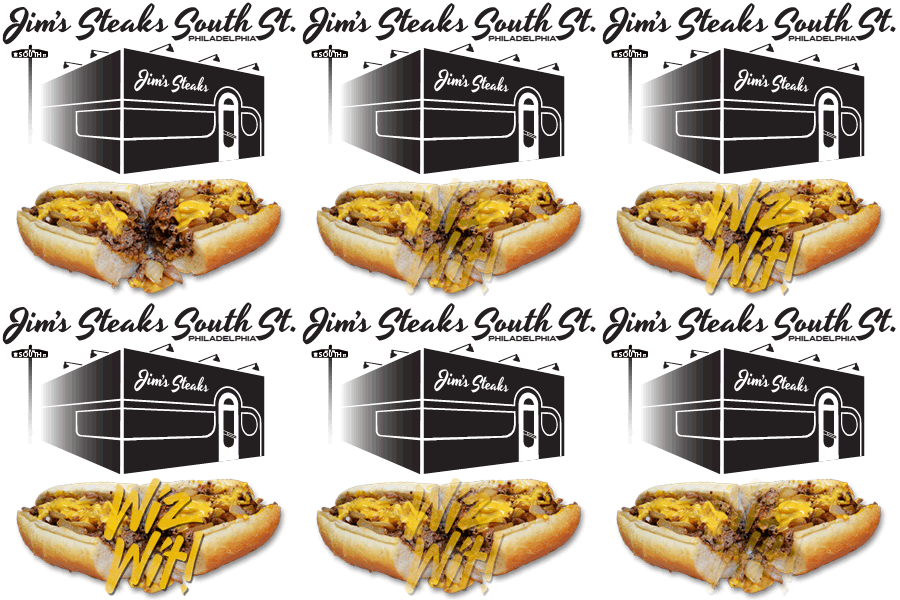
Cheez Whiz is a thick processed cheese sauce or spread sold by Kraft Foods. It was developed by a team led by food scientist Edwin Traisman and was first marketed in 1953. The bright orange, viscous paste usually comes in a glass jar and is used as a topping for celery, cheesesteaks, corn chips, hot dogs and other foods. It is marketed in Canada, México, the Philippines, the United States and Venezuela.
Cheez Whiz is one of a number of ‘processed cheese foods,’ a category including some types of individually-wrapped cheese slices. These products contain regular cheese that has been reprocessed along with additional ingredients such as emulsifiers and stabilizing agents, such as xanthan gum or carrageenan. These products derive their tanginess and flavor from additional ingredients such as citric acid and flavoring compounds. Annatto is used for coloring. In some markets, the product has been sold in a narrow jar that tapered towards the base when sold as a spread. When Cheez Whiz is advertised as a dip or a sauce, the jars are larger and more of a squat cylindrical shape.
Posted in Food, Money |
Leave a Comment »
September 12, 2011

Easy Cheese is the trademark for a processed cheese product distributed by Kraft Foods, also referred to as aerosol cheese or spray cheese, and is a descendant of squeeze cheese (a semi-solid cheesefood from the 1970s packaged in a squeezable plastic tube). It comes packaged in a spray can, much like canned whipped cream and does not require refrigeration. Easy Cheese contains milk, water, whey protein concentrate, canola oil, milk protein concentrate, sodium citrate, sodium phosphate, calcium phosphate, lactic acid, sorbic acid, sodium alginate, apocarotenal, annatto, cheese culture, and enzymes.
Although sometimes called ‘aerosol cheese,’ its container is not actually an aerosol spray can. Rather, the can contains a piston and a barrier plastic cap which squeezes the cheese through the nozzle in a solid column when the nozzle is pressed and the propellant expands in volume. The propellant, therefore, does not mix with the cheese. This explains why the can has a small rubber plug on its base. The can design also ensures that the cheese can be dispensed with the can upright or inverted.
Posted in Food, Money, Technology |
Leave a Comment »
September 12, 2011


Processed cheese is a food product made from normal cheese and sometimes other unfermented dairy ingredients, plus emulsifiers, extra salt, food colorings, or whey. Many flavors, colors, and textures of processed cheese exist. In the United States, the most recognizable variety of processed cheese is sold under the name American cheese, although this name also has other meanings. The Laughing Cow is an example of processed cheese.
Although processed cheese was first invented in 1911 by Walter Gerber of Thun, Switzerland, it was James L. Kraft who first applied for an American patent for his method in 1916. Kraft Foods also created the first commercially available sliced processed cheese, which was introduced in 1950. This form of sliced cheese and its derivatives have become commonplace in the United States, most notably used for cheeseburgers and grilled cheese sandwiches.
read more »
Posted in Food, Health, Money |
Leave a Comment »
September 12, 2011

Kraft Singles is a processed ‘cheese product’ manufactured and sold by Kraft Foods, introduced in 1949. Although processed cheese was first invented in 1911 by Walter Gerber of Thun, Switzerland, it was James L. Kraft who first applied for an American patent for his method in 1916. Kraft Foods also created the first commercially available sliced processed cheese, which was introduced in 1950.
One of the more famous ad campaigns in the 1980s claimed that each ¾ ounce slice contained ‘five ounces of milk’ (with milk being poured into a glass next to Kraft Singles), which makes them taste better than imitation cheese slices made mostly with vegetable oil and water (with oil being poured into a glass next to imitation cheese) and hardly any milk. The campaign was lambasted for its implications that each slice contained the same amount of calcium as a five ounce glass of milk and also more calcium than imitation cheese slices, which eventually led to a ruling by the Federal Trade Commission in 1992 that ordered Kraft to stop making false claims in its advertising. Kraft removed the ads, but continues to taut the use of milk in its ‘cheese products.’
Posted in Food, Money, Politics |
Leave a Comment »
September 12, 2011
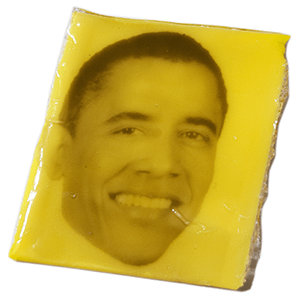
American cheese is a processed cheese, mild in flavor, with a medium-firm consistency, which melts easily. It was originally only white in color, but is usually now darkened to yellow or orange, typically with annatto, a natural food coloring.
At one time it was made from a blend of cheeses, most often Colby and Cheddar, but today’s American cheese is typically manufactured from raw ingredients, such as milk, whey, milkfat, milk protein concentrate, whey protein concentrate, and salt. In many jurisdictions, it does not meet the legal definition of cheese and must be labeled as ‘cheese analogue,’ ‘cheese product,’ ‘processed cheese,’ or similar and is commonly referred to as ‘plastic cheese’ or ‘burger cheese’ in the UK.
read more »
Posted in Food, Money, World |
1 Comment »
September 9, 2011


Freeter is a Japanese expression for people between the ages of 15 and 34 who lack full time employment or are unemployed, excluding housewives and students. The term originally included young people who deliberately chose not to become salary-men, even though jobs were available at the time. Freeters may also be described as underemployed or freelance workers.
These people do not start a career after high school or university, but instead earn money from low skilled and low paid jobs. The low income makes it difficult for freeters to start a family, and the lack of qualifications makes it difficult to start a career at a later point in life. Freeters have sometimes been glamorized as people pursuing their dreams and trying to live life to the fullest.
read more »
Posted in Language, Money, World |
1 Comment »
September 9, 2011

Laziness (also called indolence) is a disinclination to activity or exertion despite having the ability to do so. It is often used as a pejorative; related terms for a person seen to be lazy include couch potato, slacker, and in Australian slang, bludger.
Despite Sigmund Freud’s discussion of the pleasure principle, American psychologist Leonard Carmichael notes that ‘laziness is not a word that appears in the table of contents of most technical books on psychology… It is a guilty secret of modern psychology that more is understood about the motivation of thirsty rats and hungry pecking pigeons as they press levers or hit targets than is known about the way in which poets make themselves write poems or scientists force themselves into the laboratory when the good golfing days of spring arrive.’
read more »
Posted in Health, Language, Money |
Leave a Comment »
September 7, 2011

Hilti develops, manufactures, and markets products for the construction and building maintenance industries, primarily to the professional end-user. It concentrates primarily on hammer drills, firestops, and installation systems, but manufactures and markets an array of tools (including cordless electric drills, heavy angle drills, laser levels, power saws, and fasteners). Hilti is based in Liechtenstein, and is the principality’s largest employer. The company employs more than 20,000 people worldwide with over 2,500 employees in the United States. Hilti’s North American headquarters has been located in Tulsa, Oklahoma, since 1979.
The Hilti Group invests over US$160 million annually in researching and developing safer and more efficient building technologies. A recent example of this R&D in power tool technology is Hilti’s TPS (Theft Protection System), which relies on RF technology to prevent unauthorized users from activating power tools, thus discouraging theft. Similarly, Hilti’s ATC (Active Torque Control) technology monitors tool-body movement to prevent equipment from twisting out of the operator’s grip and causing injury. Other developments include improved design of chemical and mechanical anchors for better durability during seismic events, thus helping to save lives during natural disasters.
Posted in Money, Technology |
1 Comment »
September 7, 2011
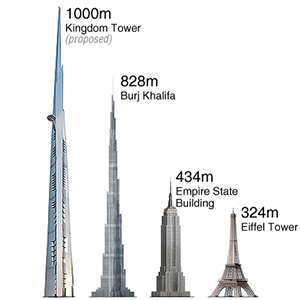
Kingdom Tower is a supertall skyscraper approved for construction in Jeddah, Saudi Arabia at a preliminary cost of US$1.23 billion. It will be the centerpiece and first phase of a US$20 billion proposed development known as Kingdom City that will be located along the Red Sea on the north side of Jeddah. If completed as planned, the tower will reach unprecedented heights, becoming the tallest building in the world, as well as the first structure to reach the one-kilometer mark. The design, created by American architect Adrian Smith, incorporates many unique structural and aesthetic features.
The creator and leader of the project is Saudi Arabian Prince Al-Waleed bin Talal, the wealthiest Arab in the Middle East, and nephew of King Abdullah. Talal is the chairman of Kingdom Holding Company (KHC), the largest company in Saudi Arabia, which owns the project, and a partner in Jeddah Economic Company (JEC), which was formed in 2009 for the development of Kingdom Tower and City. Reception of the proposal has been highly polarized, receiving high praise from some as a culturally significant icon that will symbolize the nation’s wealth and power, while others question its socioeconomic motives, and forecast that it will actually have negative financial consequences.
Posted in Money, Technology, World |
1 Comment »
September 7, 2011

Bowie Bonds are asset-backed securities of current and future revenues of the 25 albums (287 songs) that David Bowie recorded before 1990. Issued in 1997, the bonds were bought for US$55 million by the Prudential Insurance Company. The bonds paid an interest rate of 7.9% and had an average life of ten years. Royalties from the 25 albums generated the cash flow that secured the bonds’ interest payments. By forfeiting ten years worth of royalties, David Bowie was able to receive a payment of US$55 million up front. Bowie used this income to buy songs owned by his former manager.
The Bowie Bond issuance was perhaps the first instance of intellectual property rights securitization. The securitization of the collections of other artists, such as James Brown, Ashford & Simpson and the Isley Brothers, later followed. These Bonds are named Pullman Bonds after David Pullman, the banker who pushed the original Bowie deal. In March 2004, Moody’s Investors Service lowered the bonds from an A3 rating (the seventh highest rating) to Baa3, one notch above junk status. This downgrade was prompted by lower-than-expected revenue ‘due to weakness in sales for recorded music.’ A downgrade to an unnamed company that guarantees the issue was also cited as a reason for the downgrade. However, the success of Apple’s iTunes and other legal online music retailers has led to a renewed interest in Bowie and Pullman Bonds.
Posted in Art, Language, Money |
Leave a Comment »
September 7, 2011
Bubblegum is a type of elastic chewing gum, designed to be blown out of the mouth as a bubble. A 23-inch bubble blown by Susan Montgomery Williams of California in 1996 holds the Guinness World Record for largest bubble blown. Bubble gum was invented by Walter Diemer in 1928. Diemer was working as an accountant for the Fleer Chewing Gum Company in Philadelphia. In his spare time, he experimented with a new gum recipes. The gum he invented was less sticky than regular chewing gum, and stretched more easily. He sold his gum under the name Dubble Bubble in 1928. Original bubble gum was pink because that was the only dye Diemer had on hand at the time.
Bubblegum is available in many different colors and flavors. ‘Bubblegum flavor’ is the taste of the plain gum, an d it is made from synthetic chemicals, such as ethyl methylphenylglycidate, isoamyl acetate and others, and fruit extracts, the true ingredients being kept a mystery to customers. When blended, the chemicals and extracts fuse together to make a sweet, palatable flavor. Other flavors also include strawberry, apple, cherry, watermelon, cinnamon, banana, and grape. Strawberry and banana can be achieved with isoamyl acetate limonene and ethyl methylphenylglycidate, respectively. Malic acid can be used for apple flavor, allyl hexanoate for pineapple, ethyl propionate for fruit punch, cinnamic aldehyde for cinnamon, and acetophenone for cherry.
Posted in Food, Money |
Leave a Comment »