March 29, 2013
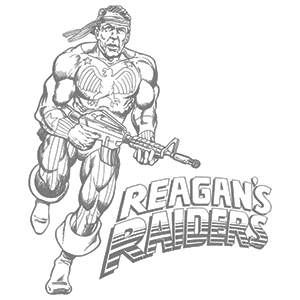
The American Monomyth is a 1977 book by Robert Jewett and John Shelton Lawrence arguing for the existence and cultural importance of an ‘American Monomyth,’ a variation on the classical monomyth (the hero’s journey, a theme found in narratives from around the world) as proposed by Joseph Campbell. The hero ventures from the normal world into a supernatural one, winning a decisive victory there and returning with a ‘boon.’
In contrast, Jewett and Lawrence define the American monomyth as: ‘A community in a harmonious paradise is threatened by evil; normal institutions fail to contend with this threat; a selfless superhero emerges to renounce temptations and carry out the redemptive task; aided by fate, his decisive victory restores the community to its paradisiacal condition; the superhero then recedes into obscurity.’
Posted in Language, Politics, World |
Leave a Comment »
March 29, 2013

The American way of life is an expression that refers to the lifestyle of people living in the United States of America. It is an example of a behavioral modality, developed from the 17th century until today.
It refers to a nationalist ethos that purports to adhere to principles of ‘life, liberty and the pursuit of happiness.’ It has some connection to the concept of American exceptionalism and the American Dream.
read more »
Posted in Language, Politics, World |
Leave a Comment »
March 29, 2013
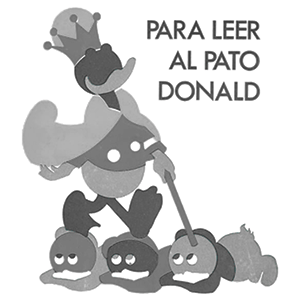
How to Read Donald Duck (‘Para leer al Pato Donald’) is a political analysis by Chilean activists Ariel Dorfman and Armand Mattelart, published in 1972. It is a pioneering work on cultural imperialism. Written in the form of essay (or, in the authors’ words, a ‘decolonization manual’), the book is an analysis of mass literature, specifically the Disney comics published for the Latin American market.
It is one of the first social studies of entertainment and the leisure industry from a political-ideological angle, and the book deals extensively with the political role of children’s literature. The book’s thesis is that Disney comics are not only a reflection of the prevailing ideology at the time (capitalism), but that they are also aware of this, and are active agents in spreading the ideology.
read more »
Posted in Money, Politics, World |
Leave a Comment »
March 21, 2013

Prison sexuality deals with sexual relationships between confined individuals or those between a prisoner and a prison employee (or other persons to whom prisoners have access). Since prisons are separated by gender, most sexual activity is conducted with a same-sex partner, often in contradiction to a person’s normal social sexual orientation. Exceptions to this are sex with an employee of the opposite sex, as well as conjugal visits.
According to ‘Human Rights Watch’ 2001 report ‘No Escape: Male Rape in U.S. Prisons,’ sexual slavery frequently poses as a consensual sexual relationship. Rape victims are often intimidated into feigning consent to sexual activity, to the point of becoming ‘slaves’ and the figurative property of their rapists. This occurs in both male and female prisons.
read more »
Posted in Politics, Sex |
Leave a Comment »
March 21, 2013

The treatment of animals in rodeo has been a source of concern for the industry, the public, and the law for decades. Protests were first raised in the 1870s, and, in the middle twentieth century, laws were enacted to curb events using animals. The American Humane Association (AHA) has worked with the rodeo industry (specifically, the PRCA, Professional Rodeo Cowboys Association) to establish rules improving animal treatment in rodeo and the treatment of rodeo animals. Today, animal cruelty complaints in rodeo are still very much alive, and continue to be a source of aggravation to the rodeo industry.
The PRCA (which governs about a third of the rodeos conducted in the United States annually) has provided rules for its members regarding animal welfare. Some locals have banned the use of certain rodeo tack (equipment worn by an animal) including flank straps (also called ‘bucking straps,’ irritants which encourage bucking) and certain events such as steer tripping (roping). Some charreada (amateur Mexican-American rodeo) events staged in the United States saw a crack down in the early years of the twenty-first century.
read more »
Posted in Games, Money, Politics |
1 Comment »
March 21, 2013

Consumerism is a social and economic order that encourages the purchase of goods and services in ever-greater amounts. The term is often associated with criticisms of consumption starting with American economist Thorstein Veblen. However, the term is also used to refer to the consumerists movement, consumer protection or consumer activism, which seeks to protect and inform consumers by requiring such practices as honest packaging and advertising, product guarantees, and improved safety standards.
In economics, consumerism refers to economic policies placing emphasis on consumption. In an abstract sense, it is the belief that the free choice of consumers should dictate the economic structure of a society. Consumerism has weak links with the Western world, but is in fact an international phenomenon. People purchasing goods and consuming materials in excess of their basic needs is as old as the first civilizations.
read more »
Posted in Money, Politics |
Leave a Comment »
March 20, 2013

Margaret Sanger (1879 – 1966) was an American birth control activist, sex educator, and nurse. Sanger popularized the term ‘birth control,’ opened the first birth control clinic in the United States, and established Planned Parenthood. Sanger’s efforts contributed to the landmark U.S. Supreme Court case which legalized contraception in the United States.
Sanger is a frequent target of criticism by opponents of birth control and has also been criticized for supporting eugenics (‘racial hygiene’), but remains an iconic figure in the American reproductive rights movement. Sanger’s early years were spent in New York City. In 1914, prompted by suffering she witnessed due to frequent pregnancies and self-induced abortions, she started a monthly newsletter, ‘The Woman Rebel.’ Sanger’s activism was influenced by the conditions of her youth—her mother had 18 pregnancies in 22 years, and died at age 50 of tuberculosis and cervical cancer.
read more »
Posted in Health, Politics, Sex |
Leave a Comment »
March 20, 2013

The Nureongi is a yellowish, local dog breed from Korea. It is most often used as a livestock dog, raised for its meat and not commonly kept as a pet. This dog has no formal name in the Korean language. ‘Nureongi’ and ‘hwangu’ are informal Korean words meaning ‘yellow one,’ and might best translate as ‘Brownie’ or ‘Blackie. Another common term is the Korean slang ‘ddong-gae,’ meaning ‘dung dogs’ or ‘shit dogs,’ which refers to the common dogs’ habit of eating feces.
The consumption of dog meat in South Korea, where it is known as ‘Gaegogi,’ has a long history in that country, as well as that of other East Asian cultures. In recent years, it has been controversial both in South Korea and around the world, due to animal rights and sanitary concerns. There is a large and vocal group of Korean people that are against the practice of eating dog meat. There is also a large population of people in South Korea that do not eat or enjoy the meat, but do feel strongly that it is the right of others to do so. There is a smaller but still vocal group of pro-dog cuisine people in South Korea who want to popularize the consumption of dog in Korea and the rest of the world, considering it to be part of the traditional culture of Korea with a long history worth preserving.
Posted in Food, Politics, World |
1 Comment »
March 18, 2013

Nina Paley (b. 1968) is an American cartoonist, animator and free culture activist. She directed the animated feature film ‘Sita Sings the Blues.’ She was the artist and often the writer of comic strips ‘Nina’s Adventures’ and ‘Fluff,’ but most of her recent work has been in animation. Her early short films include ‘Fetch!,’ ‘The Stork,’ and ‘The Wit & Wisdom of Cancer.’ Paley was born in Urbana, Illinois, to Hiram and Jean Paley in an American Jewish family.
Her father was a mathematics professor at the University of Illinois and was mayor of Urbana, where they resided, for a term in the early 1970s. She attended local elementary and high schools, illustrating a ‘History of the North Pole’ comic in collaboration with University High School history teacher Chris Butler, and attended the University of Illinois, studying art for two years.
read more »
Posted in Art, Money, Politics |
Leave a Comment »
March 18, 2013

Paul Krassner (b. 1932) is an American author, journalist, stand-up comedian, and the founder, editor and a frequent contributor to the freethought magazine ‘The Realist,’ first published in 1958. Krassner became a key figure in the counterculture of the 1960s as a member of Ken Kesey’s ‘Merry Pranksters’ and a founding member of the Yippies (Youth International Party).
Krassner was a child violin prodigy (and was the youngest person ever to play Carnegie Hall, in 1939 at age six). His parents were Jewish, but Krassner is firmly secular, considering religion ‘organized superstition.’
read more »
Posted in Humor, Language, Politics |
1 Comment »
March 18, 2013
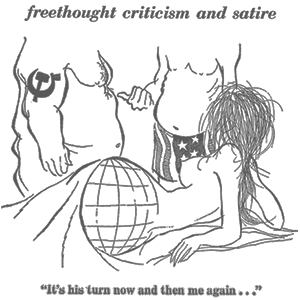
The Realist was a pioneering magazine of ‘social-political-religious criticism and satire, ‘intended as a hybrid of a grown-ups version of ‘Mad’ and Lyle Stuart’s anti-censorship monthly ‘The Independent.’ Edited and published by journalist and stand-up comedian Paul Krassner, and often regarded as a milestone in the American underground or countercultural press of the mid-20th century, it was a nationally-distributed newsstand publication as early as 1959.
Publication was discontinued in 2001. First published in the spring of 1958 in New York City in the offices of ‘Mad,’ ‘The Realist’ appeared on a fairly regular schedule during the 1960s and then on an irregular schedule after the early 1970s. In 1984, it was revived as a much smaller newsletter. Articles and cartoons from the magazine were collected in a book, ‘The Best of the Realist.’
read more »
Posted in Humor, Language, Politics |
Leave a Comment »
March 18, 2013
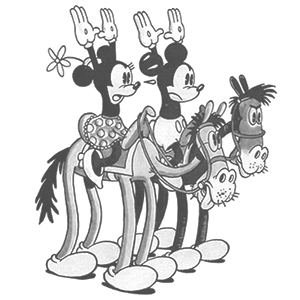
The Air Pirates were a group of cartoonists who created two issues of an underground comic called ‘Air Pirates Funnies’ in 1971, leading to a famous lawsuit by The Walt Disney Company. Founded by Dan O’Neill, the group also included Shary Flenniken, Bobby London, Gary Hallgren, and Ted Richards. The collective shared a common interest in the styles of past masters of the comic strip, and in creating their stories for the collective each set out to imitate the style of an old time cartoonist.
Flenniken emulated Clare Briggs and H. T. Webster in her ‘Trots and Bonnie’ comics, London’s strip ‘Dirty Duck’ paid homage to the style of George Herriman’s ‘Krazy Kat,’ Richards’ ‘Dopin’ Dan’ was supposed to be influenced by Bud Fisher but showed more similarity to Mort Walker’s ‘Beetle Bailey,’ and Gary Hallgren drew a strip called ‘Pollyanna Pals’ in the style of Cliff Sterrett’s ‘Polly and Her Pals.’ The original Air Pirates were a gang of Mickey Mouse antagonists of the 1930s; O’Neill regarded Mickey Mouse as a symbol of conformist hypocrisy in American culture, and therefore a ripe target for satire.
read more »
Posted in Art, Humor, Politics |
Leave a Comment »


 The Daily Omnivore