February 25, 2012

Moneybomb is a neologism coined in 2007 to describe a grassroots fundraising effort over a brief fixed time period, usually to support a candidate for election by dramatically increasing, concentrating, and publicizing fundraising activity during a specific hour or day. The term was first applied to a supporter-led fundraiser on behalf of presidential candidate Ron Paul.
The effort combines traditional and Internet-based fundraising appeals focusing especially on viral advertising through online vehicles such as YouTube, Facebook, and online forums. In the case of lesser-known candidates it is also intended to generate significant free mass media coverage the candidate would otherwise not receive. The term has also been used as a verb and apparently arose from analogy with the neologism ‘googlebomb,’ a method of search engine optimization.
Posted in Money, Politics, Technology |
Leave a Comment »
February 23, 2012

Free speech zones (also known as ‘First Amendment Zones’) are areas set aside in public places for political activists to exercise their right of free speech in the US. The First Amendment states that ‘Congress shall make no law… abridging… the right of the people peaceably to assemble, and to petition the Government for a redress of grievances.’ The existence of free speech zones is based on court decisions stipulating that the government may regulate the time, place, and manner—but not content—of expression.
The stated purpose is to protect the safety of those attending the political gathering, or for the safety of the protesters themselves. Critics, however, suggest that such zones are ‘Orwellian,’ and that authorities use them in a heavy-handed manner to censor protesters by putting them literally out of sight of the mass media, hence the public, as well as visiting dignitaries. Civil libertarians claim that such areas are used as a form of censorship and public relations management to conceal the existence of popular opposition from the mass public and elected officials.
Posted in Language, Politics, World |
Leave a Comment »
February 23, 2012

Jewish humor is self-deprecating, crude, and often anecdotal humor originating in Eastern Europe, which took root in the United States over the last hundred years. Beginning with vaudeville, and continuing through radio, stand-up comedy, film, and television, a disproportionately high percentage of American and Russian comedians have been Jewish.
Jewish humor is rooted in several traditions. The first is the intellectual and legal methods of the Talmud, which uses elaborate arguments and situations often seen as so absurd as to be humorous in order to tease out the meaning of religious law. There is an egalitarian tradition among the Jewish communities of Eastern Europe in which the powerful were often mocked subtly, rather than attacked overtly—as Saul Bellow once put it, ‘oppressed people tend to be witty.’ Jesters known as badchens used to poke fun at prominent members of the community during weddings, creating a good-natured tradition of humor as a levelling device.
read more »
Posted in Humor, Philosophy, Politics |
1 Comment »
February 22, 2012

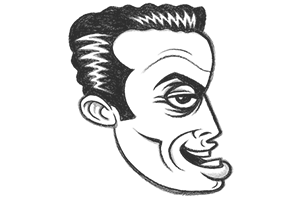
Blue comedy is comedy that is off-color, risqué, indecent or profane, largely about sex. It often contains profanity and/or sexual imagery that may shock and offend some audience members. ‘Working blue’ refers to the act of performing this type of material. A ‘blue comedian’ or ‘blue comic’ is a comedian who usually performs blue, or is known mainly for his or her blue material. Blue comedians often find it difficult to succeed in mainstream media.
Many comedians who are normally family-friendly might choose to work blue when off-camera or in an adult-oriented environment; Bob Saget exemplifies this dichotomy. A recording survives of one Masquers roast from the 1950s with Jack Benny, George Jessel, George Burns, and Art Linkletter all using highly risque material and, in some cases, obscenities. In the 1970s, CBS aired the ground-breaking sitcom ‘All in the Family,’ based on the British series ‘Till Death Us Do Part,’ which featured a ‘lovable’ bigot, Archie Bunker. The character’s dialogue usually contained racial prejudices and ethnic slurs, as well as derogatory comments against Jews, gays and women’s rights, but in a guise of blue humor against his own bigotry.
Posted in Humor, Politics, Sex |
1 Comment »
February 22, 2012
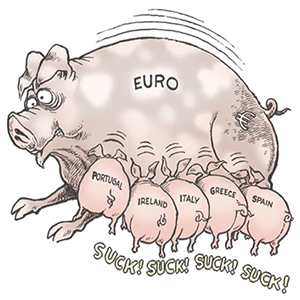
PIGS is a pejorative acronym used to refer to the economies of Portugal, Italy, Greece and Spain which are facing a financial crisis.
Since 2008, the term has included Ireland, either in place of Italy or with an additional I. Some news organizations have limited or banned use of the term because of criticism regarding perceived offensive connotations. The term has been used since at least the mid-1990s as an epithet.
Posted in Money, Politics, World |
1 Comment »
February 21, 2012

Everybody Draw Mohammed Day was an event held on 20 May 2010 in support of free speech and freedom of artistic expression of those threatened by violence for drawing representations of the Islamic Prophet Muhammad. It began as a protest against censorship of an American television show, ‘South Park,’ ‘201’ by its distributor, Comedy Central, in response to death threats against some of those responsible for two segments broadcast in April. Observance of the day began with a drawing posted on the Internet on April 20, 2010, accompanied by text suggesting that ‘everybody’ create a drawing representing Muhammad, on May 20, 2010, as a protest against efforts to limit freedom of speech. U.S. cartoonist Molly Norris of Seattle created the artwork. Depictions of Muhammad are explicitly forbidden by a few hadiths (sayings of and about Muhammad), though not by the Qur’an.
South Park episodes ‘200’ and ‘201,’ broadcast in April 2010, featured a character in a bear costume, who various other characters stated was Muhammad. The ‘South Park’ episode sparked statements from the extremist website Revolution Muslim, which posted a picture of the partially decapitated body of the Dutch filmmaker, Theo van Gogh, with a statement declaring that Parker and Stone could meet a similar fate. Comedy Central self-censored the episode when it was broadcast by removing the word ‘Muhammad’ and a speech about intimidation and fear from the episode.
Posted in Humor, Philosophy, Politics |
1 Comment »
February 19, 2012

Tank Man, or the Unknown Rebel, is the nickname of an anonymous man who stood in front of a column of Chinese Type 59 tanks the morning after the Chinese military forcibly removed protestors from in and around Beijing’s Tiananmen Square in the summer of 1989. The man achieved widespread international recognition due to the videotape and photographs taken of the incident. Despite his anonymity, he is commonly (though not necessarily correctly) referred to in Chinese as Wang Weilin.
The man placed himself alone in the middle of the street as the tanks approached, directly in the path of the armored vehicles. He held two shopping bags, one in each hand. As the tanks came to a stop, the man gestured towards the tanks with his bags. In response, the lead tank attempted to drive around the man, but the man repeatedly stepped into the path of the tank in a show of nonviolent action. After repeatedly attempting to go around rather than crush the man, the lead tank stopped its engines, and the armored vehicles behind it seemed to follow suit. There was a short pause with the man and the tanks having reached a quiet, still impasse.
read more »
Posted in Politics, War, World |
2 Comments »
February 19, 2012
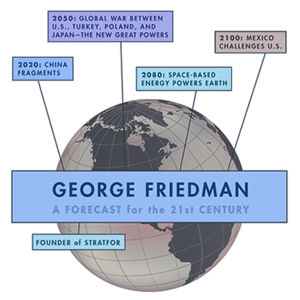
The Next 100 Years is a 2009 non-fiction book by American political scientist George Friedman. In the book, Friedman attempts to predict the major geopolitical events and trends of the 21st century. Friedman also speculates in the book on changes in technology and culture that may take place during this period. Friedman predicts a second American cold war with Russia in the 2010s. Friedman asserts that around 2015, the United States will become a close ally to some Eastern European countries, who will be dedicated to resisting Russian geopolitical threats during this period.
Friedman speculates in the book that the United States will probably become a close ally of Poland, the Czech Republic, Hungary, and Romania, who may form a military alliance during this period. According to Friedman’s prediction, around the year 2020, Russia will collapse, fragment, and disintegrate from the economic and political pressure of a second cold war.
read more »
Posted in Language, Politics, War |
Leave a Comment »
February 18, 2012
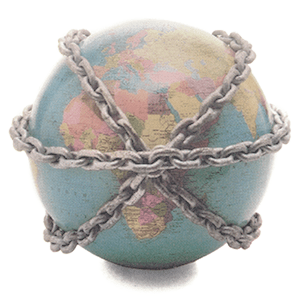
The Limits to Growth is a 1972 book modeling the consequences of a rapidly growing world population and finite resource supplies, commissioned by the Club of Rome (a global think tank) and firstly presented at the 3. St. Gallen Symposium (an annual conference taking place at the University of St. Gallen in Switzerland, aimed at fostering intergenerational and intercultural dialogue between the decision makers of today and tomorrow). The book echoes some of the concerns and predictions of the Reverend Thomas Robert Malthus in ‘An Essay on the Principle of Population’ (1798).
Its authors were Donella H. Meadows, Dennis L. Meadows, Jørgen Randers, and William W. Behrens III. The book used World3, a computer model to simulate the consequence of interactions between the Earth’s and human systems. Five variables were examined in the original model, on the assumptions that exponential growth accurately described their patterns of increase, and that the ability of technology to increase the availability of resources grows only linearly. These variables are: world population, industrialization, pollution, food production and resource depletion.
read more »
Posted in Politics, Technology, World |
Leave a Comment »
February 18, 2012

‘In the Year 2525 (Exordium and Terminus)’ is a hit song from 1969 by American pop-rock duo Zager and Evans. It opens with the words ‘In the year 2525, If man is still alive, If woman can survive, They may find…’ Subsequent verses pick up the story at 1,010-year intervals from 2525 to 6565. Disturbing predictions are given for each selected year. In the year 3535, for example, all of a person’s actions, words and thoughts will be preprogrammed into a daily pill. Then the pattern as well as the music changes, going up a half step in the key of the song, after two stanzas, first from A flat minor, to A minor, and, then, finally, to B flat minor, and verses for the years 7510, 8510 and 9595 follow.
The overriding theme, of a world doomed by its passive acquiescence to and overdependence on its own overdone technologies, struck a resonant chord in millions of people around the world in the late 1960s. The song describes a nightmarish vision of the future as man’s technological inventions gradually dehumanize him. It includes a colloquial reference to the Second Coming (In the year 7510, if God’s a-coming, He ought to make it by then.), which echoed the zeitgeist of the Jesus Movement.
Posted in Art, Politics, Technology |
1 Comment »
February 18, 2012

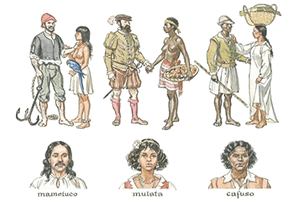
The Race of the Future theory states that due to the process of miscegenation, the mixing of different races, especially in marriage, cohabitation, or sexual relations, all the races are blending to become one single new race in the future. Count Richard Nikolaus von Coudenhove-Kalergi distinctly advocated race mixing in his 1925 book ‘Practical Idealism’: ‘The man of the future will be of mixed race. Today’s races and classes will gradually disappear owing to the vanishing of space, time, and prejudice. The Eurasian-Negroid race of the future, similar in its appearance to the Ancient Egyptians, will replace the diversity of peoples with a diversity of individuals.’
The same scenario had been envisaged, with rather less enthusiasm, by Madison Grant in his 1916 book ‘The Passing of the Great Race,’ calling for an eugenics program to prevent this development, and in a similar ideological context in Lothrop Stoddard’s ‘The Rising Tide of Color Against White World-Supremacy’ in 1920. In the United States, the proportion of Multiracial American children is growing. Interracial partnerships are rising, as are transracial adoptions.
Posted in Politics, Sex, World |
Leave a Comment »
February 18, 2012
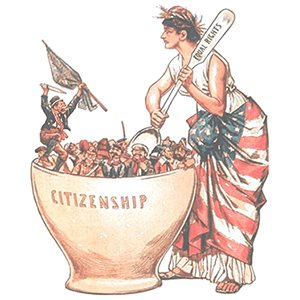
The melting pot is a metaphor for a heterogeneous society becoming more homogeneous, the different elements ‘melting together’ into a harmonious whole with a common culture. It is particularly used to describe the assimilation of immigrants to the United States; the melting-together metaphor was in use by the 1780s.
After 1970 the desirability of assimilation and the melting pot model was challenged by proponents of multiculturalism, who assert that cultural differences within society are valuable and should be preserved, proposing the alternative metaphor of the mosaic or salad bowl – different cultures mix, but remain distinct.
read more »
Posted in Language, Politics, World |
Leave a Comment »



