March 10, 2013

Pharming is a portmanteau of farming and ‘pharmaceutical’ and refers to the use of genetic engineering to insert genes that code for useful pharmaceuticals into host animals or plants that would otherwise not express those genes, thus creating a genetically modified organism (GMO).
The products of pharming are typically recombinant proteins (or their metabolic products), which are proteins that result from the expression of recombinant DNA (molecular cloning in a laboratory brings together genetic material from multiple sources, creating sequences that would not otherwise be found in biological organisms). Recombinant proteins are most commonly produced using bacteria or yeast in a bioreactor.
read more »
Posted in Drugs, Health, Science |
Leave a Comment »
March 10, 2013


AquAdvantage salmon is the trade name for a genetically modified Atlantic salmon developed by AquaBounty Technologies. It has been modified by the addition of a growth hormone regulating gene from a Pacific Chinook salmon and a gene from an ocean pout (the Atlantic salmon has 40,000 genes). These additions enable it to grow year-round instead of only during spring and summer.
The purpose of the modifications is to increase the speed at which the fish grows, without affecting its ultimate size or other qualities, though conventional salmon growers have publicly challenged the purported fast growth rates of AquaBounty’s salmon. The fish grows to market size in 16 to 18 months rather than three years. The latter figure refers to varieties whose growth rate has already been improved by 2:1 as a result of traditional selective breeding.
read more »
Posted in Food, Politics, Science |
Leave a Comment »
March 10, 2013
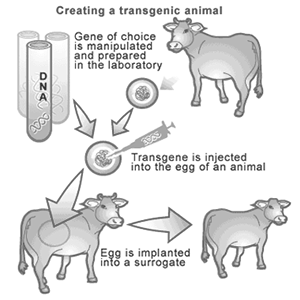
Enviropig is the trademark for a genetically modified line of Yorkshire pigs with the capability to digest plant phosphorus more efficiently than ordinary unmodified pigs that was developed at the University of Guelph.
The benefits of the Enviropig if commercialized include reduced feed cost and reduced phosphorus pollution as compared to the raising of ordinary pigs. Enviropigs produce the enzyme phytase in their salivary glands. When cereal grains are consumed, the phytase mixes with feed in the pig’s mouth, and once swallowed the phytase is active in the acidic environment of the stomach degrading indigestible phytic acid with the release of phosphate that is readily digested by the pig.
read more »
Posted in Food, Science |
Leave a Comment »
March 7, 2013
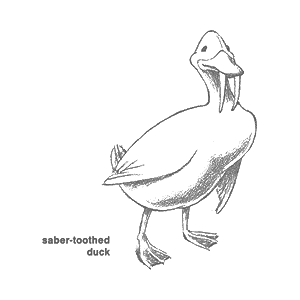
‘Science Made Stupid: How to Discomprehend the World Around Us’ is a book written and illustrated by Tom Weller in 1985. The winner of the 1986 Hugo Award for Best Non-Fiction Book, it is a parody of a junior high or high school-level science textbook. Though currently out-of-print, high-resolution scans are available online, as well as an abridged transcription, both of which have been endorsed by Weller.
Highlights of the book include a satirical account of the creationism vs. evolution debate and Weller’s drawings of fictional prehistoric animals (e.g., the duck-billed mastodon.) Weller released a companion volume, ‘Culture Made Stupid’ (also spelled ‘Cvltvre Made Stvpid’), which satirizes literature and the humanities.
Posted in Education, Humor, Science |
1 Comment »
March 5, 2013

Social proof, also known as informational social influence, is a psychological phenomenon where people assume the actions of others in an attempt to reflect correct behavior for a given situation. This effect is prominent in ambiguous social situations where people are unable to determine the appropriate mode of behavior, and is driven by the assumption that surrounding people possess more knowledge about the situation.
The effects of social influence can be seen in the tendency of large groups to conform to choices which may be either correct or mistaken, a phenomenon sometimes referred to as herd behavior. Although social proof reflects a rational motive to take into account the information possessed by others, formal analysis shows that it can cause people to converge too quickly upon a single choice, so that decisions of even large groups of individuals may be grounded in very little information (i.e. information cascades).
read more »
Posted in Health, Science |
Leave a Comment »
February 20, 2013
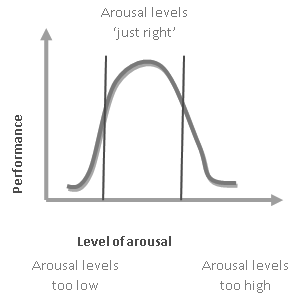
In economics, a bliss point is a quantity of consumption where any further increase would make the consumer less satisfied. It is a quantity of consumption which maximizes utility in the absence budget constraint.
In other words, it refers to the amount of consumption that would be chosen by a person so rich that money imposed no constraint on his or her decisions.
Posted in Food, Money, Science |
Leave a Comment »
February 14, 2013

In science and philosophy, a just-so story, also called an ad hoc fallacy, is an unverifiable and unfalsifiable narrative explanation for a cultural practice, a biological trait, or behavior of humans or other animals. The pejorative nature of the expression is an implicit criticism that reminds the hearer of the essentially fictional and unprovable nature of such an explanation. Such tales are common in folklore and mythology (where they are known as ‘origin’ or ‘etiological’ myths).
Published in 1902, Rudyard Kipling’s ‘Just So Stories,’ is a collection of fictional and deliberately fanciful tales for children in which the stories pretend to explain animal characteristics, such as the origin of the spots on the leopard.
read more »
Posted in Philosophy, Science |
Leave a Comment »
February 12, 2013
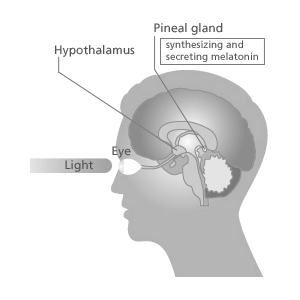
Melatonin [mel-uh-toh-nin] is a naturally occurring hormone found in animals, plants, and microbes. In animals, circulating levels of melatonin vary in a daily cycle, thereby allowing the entrainment of the circadian rhythms of several biological functions.
Many biological effects of melatonin are produced through activation of melatonin receptors, while others are due to its role as a pervasive and powerful antioxidant (a molecule that neutralizes free radicals), with a particular role in the protection of nuclear and mitochondrial DNA. Products containing melatonin have been available over-the-counter in the United States since the mid-1990s. In many other countries, the sale of this neurohormone is not permitted or requires a prescription.
read more »
Posted in Drugs, Health, Science |
3 Comments »
February 12, 2013

In evolutionary biology, a spandrel [span-druhl] is a a characteristic that did not originate by the direct action of natural selection, that was later co-opted for a current use. The term was coined by the Harvard paleontologist Stephen Jay Gould and population geneticist Richard Lewontin in their influential paper ‘The Spandrels of San Marco and the Panglossian Paradigm: A Critique of the Adaptationist Program’ (1979).
In their paper Gould and Lewontin employed the analogy of spandrels in Renaissance architecture: curved areas of masonry between arches supporting a dome that arise as a consequence of decisions about the shape of the arches and the base of the dome, rather than being designed for the artistic purposes for which they were often employed. The authors singled out properties like the necessary number of four and their specific three-dimensional shape.
read more »
Posted in Language, Science |
1 Comment »
February 12, 2013

Segmented sleep, also known as divided sleep, bimodal sleep pattern, or interrupted sleep, is a polyphasic or biphasic sleep pattern where two or more periods of sleep are punctuated by a period of wakefulness. Along with a nap (siesta) in the day, it has been argued that this is the natural pattern of human sleep. A case has been made that maintaining such a sleep pattern may be important in regulating stress.
Historian A. Roger Ekirch argues that before the Industrial Revolution, segmented sleep was the dominant form of human slumber in Western civilization. He draws evidence from documents from the ancient, medieval, and modern world, which he discovered over the course of fifteen years of research. Other historians, such as Craig Koslofsky, have endorsed Ekirch’s discovery and analysis.
read more »
Posted in Health, Science |
Leave a Comment »
February 9, 2013
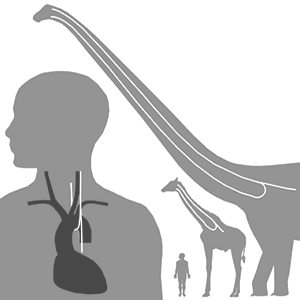
The recurrent [ri-kur-uhnt] laryngeal [luh-rin-jee-uhl] nerve is a branch of the vagus nerve (tenth cranial nerve) that supplies motor function and sensation to the larynx (voice box). It is referred to as ‘recurrent’ because the branches of the nerve innervate the laryngeal muscles in the neck through a rather circuitous route: it descends into the thorax before rising up between the trachea and esophagus to reach the neck.
The extreme detour of this nerve (about 15 feet in the case of giraffes) is cited as evidence of evolution as opposed to intelligent design. The nerve’s route would have been direct in the fish-like ancestors of modern tetrapods, traveling from the brain, past the heart, to the gills (as it does in modern fish). Over the course of evolution, as the neck extended and the heart became lower in the body, the laryngeal nerve was caught on the wrong side of the heart. Natural selection gradually lengthened the nerve by tiny increments to accommodate, resulting in the circuitous route now observed.
Posted in Science |
Leave a Comment »
February 6, 2013

The God gene hypothesis proposes that a specific gene (VMAT2) predisposes humans towards spiritual or mystic experiences. The idea has been postulated by geneticist Dean Hamer, the director of the Gene Structure and Regulation Unit at the U.S. National Cancer Institute, and author of the 2005 book ‘The God Gene: How Faith is Hardwired into our Genes.’ The God gene hypothesis is based on a combination of behavioral genetic, neurobiological, and psychological studies.
The major arguments of the theory are: (1) spirituality can be quantified by psychometric measurements; (2) the underlying tendency to spirituality is partially heritable; (3) part of this heritability can be attributed to the gene VMAT2; (4) this gene acts by altering monoamine levels; and (5) spiritual individuals are favored by natural selection because they are provided with an innate sense of optimism, the latter producing positive effects at either a physical and psychological level.
read more »
Posted in Health, Philosophy, Science |
1 Comment »


 The Daily Omnivore