February 24, 2011
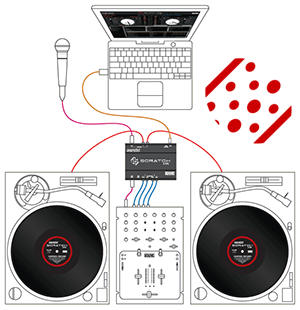
Vinyl emulation software allows the user to physically manipulate the playback of digital audio files on a computer using the turntables as an interface. Vinyl emulation normally uses special vinyl records which are played on conventional turntables. The result is digital audio playback that feels like it can be manipulated like a vinyl record.
However, there is always a short delay between the needle’s reading of the time code and the software’s playback of the audio. This delay is usually between 6 and 30 milliseconds. The delay is treated as a figure of merit for vinyl emulation products. A shorter delay allows the DJ to have better response and control of the music. In some countries, including the United Kingdom and Finland, a digital DJ license is required to legally play copyrighted music with vinyl emulation software.
Posted in Art, Technology |
Leave a Comment »
February 24, 2011

A placebo button, also called an idiot button, is a push-button with apparent functionality that actually has no effect when pressed, analogous to a placebo. In other cases, a control like a thermostat may not be connected. Although non-functional, the buttons can give the user an illusion of control. In some cases the button may have been functional, but may have failed or been disabled during installation or maintenance. Only in relatively rare cases will the button have been deliberately designed to do nothing. In many cases, a button may not appear to do something, but in fact cause behavior that is not immediately apparent; this can give the appearance of it being a placebo button.
Many walk buttons at pedestrian crossings were once functional in New York City, but now serve as placebo buttons. Some door-close buttons in elevators are placebo buttons, although some of them do in fact change the timing, and others are functional only when activated with a maintenance key. It has been reported that the temperature set point adjustment on thermostats in many office buildings are non-functional, installed to give tenants’ employees a similar illusion of control.
Posted in Humor, Technology |
Leave a Comment »
February 24, 2011
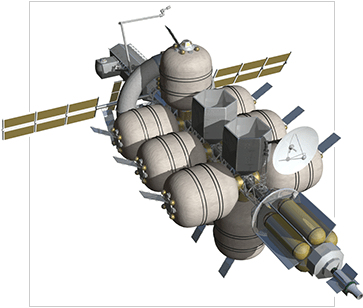
The NAUTILUS-X is a 2011 NASA proposal for a long-duration crewed space transport vehicle with an artificial gravity space habitat intended to promote crew-health for a crew of up to six persons on missions of up to two years duration. The partial-g torus-ring centrifuge would utilize both standard metal-frame and inflatable spacecraft structures and would provide 0.11 to 0.69g if built with the 40 feet (12 m) diameter option. As of 2011, developing and assembling the NAUTILUS-X ‘would take at least five years and require two or three rocket launches. It would cost about $3.7 billion.’
Posted in Technology |
Leave a Comment »
February 24, 2011
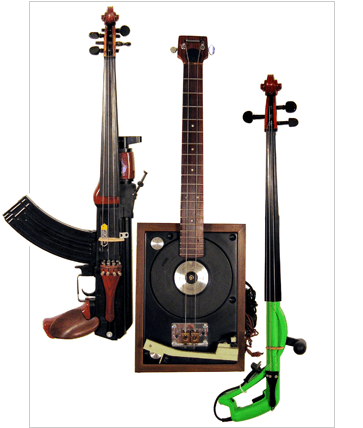
Ken Butler (b. 1948) is an artist and musician, as well as an experimental musical instrument builder. His Hybrid musical instruments and other artworks explore the interaction and transformation of common and uncommon objects, altered images, sounds and silence. The idea of bricolage, essentially using whatever is ‘at hand,’ is at the center of his art, encompassing a wide range of practice that combines live music, instrument design, performance art, theater, sculpture, installation, photography, film/video, graphic design, drawing, and collage.
Posted in Art, Technology |
Leave a Comment »
February 24, 2011
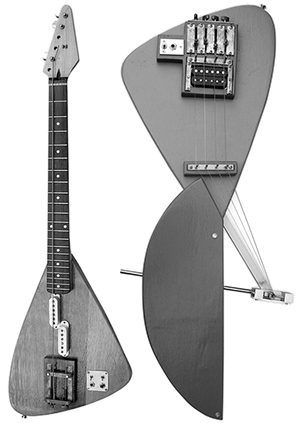
Yuri Landman (b. 1973) is a Dutch luthier (someone who makes or repairs stringed instruments) who has made several experimental electric string instruments for a list of artists including Lee Ranaldo of Sonic Youth, Liars, Jad Fair of Half Japanese and Liam Finn. He has also been active as a comic book creator, musician, and singer.
Posted in Art, Technology |
Leave a Comment »
February 23, 2011
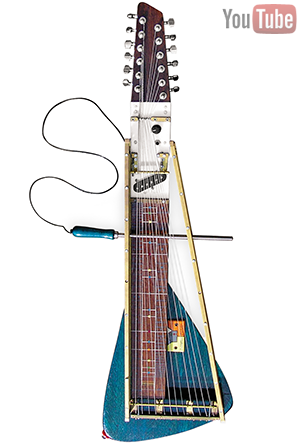
The Moodswinger is a twelve string electric zither with an additional third bridge designed by Dutch luthier Yuri Landman. The rod which functions as the third bridge divides the strings into two sections to cause an overtone multiphonic sound. In 2006 Landman was contacted by the noise band Liars to make an instrument for them. Although it closely resembles an electric guitar, it is actually a zither, as it has neither frets nor a proper neck. The pickup and electronics are built into the neck instead of in the body like usual electric guitars.
After Liars received their Moodswinger, they started recording their fourth album ‘Liars.’ The song ‘Leather Prowler’ is played with the Moodswinger, in many reviews confused with a piano. In 2008 the Moodswinger II was released as a serial product. Jessie Stein of The Luyas owns a copy. In 2009 Landman created a derivative version of the instrument called the Home Swinger, for workshops at festivals, where participants built their own copy within four hours.
Posted in Art, Technology |
Leave a Comment »
February 22, 2011

A flying submarine or submersible aircraft is a craft able both to fly or travel under water. The Soviet Union made an unsuccessful attempt at developing a flying submarine during World War II. In 1961 American engineer, Donald Reid designed and built a single-seat craft (32.83 ft length) capable of flight and underwater movement, the Reid Flying Submarine 1 (RSF-1). The first full-cycle flight [underwater at 6.5 feet (2 m) depth, airborne at 33 ft (10 m) altitude] was demonstrated on 9 June 1964.
The US Navy is looking at the Lockheed Martin Cormorant, a drone aircraft launched from a submarine. On launching it floats to the surface and after flight it is retrieved from the water surface; it cannot travel directly underwater. In 2008, DARPA announced that it was preparing to issue contracts for a submersible aircraft.
Posted in Technology, War |
Leave a Comment »
February 22, 2011
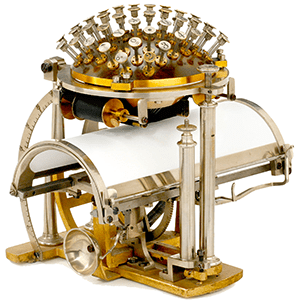
The Hansen Writing Ball was invented in 1865 by the reverend and principal of the Royal Institute for the deaf-mutes in Copenhagen. The writing ball was first patented and entered production in 1870, and was the first commercially produced typewriter. In Danish it was called the skrivekugle. The Hansen ball was a combination of unusual design and ergonomic innovations, but like most of the early 19th century typewriters, it did not allow the paper to be seen as it passed through the device.
Posted in Language, Technology |
1 Comment »
February 21, 2011
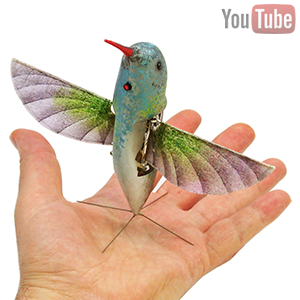
The Nano Hummingbird or Nano Air Vehicle (NAV) is a tiny, remote controlled aircraft built to resemble and fly like a hummingbird, developed in the United States by AeroVironment, Inc. to specifications provided by the Defense Advanced Research Projects Agency (DARPA). The Hummingbird is equipped with a small video camera for surveillance and reconnaissance purposes and operates in the air for up to 11 minutes. It can fly outdoors, or enter a doorway to investigate indoor environments.
Posted in Technology, War |
Leave a Comment »
February 21, 2011
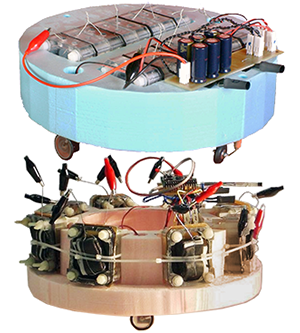
EcoBot refers to a class of robots that can remain self-sustainable by collecting their energy from waste in the environment. The only by-product from this process is carbon dioxide, which would have been produced from biodegradation in the first place. EcoBots do not employ any other form of conventional power supply and do not require any form of initial charging from an external source. Instead, they are powered directly by the on-board microbial fuel cells (MFCs).
EcoBot-I, was developed in 2002 at Bristol Robotics Laboratory (U.K.); it utilized sugar as the fuel to perform phototaxis (move towards the light). EcoBot-II (2004) was the first robot in the world to perform sensing, information processing, communication and phototaxis, by utilizing unrefined biomass (e.g. dead flies, rotten fruits and crustacean shells). EcoBot-II operated continuously for 12 days after having been fed with 8 houseflies.
Posted in Food, Technology |
Leave a Comment »
February 21, 2011
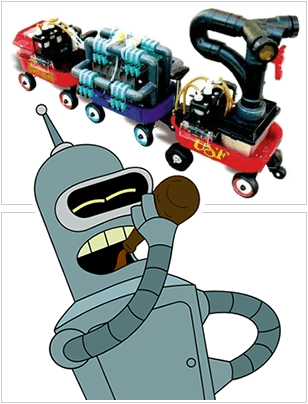
Gastrobot (literally ‘robot with stomach’) was a term coined in 1998 by the University of South Florida Institute’s director, Dr. Stuart Wilkinson. A gastrobot is a machine that derives all its energy from the digestion of food (a mixture of carbohydrates and protein). These molecules are obtained through a microbial fuel cell (MFC) which then converts the food into gases and other potential energy. The gases and liquids are used to help fuel things such as a hydrogen fuel cell which help create more energy, along with other gases that help power the mechanics of the gastrobot.
The future of these robots supposedly is for certain types of so called ‘start and forget’ missions on an ecological plateau which would be Earth at the current period in time. Their optic sensors may have artificial intelligence software that allows them to determine what is edible for consumption and energy conversion. Possible future commercial uses would be a self powered lawnmower that would obtain energy for itself from the cellulose in the grass cuttings.
Posted in Food, Technology |
Leave a Comment »
February 21, 2011


Canard [kuh-nahrd] is the French word for duck. The word also can mean an unfounded or false, deliberately misleading fabrication, a false report, rumor or hoax. That usage derives from the phrase ‘vendre un canard à moitié’ (‘to half-sell a duck’), thus, from some long-forgotten joke, ‘to cheat.’ The Canard Digérateur, or Digesting Duck, was an automaton in the form of a duck, created in 1739 by Jacques de Vaucanson (the French inventor credited with creating the world’s first true robots, as well as the first automated loom).
The mechanical duck appeared to have the ability to eat kernels of grain, and to metabolize and defecate them. While the duck did not actually have the ability to do this – the food was collected in one inner container, and the pre-stored feces was ‘produced’ from a second, so that no actual digestion took place – Vaucanson hoped that a truly digesting automaton could one day be designed.
Posted in Art, Language, Technology |
Leave a Comment »