February 12, 2011

A script kiddie or skiddie, is a derogatory term used to describe those who use scripts or programs developed by others to attack computer systems and networks and deface websites. Script kiddies have at their disposal a large number of effective, easily downloadable malicious programs capable of breaching computers and networks.
They vandalize websites both for the thrill of it and to increase their reputation among their peers, but they lack, or are only developing, coding skills sufficient to understand the effects and side effects of their work. As a result, they leave significant traces which lead to their detection, or directly attack companies which have detection and countermeasures already in place.
Posted in Language, Technology |
Leave a Comment »
February 11, 2011

A la carte cable television (from the French ‘from the menu’) refers to a model for cable companies to allow subscribers to select to which channels they would like to have access. This is in opposition to the large package deals currently prevalent in American cable deals, which often result in consumers paying for additional channels irrelevant to their interests. Leading companies such as Disney, and cable providers such as Time Warner prohibit operators from selling channels which stand alone.
Posted in Money, Politics, Technology |
Leave a Comment »
February 11, 2011

Chemex Coffeemaker, a famous coffee-making device, was introduced by the Chemex Corporation of Pittsfield, Mass. in the 1940s. It consists of a single hourglass-shaped vessel and is used to make coffee. It was invented by industrial chemist, Peter Schlumbohm; the New York Times in its obituary of Schlumbohm called the device ‘one of 100 best modern devices.’
Posted in Food, Money, Technology |
Leave a Comment »
February 11, 2011

The AeroPress is a device for brewing coffee. It was invented in 2005 by Alan Adler. Coffee is steeped for about 10 seconds and then forced through a paper microfilter. The maker describes the result as an espresso strength concentration of coffee. The device consists of two copolyester cylinders. One cylinder has a rubber plunger and fits inside the larger cylinder to create an airtight seal, similar to a syringe.
The AeroPress, though sharing some similarities with a French press, is quite different. It uses a disposable paper filter which removes most of the coffee solids, resulting in a sediment-free brew, and air pressure is used to extract more coffee oils.
Posted in Food, Money, Technology |
Leave a Comment »
February 11, 2011
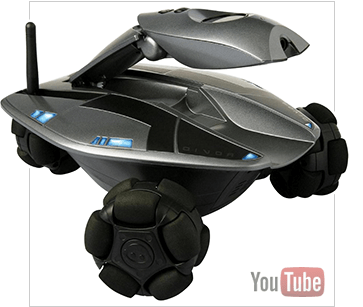
Omni wheels (or poly wheels) are wheels with small discs around the circumference which are perpendicular to the rolling direction. The effect is that the wheel will roll with full force, but will also slide laterally with great ease. These wheels are often employed in holonomic drive systems (those with ability to move in all direction and rotate independently). Although omniwheels are capable of movement in many directions, they are not true omni-directional wheels, a classification reserved for spherical wheels such as ball transfer units.
A platform employing three omni wheels in a triangular configuration is generally called Kiwi Drive. The Killough platform is similar; so named after Stephen Killough’s work with omnidirectional platforms at Oak Ridge National Laboratory. They are often used in small robots. In leagues such as Robocup, many robots use these wheels to have the ability to move in all directions. Omniwheels combined with conventional wheels provide interesting performance properties, such as on a six wheel vehicle employing two conventional wheels on a center axle and four omniwheels on front and rear axles.
Posted in Language, Technology |
Leave a Comment »
February 11, 2011
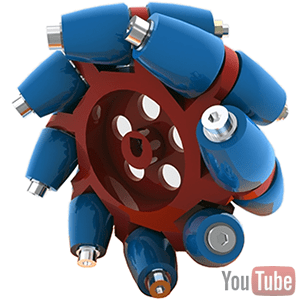
The Mecanum wheel is one design for a wheel which can move in any direction. It is sometimes called the Ilon wheel after its Swedish inventor, Bengt Ilon, who came up with the idea in 1973 when he was an engineer with the Swedish company Mecanum AB. It is a conventional wheel with a series of rollers attached to its circumference. As well as moving forward and backward like conventional wheels, they allow sideways movement by spinning wheels on the front and rear axles in opposite directions.
Posted in Money, Technology |
Leave a Comment »
February 11, 2011
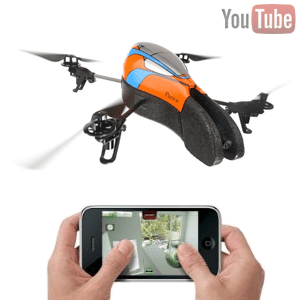
The Parrot AR.Drone is a RC quadricopter with cameras attached to it built by French wireless products manufacturer Parrot. It is designed to be controllable with an iPhone, iPad, or an iPod Touch. Parrot demos the device with 2 games, a virtual combat called ‘DRONE WAR’ with solo and multiplayer mode and a ‘ROBOT’ solo game demo against a virtual Robot. Parrot has launched ARdrone.org Open API game development platform, to gather game studios and developers. It sells for around $300 on Amazon.com.
Posted in Games, Money, Technology |
Leave a Comment »
February 10, 2011


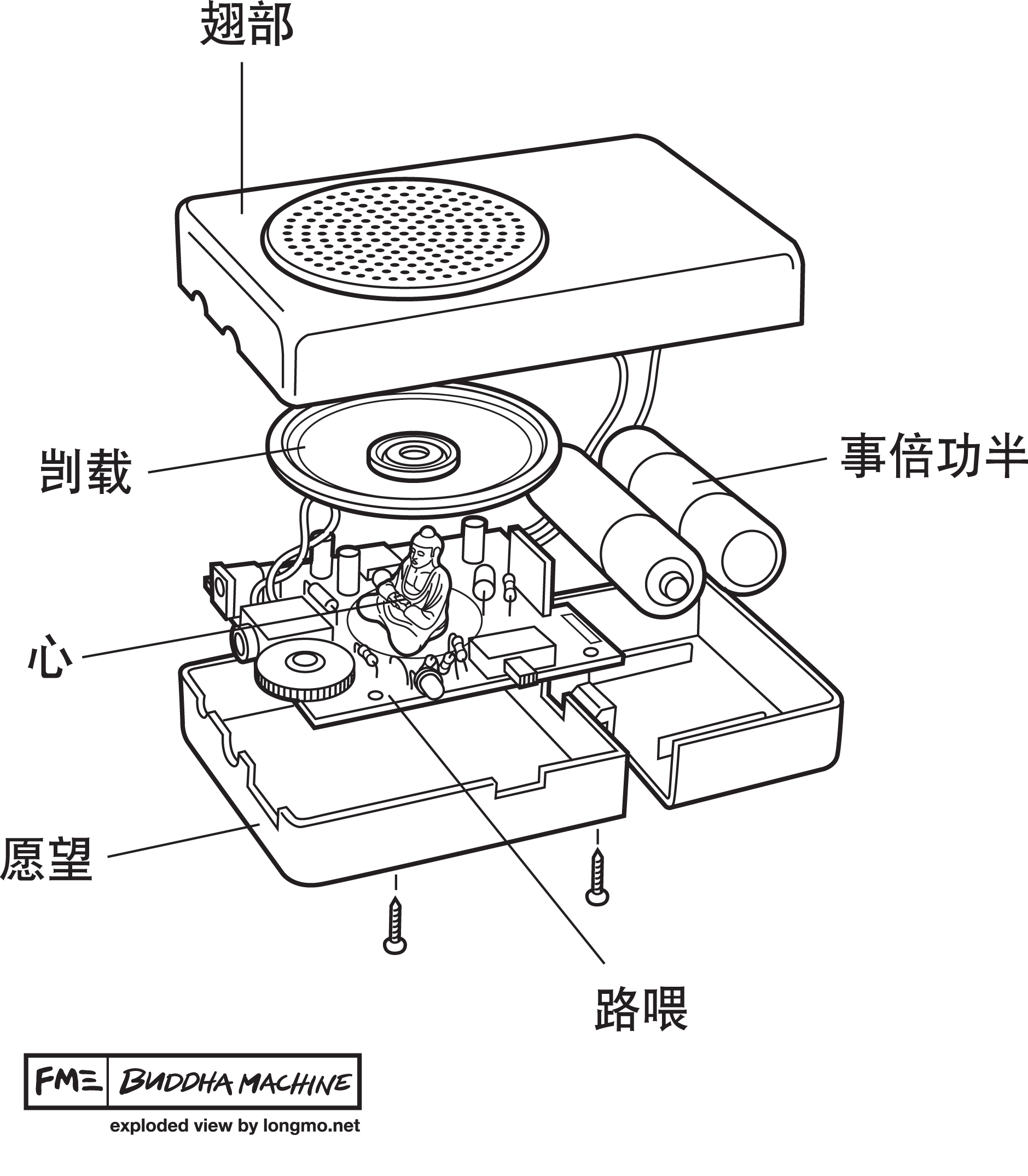
The Buddha Machine is a small musical loop player released by FM3, a China-based music duo. The name and idea derived from a popular Chinese music player that intones repeating loops of Buddhist chanting. The Buddha Machine continuously plays one of 9 ambient sound loops (drones) that range in length from 5 to 40 seconds. Resembling a small transistor radio, the device has a volume control that doubles as an on/off switch; a headphone jack; a 4.5V AC adapter jack; and a switch that, when moved, selects the next of 9 ambient loops. In 2008, the second edition (version 2.0) was released commercially; it replaces the original nine loops with nine new ones (totaling approximately 300 seconds of sound), and includes a new control that allows the user to alter the pitch of the sound.
In 2009, FM3 Productions Ltd released an iPhone app that has similar functionality to the real device. It has the option to select from version 1.0 or version 2.0 of the device and a single button that selects the loop to play. Also that year, Throbbing Gristle & Industrial Records released their version of the Buddha Machine, ‘Gristleism,’ with more loops and almost twice the frequency range of the Buddha Machine. In 2010, FM3 released the third generation Buddha Machine, titled Chan Fang. The music is divided into four loops which were composed and performed on the Gu Qin, an ancient Chinese classical instrument.
Posted in Art, Philosophy, Technology |
Leave a Comment »
February 10, 2011

FM-2030 (1930 – 2000) was a transhumanist author, born Fereidoun M. Esfandiary in Brussels to an Iranian diplomat. He became notable in 1989 with the book ‘Are You a Transhuman?: Monitoring and Stimulating Your Personal Rate of Growth in a Rapidly Changing World.’ He also wrote a number of works of fiction under his original name. He changed his name to FM-2030 to reflect the hope and belief that he would live to celebrate his 100th birthday in 2030, and more importantly, to break free of the widespread practice of naming conventions that he saw as rooted in a collectivist mentality, and existing only as a relic of humankind’s tribalistic past. He viewed traditional names as almost always stamping a label of collective identity – varying from gender, to nationality – on the individual.
Many of FM-2030’s predictions about social trends from the 1970s through the early 21st century proved remarkably prescient. He argued that the inherent dynamic of the modern globalizing civilization would bring such changes about despite the best efforts of conservative elites to enforce traditional beliefs. He predicted in vitro fertilization and correcting genetic flaws in 1977; in 1980, he predicted teleconferencing, telemedicine, and teleshopping. He taught at The New School, UCLA, and Florida International University. He worked as a corporate consultant for Lockheed and J.C. Penney. He was a lifelong vegetarian and said he would not eat anything that had a mother. He died from pancreatic cancer and was placed in cryonic suspension at the Alcor Life Extension Foundation in Arizona, where his body remains today.
Posted in Art, Philosophy, Technology |
Leave a Comment »
February 10, 2011

Sacred geometry ascribes symbolic and sacred meanings to certain geometric shapes and certain geometric proportions. It is associated with the belief that a god is the geometer (geometry mathematician) of the world. The geometry used in the design and construction of religious structures such as churches, temples, mosques, religious monuments, altars, and tabernacles has sometimes been considered sacred. The concept applies also to sacred spaces such as temenoi, sacred groves, village greens, and holy wells, and the creation of religious art.
The belief that a god created the universe according to a geometric plan has ancient origins. Plutarch attributed the belief to Plato, writing that ‘Plato said God geometrizes continually’ In modern times, the mathematician Carl Friedrich Gauss adapted this quote, saying ‘God arithmetizes.’ As late as Johannes Kepler (1571–1630), a belief in the geometric underpinnings of the cosmos persisted among some scientists.
read more »
Posted in Art, Philosophy, Technology |
Leave a Comment »
February 10, 2011

Nickelodeon compounds refers to a number of molding substances for children’s play that were created and sold by the children’s television channel Nickelodon and toy company Mattel in the 1990s. Like most molding compounds, they could be kept in their container to retain plasticity, or molded and allowed to harden overnight. They featured a wide variety of compounds with different attributes. The first compound, whose idea was taken from the show ‘You Can’t Do That on Television,’ was Nickelodeon ‘Slime,’ first manufactured in the 1980s.
The most popular compound, ‘Gak,’ was inspired by the game show ‘Double Dare.’ It made a ‘fart’ noise when squeezed into its clear, star-shaped container. In 1994 ‘Floam,’ originally called ‘bubble-gak,’ a compound composed of microbeads in a foam-like substance, was released. ‘Smud’ was much like Play-Doh, but slicker and would not dry out if left out of its container. ‘Skweeez’ was also like Play-Doh but had a more Marshmallow-like feel. ‘Gooze’ was similar to ‘Gak’ but more watery. ‘Sqand,’ or ‘Magic sand,’ begins as ordinary sand, but is dyed and coated in a hydrophobic substance.
Posted in Humor, Money, Technology |
Leave a Comment »
February 9, 2011

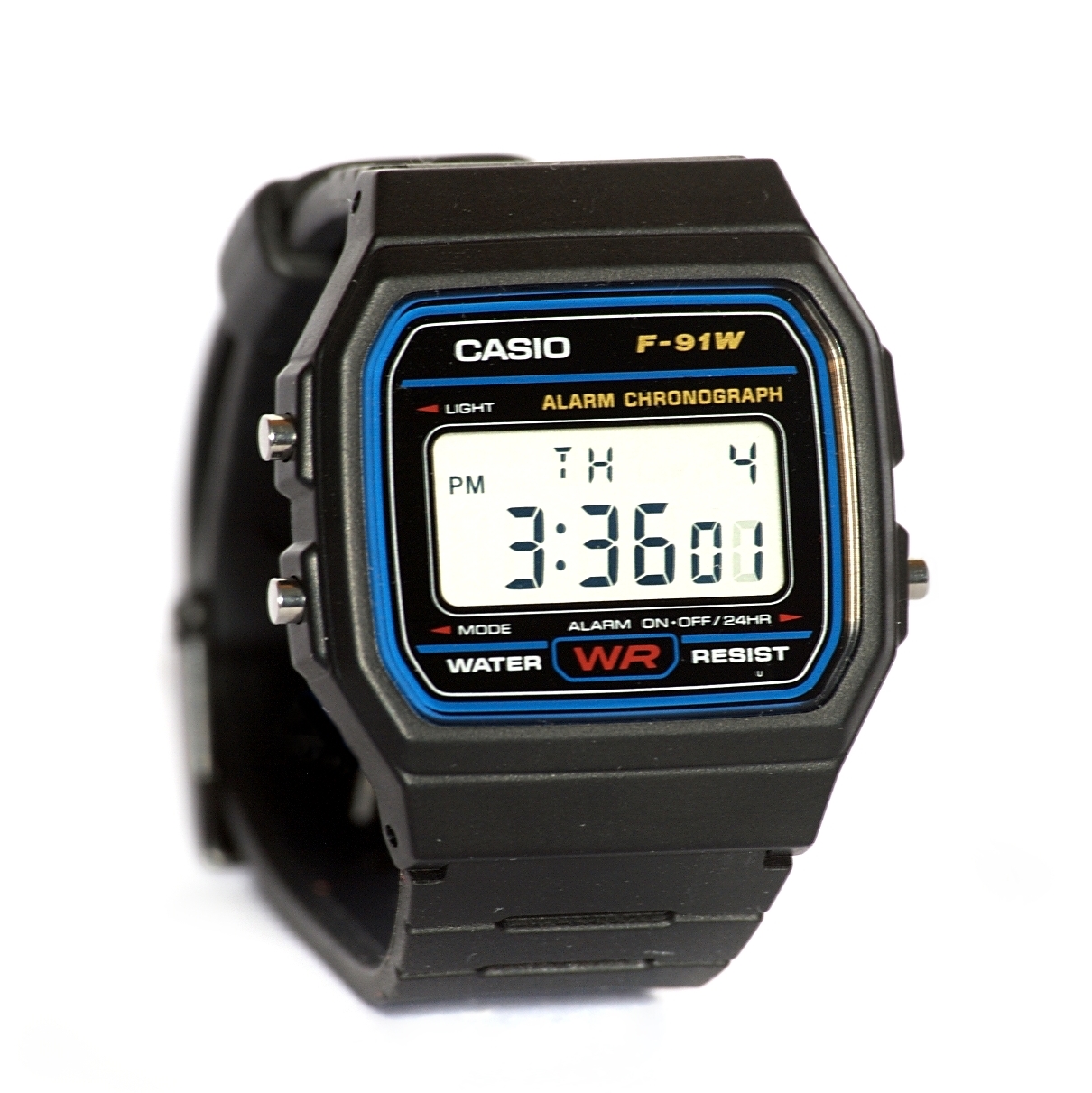
The Casio F91W is an inexpensive quartz digital watch, manufactured by the Japanese firm Casio Computer Co., Ltd.. It was introduced in 1991. This watch is widely available throughout the world. It is widely noticeable due to its classic Casio shape. Prices vary, normally in the $7.50 – $15 range. United States intelligence officials have identified the F91W as a watch that terrorists often use when constructing time bombs.
Posted in Money, Technology, World |
Leave a Comment »