January 17, 2011
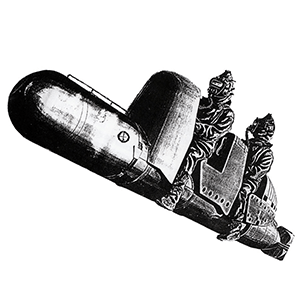
Human torpedoes or manned torpedoes are a type of rideable submarine used as secret naval weapons in World War II. The basic design is still in use today for recreational sport diving. The name is most commonly used to refer to the weapons that Italy, and later Britain, deployed in the Mediterranean and used to attack ships in enemy harbors.
The first human torpedo (the Italian Maiale) was electrically propelled, with two crewmen in diving suits riding astride. They steered the torpedo at slow speed to the enemy ship. The detachable warhead was then used as a limpet mine. They then rode the torpedo away. In operation, the Maiale torpedo was carried by another vessel (usually a normal submarine), and launched near the target. Most manned torpedo operations were at night and during the new moon to cut down the risk of being seen.
Posted in Technology, War |
Leave a Comment »
January 17, 2011

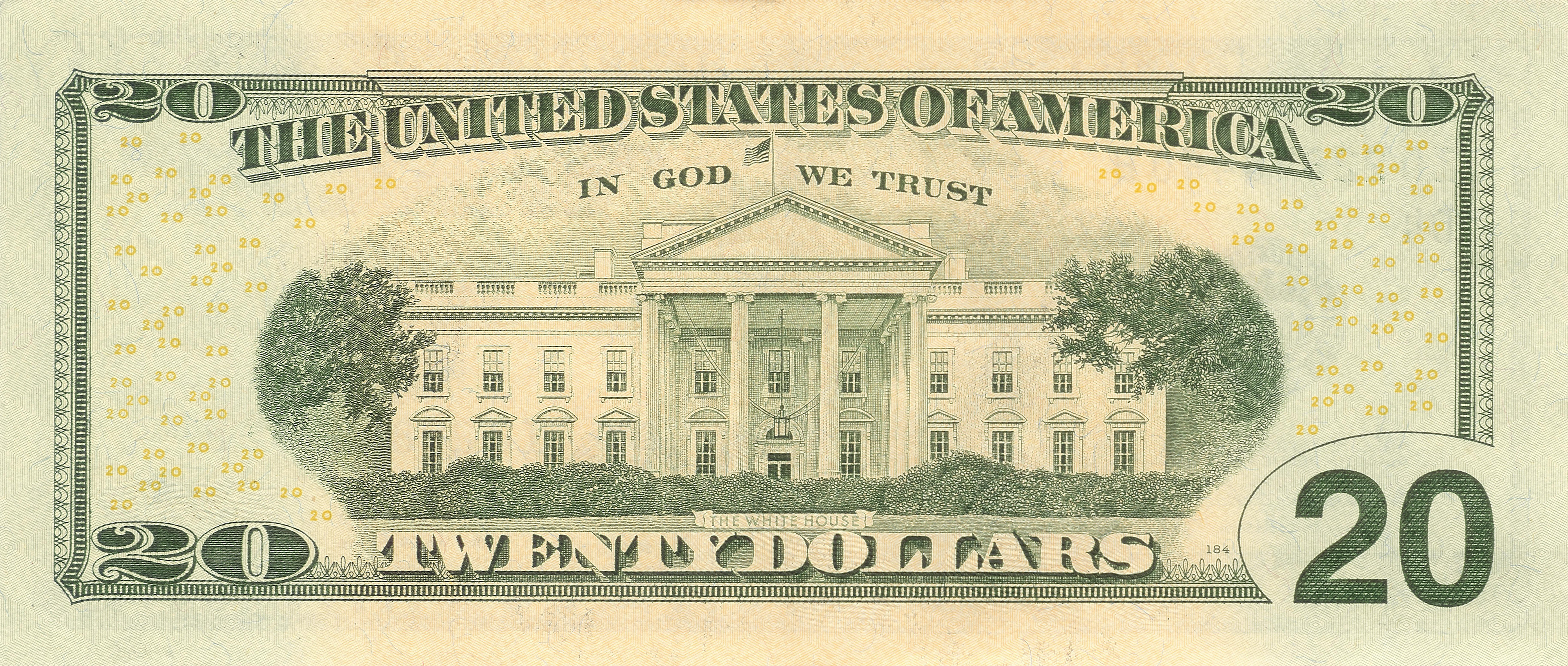
The EURion constellation is a pattern of symbols found on a number of banknote designs worldwide since about 1996. It is added to help software detect the presence of a banknote in a digital image. Such software can then block the user from reproducing banknotes to prevent counterfeiting using color photocopiers. The system is employed on Euros, U.S., dollars, Japanese Yen, and British pounds sterling.
The name ‘EURion constellation’ was coined by German computer scientist, Markus Kuhn, who uncovered the pattern in early 2002 while experimenting with a Xerox photocopier that refused to reproduce banknotes. Technical details regarding the EURion constellation are kept secret by its inventors and users. A patent application suggests that the pattern and detection algorithm were designed at OMRON Corporation, a Japanese electronics company.
Posted in Money, Technology, World |
Leave a Comment »
January 17, 2011

A narco submarine (also called a Bigfoot submarine) is a type of custom-made ocean-going self-propelled semi-submersible (SPSS) vessel built by drug traffickers to smuggle drugs. They are especially known to be used by Colombian drug cartel members to export cocaine from Colombia to Mexico, which is often then transported overland to the United States. First detected in 1993, they are popularly called submarines, though typically they are semi-submersibles since they cannot dive; most of the craft is submerged with little more than the cockpit and the exhaust gas pipes above the water.
However, in 2010 Ecuadorian authorities seized a fully functional, completely submersible submarine in the jungles bordering Ecuador and Colombia. This diesel electric submarine had a cylindrical fiberglass hull of 31 meters (102 ft) long, a 3 meter conning tower with periscope, and air conditioning. The vessel had the capacity for about 10 metric tons of cargo, a crew of five or six people, the ability to fully submerge down to 65 feet (20 m), and capable of long-range underwater operation.
Posted in Drugs, Politics, Technology |
Leave a Comment »
January 13, 2011

Watson, named after IBM’s founder, Thomas J. Watson, is an artificial intelligence program developed to answer questions posed in natural language. Watson competed on the TV game show ‘Jeopardy!’ in 2011, defeating past champions Ken Jennings and Brad Rutter. During the game, Watson had access to 200 million pages of content, including the full text of Wikipedia. Watson consistently outperformed its human opponents on the game’s signaling device, but had trouble responding to a few categories, notably those having short clues containing only a few words.
The original Watson was made up of a cluster of 2880 POWER7 processor cores and 16 Terabytes of RAM. IBM’s master inventor and senior consultant Tony Pearson estimated Watson’s hardware cost about $3 million and with 80 TeraFLOPs would be placed 94th on the Top 500 Supercomputers list in 2011. In 2013, IBM announced that Watson software system’s first commercial application would be for utilization management decisions in lung cancer treatment at Sloan–Kettering in conjunction with health insurance company WellPoint. Watson’s business chief Manoj Saxena says that 90% of nurses in the field who use Watson now follow its guidance.
Posted in Language, Money, Technology |
Leave a Comment »
January 13, 2011

The Internet Corporation for Assigned Names and Numbers (ICANN) is a non-profit corporation headquartered in California that was incorporated in 1998 to oversee a number of Internet-related tasks previously performed directly on behalf of the U.S. Department of Defense, which created the Internet. ICANN manages the assignment of domain names and IP addresses. To date, much of its work is about making new generic top-level domains (e.g. .edu, .com, .gov, etc.).
Posted in Money, Politics, Technology |
Leave a Comment »
January 13, 2011

Network neutrality is a principle that restricts Internet Service Providers (ISP) and governments from giving some internet traffic (email, web, peer-to-peer, BitTorrent, etc.) priority over others. On a completely neutral network, all traffic is treated equally. On non-neutral network, ISPs could charge for access to types of traffic, instead of for access to the internet in general. Some degree of traffic management is necessary on any network, but where to draw the line is at issue presently. Many believe net neutrality to be primarily important as a preservation of current freedoms.
Vinton Cerf, considered a ‘father of the Internet’ and co-inventor of the Internet Protocol, Tim Berners-Lee, creator of the Web, and many others have spoken out in favor of network neutrality. Opponents of net neutrality contend that broadband service providers have no plans to block content or degrade network performance. In spite of this claim, some Internet service providers have intentionally slowed peer-to-peer communications. Still other companies have acted in contrast to these assertions of hands-off behavior and have begun to discriminate against P2P, FTP and online games, instituting a cell-phone style billing system of overages, free-to-telecom ‘value added’ services,’ and bundling.
Posted in Money, Politics, Technology |
Leave a Comment »
January 12, 2011
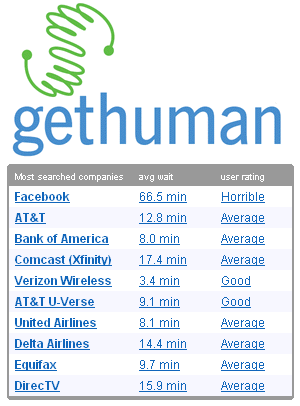
Paul English, cofounder and CTO of Kayak.com is also founder of the “gethuman” movement to restore personal contact in customer service. The most popular part of the gethuman.com website is a database of phone numbers and shortcuts to reach a humans at 500 major US corporations.
Posted in Money, Technology |
Leave a Comment »
January 12, 2011
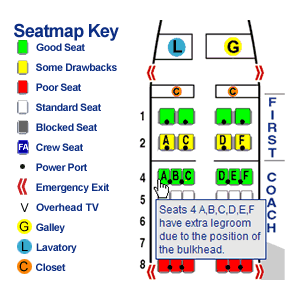
SeatGuru is a website that features aircraft seat maps, seat reviews, and a color-coded system to identify superior and substandard airline seats. It also features information about in-flight amenities and airline specific information regarding Check-in, Baggage, Unaccompanied Minors and Traveling with Infants and Pets. SeatGuru covers more than 700 aircraft seatmaps from more than 95 different airlines. In 2007, SeatGuru was purchased by Expedia subsidiary, TripAdvisor.
Posted in Money, Technology |
Leave a Comment »
January 12, 2011

A black light is a lamp that emits electromagnetic radiation almost exclusively in the soft near ultraviolet range that is only partially visible. It is mainly seen by humans using the low-light receptors in the eye, which are sensitive to near ultraviolet. The low-light receptors however also have the distinctive feature that they are more accurate in the peripheral vision, this means black light will always look out of focus when looked at directly. In medicine, forensics, and some other scientific fields, such a light source is referred to as a Wood’s lamp (named for American physicist, Robert Williams Wood).
Black light sources have many uses. They may be employed for decorative and artistic lighting effects, for diagnostic and therapeutic uses in medicine, for the eradication of microorganisms, for the observation or detection of substances tagged with other substances that exhibit a fluorescent effect, for the curing of plastic resins and for attracting insects. Strong sources of long-wave ultraviolet light are used in tanning beds. Black light lamps are used for the detection of counterfeit money.
Posted in Technology |
Leave a Comment »
January 12, 2011


Wunderwaffe (‘wonder weapon’) and was a term assigned during World War II by the German propaganda ministry to a few revolutionary ‘superweapons.’ Most of these weapons however remained more or less feasible prototypes, or reached the combat theatre too late, and in too insignificant numbers (if at all) to have a military effect. A derisive abbreviation of the term emerged: Wuwa, pronounced ‘voo-vah.’
The ‘V’-weapons (including the V-2 rocket), which were developed earlier, and saw considerable deployment especially against Great Britain, trace back to the same pool of highly inventive armament concepts. Although the Wunderwaffen failed to meet their strategic objective of turning the tides of World War II in Nazi Germany’s favor at a time when the war was already strategically lost, they represented designs and prototypes that were extremely advanced for their time including some of the the earliest work on rockets, jets, night vision, orbital weapons, and ballistic missile submarines.
Posted in Technology, War |
1 Comment »
January 12, 2011

The Pale Blue Dot is a photograph of planet Earth taken in 1990 by Voyager 1 from a record distance, showing it against the vastness of space. By request of Carl Sagan, NASA commanded the Voyager 1 spacecraft, having completed its primary mission and now leaving the Solar System, to turn its camera around and to take a photograph of Earth across a great expanse of space. Subsequently, the title of the photograph was used by Sagan as the primary title of his 1994 book, ‘Pale Blue Dot: A Vision of the Human Future in Space.’
Posted in Science, Technology |
Leave a Comment »
January 11, 2011

The Walker Library of Human Imagination is the private library of Priceline.com founder Jay S. Walker opened in 2002. The library occupies 3,600 square feet in his Connecticut home. It showcases a collection of rare books, artworks, maps and manuscripts as well as artifacts both modern and ancient. Rare books in the collection include: a complete Bible handwritten on sheepskin from 1240; the first illustrated history book (1493); the first illustrated medical book (1499); the first medical book to illustrate the human brain (1550); a copy of ‘Micrographia’ (1664), the first book of illustrations of images seen in the first microscopes; and a 1699 atlas containing the first maps to show the sun, not the earth, as the center of the known universe.
Historical artifacts include: an original 1957 Russian Sputnik backup; an instruction manual for a Saturn V rocket, along with a signed American flag carried to the surface of moon and back on the first lunar landing; and the napkin on which President Franklin D. Roosevelt jotted down his plan to win World War II, just four months after Pearl Harbor; one of two known Anastatic Facsimiles of the original 1776 Declaration of Independence (made directly from the original using a wet-copy process); a leaf from a Gutenberg Bible, the first book printed using movable type; and a Nazi Engima Machine decoder. Distributed around the Library are a series of etched-glass art panels by artist, Clyde Lynds, which illustrate major achievements in the history of human invention.
Posted in Art, Money, Technology |
Leave a Comment »