October 28, 2010
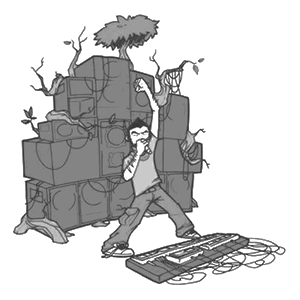
Dub FX (real name Benjamin Stanford) is a worldwide street performer and studio recording artist from Australia. His trademark is creating live music using only his own voice, Live looping, and effects pedals.
His music is based on hip hop, reggae and drum and bass rhythms. Stanford travels and performs with his fiancée, Flower Fairy (real name Shoshana Sadia).
Posted in Art, Money, Technology |
2 Comments »
October 28, 2010

Phiten is a Japanese company that makes necklaces worn for the purpose of soothing one’s body. The medical and performance-enhancing claims relating to Phiten’s products are considered pseudoscience, and the technology behind the company’s products is not approved by the U.S. Food and Drug Administration. The company claims its products relieve fatigue by balancing the body’s signals that run from brain to the body and thus regulating the body’s ‘bio-electric currents’ through what the company calls the ‘Phild process,’ where titanium is turned into ‘aqua-titanium,’ a water-soluble form of titanium. The company claims to be able to integrate small amounts of the metal directly into the fabric.
Some of the professional athletes in Japan that wear Phiten necklaces include pro golfers, Olympic runners, and pro baseball players. In the USA, the company sponsors MLB players Josh Beckett, Tim Lincecum, Joba Chamberlain, Randy Johnson, Clay Buchholz, Justin Verlander, Justin Morneau, Brandon Webb, C.J. Wilson, and Dustin Pedroia.
Posted in Money, Technology, World |
Leave a Comment »
October 28, 2010

The Hyundai Equus is a full-size high-end luxury car that serves as the flagship model of Hyundai Motor Company. According to Edmunds the 2011 model offers far more space and equipment than other competing luxury sedans, calling it the equivalent of a loaded $104,000 Mercedes-Benz S550 for the price of a lightly equipped Mercedes E550. The Equus comes standard with a 4.6-liter V8 good for 385 horsepower and 333 pound-feet of torque. The Equus is available in Signature ($58,000) and Ultimate ($64,500) trim levels.
read more »
Posted in Money, Technology |
Leave a Comment »
October 28, 2010

ROFLCon is a biennial convention of Internet memes that first took place April 25–26, 2008, at the Massachusetts Institute of Technology. Various Net celebrities attended, such as the authors of the webcomics xkcd, Questionable Content and Dinosaur comics, Jay Maynard ‘The Tron Guy,’ 4Chan founder moot, Leeroy Jenkins, The Brothers Chaps, and many others. ROFLCon was organized by a group of students from Harvard University led by Tim Hwang.
The ROFLCon team spent months tracking down people associated with memes, but many of the invited guests did not attend. Attendance was open to the public after pre-registration and a fee. The primary events of ROFLCon were moderated panel discussions with the Internet celebrities, as well as question and answer sessions with the audience. Several guest speakers gave talks on issues pertaining to internet culture. The convention ended with the ROFLConcert, featuring live performances by Group X, Leslie Hall, Lemon Demon, Trocadero and Denny Blaze. In 2010, the conference took place from April 30 to May 1 at MIT.
Posted in Humor, Technology |
Leave a Comment »
October 28, 2010

Plunderphonics is a term coined by composer John Oswald in 1985 in his essay ‘Plunderphonics, or Audio Piracy as a Compositional Prerogative.’ It has since been applied to any music made by taking one or more existing audio recordings and altering them in some way to make a new composition. Plunderphonic music is known for heavy sampling of educational films of the 1950s, news reports, radio shows, or anything with trained vocal announcers.
The process of sampling other sources is found in various genres (notably hip-hop), but in plunderphonic works the sampled material is often the only sound used. These samples are usually uncleared, and sometimes result in legal action being taken due to copyright infringement. Some plunderphonic artists use their work to protest what they consider to be overly-restrictive copyright laws. Many plunderphonic artists claim their use of other artists’ materials falls under the fair use doctrine.
Posted in Art, Money, Technology |
Leave a Comment »
October 26, 2010

Zojirushi is a Japanese multinational manufacturer and marketer of high-quality vacuum flasks, bread machines and consumer electronics including electric water boilers, refrigerators and rice cookers. It has a branch in South Korea and subsidiary companies in China, Taiwan, Hong Kong, and the United States. Zojirushi is listed on Osaka Securities Exchange.
The company was founded in 1918 as the Ichikawa Brothers Trading Company in Osaka and in 1948 was changed to Kyowa Manufacturing Co., Ltd. In 1961, its name was changed again to the Zojirushi Corporation and its corporate logo, including an elephant (Zōjirushi means ‘elephant mark’) was adopted.
Posted in Money, Technology, World |
Leave a Comment »
October 18, 2010

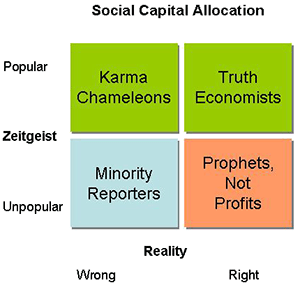
Whuffie is the ephemeral, reputation-based currency of Cory Doctorow’s science fiction novel, ‘Down and Out in the Magic Kingdom.’ This book describes a post-scarcity economy: All the necessities (and most of the luxuries) of life are free for the taking. A person’s current Whuffie is instantly viewable to anyone, as everybody has a brain-implant giving them an interface with the Net. The term has since seen some adoption as a synonym for social capital.
In the novel usual economic incentives have disappeared: Whuffie has replaced money, providing a motivation for people to do useful and creative things. A person’s Whuffie is a general measurement of his or her overall reputation and is gained (or lost) according to a person’s favorable (or unfavorable) actions. Public opinion determines which actions are favorable or unfavorable. Rudely pushing past someone on the sidewalk will cause a loss of points from the person pushed (and possibly from bystanders who witness the incident), while composing a much-loved symphony will earn the composer Whuffie from everyone who enjoyed it.
Posted in Money, Philosophy, Technology |
Leave a Comment »
October 16, 2010

When used in reference to consumer electronics, ‘brick’ describes a device that cannot function in any capacity (such as a device with damaged firmware). This usage derives from the fact that some electronic devices (and their detachable power supplies) are vaguely brick-shaped, and so those which do not function are useful only as actual bricks. The term can also be used as a verb. For example, I bricked my MP3 player when I tried to modify its firmware.’ Some devices which are ‘bricked’ because the contents of their nonvolatile memory are incorrect can be ‘unbricked‘ using separate hardware (a debug board) that accesses this memory directly.
Bricking a device is usually an unwanted consequence of an attempt to update the device. Many devices have an update procedure which must not be interrupted; if interrupted by a power failure, user intervention, or any other reason the existing firmware may be partially overwritten and unusable. Installing incorrect firmware can also brick a device, e.g., installing firmware for a different revision of the hardware, or installing firmware incompetently patched by third parties to get around restrictions imposed by official firmware, such as DVD firmware which only plays DVDs sold in a particular region. Devices can also be bricked by malware (malicious software), and sometimes by running software not intentionally harmful but with errors which cause damage.
Posted in Language, Technology |
Leave a Comment »
October 13, 2010

Controllerism is the art and practice of using musical software controllers (e.g. MIDI) to build upon, mix, scratch, remix, effect, modify, or otherwise create music, usually by a DJ or ‘Controllerist.’ Often on the side of Virtuoso performance art, Controllerism is also a nod to traditional musicianship and instrumental-ism paired with modern computer sequencing software such as Ableton Live and Native Instruments Traktor.
However a working knowledge of Scale and Chords is not necessarily required as the performers typically focus their efforts more on sequencing events, software effect and instrument manipulations using buttons, knobs, faders, keys, foot switches and pedals than on instrumental notes played in real time. The term was coined by musician Matt Moldover in 2007 and popularized by DJ Ean Golden to describe the process while paying homage to and giving respect to the art of turntablism.
Posted in Art, Technology |
Leave a Comment »
October 12, 2010
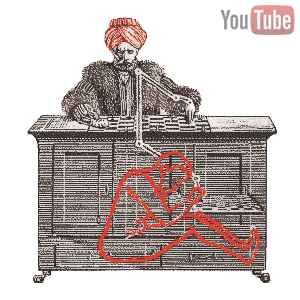
The Turk was a fake chess-playing machine constructed in the late 18th century. From 1770 until its destruction by fire in 1854, it was exhibited by various owners as an automaton. Constructed and unveiled in 1770 by Wolfgang von Kempelen (1734–1804) to impress the Empress Maria Theresa, the mechanism appeared to be able to play a strong game of chess against a human opponent. The Turk was in fact a mechanical illusion that allowed a human chess master hiding inside to operate the machine.
With a skilled operator, the Turk won most of the games played during its demonstrations around Europe and the Americas for nearly 84 years, playing and defeating many challengers including statesmen such as Napoleon Bonaparte and Benjamin Franklin. Although many had suspected the hidden human operator, the hoax was initially revealed only in the 1820s by the Londoner Robert Willis.
Posted in Games, Humor, Technology |
1 Comment »
October 12, 2010


The Amazon Mechanical Turk (MTurk) is a crowdsourcing Internet marketplace that enables computer programmers (known as Requesters) who are located in the United States to co-ordinate the use of human intelligence to perform tasks which computers are unable to do. The Requesters are able to pose tasks known as HITs (Human Intelligence Tasks), such as choosing the best among several photographs of a store-front, writing product descriptions, or identifying performers on music CDs. Workers (called Providers) can then browse among existing tasks and complete them for a monetary payment set by the Requester.
Requesters can ask that Workers fulfill Qualifications before engaging a task, and they can set up a test in order to verify the Qualification. They can also accept or reject the result sent by the Worker, which reflects on the Worker’s reputation. Currently, a Requester has to have a U.S. address, but Workers can be anywhere in the world. Requesters, which are typically corporations, pay at least 10 percent over the price of successfully completed HITs to Amazon.
Posted in Money, Technology |
Leave a Comment »
October 11, 2010

On many computer operating systems, the superuser, or root, is a special user account used for system administration. Separation of administrative privileges from normal user privileges makes an operating system more resistant to viruses and other malware. Additionally, in organizations, administrative privileges are often reserved for authorized individuals in order to control abuse, misuse, or other undesired activities by end-users.
Posted in Language, Technology |
Leave a Comment »



