March 25, 2013
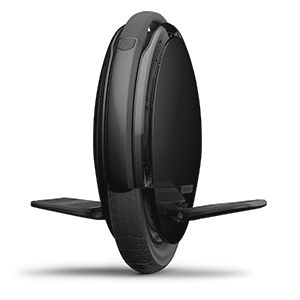
A number of self-balancing unicycle have been created which are self-balancing only in the forwards-backwards direction, and still need a human being to balance them from side to side.
Aleksander Polutnik’s Enicycle (2006) is probably the first two-axis balancing human-ridable unicycle. In 2009, RYNO Motors of Portland, Oregon created a one-wheeled electric motorcycle called the Micro-Cycle. According to the company, a commercial version is scheduled to go into production in mid 2013.
Posted in Technology |
Leave a Comment »
March 24, 2013

A monowheel is a one-wheeled single-track vehicle similar to a unicycle. However, instead of sitting above the wheel, the rider sits either within it or next to it. The wheel is a ring, usually driven by smaller wheels pressing against its inner rim. Most are single-passenger vehicles, though multi-passenger models have been built. Hand-cranked and pedal-powered monowheels were built in the late 19th century; most built in the 20th century have been motorized.
Some modern builders refer to these vehicles as monocycles, though that term is also sometimes used to describe motorized unicycles. Today, monowheels are generally built and used for fun and entertainment purposes, though from the 1860s through to the 1930s, they were proposed for use as serious transportation.
read more »
Posted in Technology |
Leave a Comment »
March 22, 2013
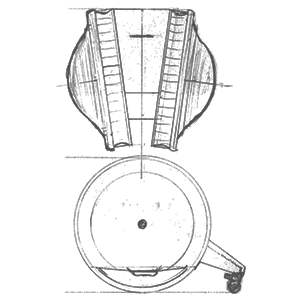
The Kugelpanzer (‘spherical tank’) was a prototype reconnaissance tank built by Nazi Germany during World War II. It was one of the most unusual armored fighting vehicles ever built.
Only one example of this Rollzeug (rolling vehicle) exists in Russia as part of the Kubinka Tank Museum’s collection of German armored vehicles. The Kugelpanzer is simply listed as Item #37 and is painted gloss gray. From fragmentary information, the drive has been removed from the vehicle and no metal samples are allowed to be taken from it.
read more »
Posted in Technology, War |
Leave a Comment »
March 22, 2013

Robert Venturi (b. 1925) is an American architect, founding principal of the firm Venturi, Scott Brown and Associates, and one of the major architectural figures in the twentieth century. Together with his wife and partner, Denise Scott Brown, he helped to shape the way that architects, planners and students experience and think about architecture and the American built environment.
Their buildings, planning, theoretical writings and teaching have contributed to the expansion of discourse about architecture. He is also known for coining the maxim ‘Less is a bore’ a postmodern antidote to Mies van der Rohe’s famous modernist dictum ‘Less is more.’
read more »
Posted in Money, Technology |
Leave a Comment »
March 19, 2013

Yoshiro Nakamatsu (b. 1928), also known as Dr. NakaMats, is Japanese inventor who has become something of a minor celebrity for the dubious science behind his inventions and his eccentricity. He regularly appears on Japanese talk shows which, in conjunction with his appearance, usually craft a humorous segment based on one or more of his inventions. He is a prolific inventor, and he even claims to hold the world record for number of inventions with over 4,000 patents.
In his interviews, Nakamatsu described his ‘creativity process,’ which includes listening to music and concludes with diving underwater, where he says he comes up with his best ideas and records them while underwater. Nakamatsu claims to benefit from lack of oxygen to the brain, making inventions ‘0.5 seconds before death.’ He also built a million dollar toilet room made completely out of gold that he claims helps make him think better. Nakamatsu also has an elevator in his house that he claims helps him think better. He strictly denies that it is an elevator, but rather a ‘vertical moving room.’ Nakamatsu’s goal is to live at least 144 years.
read more »
Posted in Humor, Technology, World |
Leave a Comment »
March 15, 2013


Google X Lab, sometimes known as Google X, is a secret facility run by Google thought to be located somewhere in the Bay Area of Northern California. Work at the lab is overseen by Sergey Brin, one of Google’s co-founders. Reportedly worked on at the lab is a list of 100 projects pertaining to future technologies such as a space elevator, self-driving car, augmented reality glasses, a neural network that uses semi-supervised learning, enabling speech recognition and extraction of objects from video – for instance detecting if a cat is in a frame of video, and the Web of Things (a network of objects with embedded computers).
Project Glass is a research and development program by Google to develop an augmented reality head-mounted display (HMD). The intended purpose of Project Glass products would be the hands-free displaying of information currently available to most smartphone users, and allowing for interaction with the Internet via natural language voice commands.
read more »
Posted in Money, Technology |
Leave a Comment »
March 15, 2013

Solve for X is a think tank project launched by Google to incite collaboration to solve global issues, ‘X’ representing a remedy. The project kicked off in 2012 at a three-day convention at CordeValle Resort in San Martin, California. ‘Solve for X’ talks were presented to 50 people, hosted by Google executives Eric Schmidt, Astro Teller, and Megan Smith.
Solve for X was initially believed to be linked to the Google X Lab working on new technology such as web-connected appliances, driverless cars, and space elevators, but ‘eWeek’ reported that Google X is wed to more realistic undertakings, not the ‘moonshot’ solutions ‘Solve for X’ was created to pursue.
Posted in Money, Technology |
Leave a Comment »
March 15, 2013

Saul Griffith is an Australian American inventor. He is best known for his inexpensive technique for making prescription eyeglasses. This method uses two flexible surfaces and a pourable resin. Saul Griffith was born into an academic family, and encouraged to question all around him, to experiment as a process of learning, and to communicate effectively.
He won a scholarship to study Material Science at the University of New South Wales where he graduated in 1997 with a Bachelor of Metallurgical Engineering. In 2000, Griffith graduated from the University of Sydney with a Master of Engineering degree. He won a scholarship to MIT Media Lab to study towards a PhD that he completed in 2004. The subject of his PhD Thesis was ‘self replicating machines.’ They were one of the first instances of artificial replication being demonstrated using real physics.
Posted in Technology |
1 Comment »
March 15, 2013

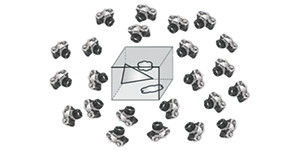
Bullet time is a special and visual effect that refers to a digitally enhanced simulation of variable-speed (i.e. slow motion, time-lapse). It is characterized both by its extreme transformation of time (slow enough to show normally imperceptible and unfilmable events, such as flying bullets) and space (by way of the ability of the camera angle—the audience’s point-of-view—to move around the scene at a normal speed while events are slowed).
This is almost impossible with conventional slow-motion, as the physical camera would have to move impossibly fast; the concept implies that only a ‘virtual camera,’ often illustrated within the confines of a computer-generated environment such as a virtual world or virtual reality, would be capable of ‘filming’ bullet-time types of moments. Technical and historical variations of this effect have been referred to as time slicing, view morphing, slow-mo, temps mort, and virtual cinematography.
read more »
Posted in Art, Games, Technology |
Leave a Comment »
March 15, 2013

Slow motion (commonly abbreviated as slowmo) is an effect in film-making whereby time appears to be slowed down. It was invented by the Austrian priest August Musger. Typically this style is achieved when each film frame is captured at a rate much faster than it will be played back.
When replayed at normal speed, time appears to be moving more slowly. A term for creating slow motion film is ‘overcranking’ which refers to hand cranking an early camera at a faster rate than normal (i.e. faster than 24 frames per second). Slow motion can also be achieved by playing normally recorded footage at a slower speed. This technique is more often applied to video subjected to instant replay, than to film.
read more »
Posted in Art, Technology |
Leave a Comment »
March 14, 2013

LifeStraw is a water filter that filters a maximum of 1000 liters of water, enough for one person for one year that was designed by the Swiss-based Vestergaard Frandsen for people living in developing nations and for distribution in humanitarian crisis. LifeStraw Family filters a maximum of 18,000 liters of water, providing safe drinking water for a family of five for up to three years. The LifeStraw is a plastic tube 310 millimeters long and 30 millimeters in diameter, Water that is drawn up through the straw first passes through hollow fibers that filter water particles down to 0.2 microns across, using only physical filtration methods and no chemicals.
LifeStraw has been generally praised for its effective and instant method of bacteria and protozoa removal and consumer acceptability. Paul Hetherington, of the charity WaterAid, has criticized the LifeStraw for being too expensive for the target market. He also points to other important problems linked with accessing the water in developing countries, which wait to be solved, but are not addressed by the device itself.
Posted in Food, Health, Technology |
Leave a Comment »
March 14, 2013

A green wall is a wall, either free-standing or part of a building, that is partially or completely covered with vegetation and, in some cases, soil or an inorganic growing medium. The concept of the green wall dates back to the Hanging Gardens of Babylon (600 BCE).
The modern green wall with integrated hydroponics was invented by Professor of Landscape Architecture Stanley Hart White at the University of Illinois Urbana-Champaign in 1931-38. White holds the first known patent for a green wall, or vertical garden, conceptualizing this new garden type as a solution to the problem of modern garden design.
read more »
Posted in Science, Technology |
Leave a Comment »


 The Daily Omnivore