February 11, 2013
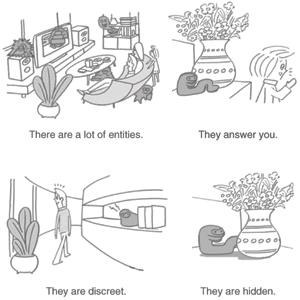
In computing, ambient intelligence (AmI) refers to electronic environments that are sensitive and responsive to the presence of people. Ambient intelligence is a vision on the future of consumer electronics, telecommunications and computing that was originally developed in the late 1990s for the time frame 2010–2020. In an ambient intelligence world, devices work in concert to support people in carrying out their everyday life activities, tasks and rituals in easy, natural way that uses information and intelligence that is hidden in the network connecting these devices (an Internet of Things).
As these devices grow smaller, more connected and more integrated into the world, the technology disappears into our surroundings until only the user interface remains perceivable by users. The ambient intelligence paradigm builds upon ubiquitous computing (ever-present, always on), profiling practices (the use of algorithms to discover patterns or correlations in large quantities of data, aggregated in databases), context awareness (complementary to location awareness), and user-centered design (in which the needs, wants, and limitations of end users of a product are given extensive attention at each stage of the design process).
read more »
Posted in Technology |
Leave a Comment »
February 11, 2013


The term Experience Economy was first described in an article published in 1998 by B. Joseph Pine II and James H. Gilmore. In it they described the experience economy as the next economy following the agrarian economy, the industrial economy, and the most recent service economy. This concept had been previously researched by many other authors.
Pine and Gilmore argue that businesses must orchestrate memorable events for their customers, and that memory itself becomes the product – the ‘experience.’ More advanced experience businesses can begin charging for the value of the ‘transformation’ that an experience offers, e.g., as education offerings might do if they were able to participate in the value that is created by the educated individual. This, they argue, is a natural progression in the value added by the business over and above its inputs.
read more »
Posted in Money, Technology |
Leave a Comment »
February 6, 2013

Gold sinks are economic processes by which a video game’s ingame currency (‘gold’), or any item that can be valued against it, is removed. Excess currency leads to inflation of player driven prices. Game designers must balance between scarcity of currency and ease of acquiring currency. This process is comparable to financial repression (measures that governments employ to channel funds to themselves, that, in a deregulated market, would go elsewhere). Most commonly the genres are role-playing game or massively multiplayer online game.
The term is comparable to timesink (an activity that consumes significant time), but usually used in reference to game design and balance, commonly to reduce inflation when commodities and wealth are continually fed to players through sources such as quests, looting monsters, or minigames. Gold sinks are commonly called drains or gold drains. They can also be associated with item drains. The intent of a sink is to remove added value from the overall economy. For example, in ‘Ultima Online,’ items that were placed on the ground would be gathered by the server. This form is referred to as decay or garbage collection.
read more »
Posted in Games, Money, Technology |
Leave a Comment »
February 3, 2013
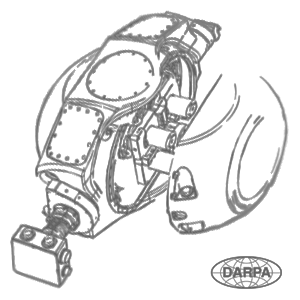
The ARGUS-IS, or the Autonomous Real-Time Ground Ubiquitous Surveillance Imaging System, is a Defense Advanced Research Projects Agency (DARPA) project contracted to BAE Systems.
According to DARPA: ‘The mission of the Autonomous Real-time Ground Ubiquitous Surveillance – Imaging System (ARGUS-IS) program is to provide military users a flexible and responsive capability to find, track and monitor events and activities of interest on a continuous basis in areas of interest.
read more »
Posted in Technology, War |
1 Comment »
February 3, 2013

In political theory and theology, to immanentize [im-uh-nuhnt-ize] the eschaton [ess-cah-ton] means trying to bring about the eschaton (the final, heaven-like stage of history) in the immanent world. It has been used by conservative critics as a pejorative reference to certain utopian projects, such as socialism, communism, and transhumanism. In all these contexts it means ‘trying to make that which belongs to the afterlife happen here and now (on Earth)’ or ‘trying to create heaven here on Earth.’
According to conservative columnist Jonah Goldberg, writing in ‘National Review Online’: ‘In modern parlance, the phrase was coined by Eric Voegelin in The New Science of Politics in 1952. In the 1950s and 1960s, thanks largely to William F. Buckley’s popularization of the phrase, Young Americans for Freedom turned it into a political slogan.’ Buckley was the most notable of many US conservative readers of Voegelin’s work. Voegelin, a German-born American political philosopher, identified a number of similarities between ancient Gnosticism and the beliefs held by a number of modernist political theories, particularly Communism and Nazism.
read more »
Posted in Philosophy, Politics, Technology |
Leave a Comment »
February 2, 2013

A jukebox is a partially automated music-playing device, usually a coin-operated machine, that will play a patron’s selection from self-contained media. The classic jukebox has buttons with letters and numbers on them that, when entered in combination, are used to play a specific selection. Coin-operated music boxes and player pianos were the first forms of automated coin-operated musical devices.
These instruments used paper rolls, metal disks, or metal cylinders to play a musical selection on the instrument, or instruments, enclosed within the device. In the 1890s these devices were joined by machines which used actual recordings instead of physical instruments. In 1890, Louis Glass and William S. Arnold invented the nickel-in-the-slot phonograph, the first of which was an Edison Class M Electric Phonograph retrofitted with a device patented under the name of Coin Actuated Attachment for Phonograph. The music was heard via one of four listening tubes.
read more »
Posted in Money, Technology |
Leave a Comment »
January 31, 2013
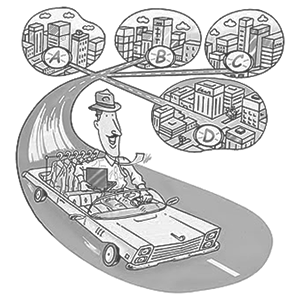
P versus NP is the name of a question that many mathematicians, scientists, and computer programmers want to answer. P and NP are two groups of mathematical problems. P problems are considered ‘easy’ for computers to solve. NP problems are easy only for a computer to check.
For example, if you have an NP problem, and someone says ‘The answer to your problem is 12345,’ a computer can quickly figure out if the answer is right or wrong, but it may take a very long time for the computer to come up with ‘12345’ on its own. All P problems are NP problems, because it is easy to check that a solution is correct by solving the problem and comparing the two solutions. However, people want to know about the opposite: Are there any NP problems that are not P problems, or are all NP problems just P problems?
read more »
Posted in Science, Technology |
Leave a Comment »
January 30, 2013
Susan P. Crawford (b. 1963) is a professor at the Benjamin N. Cardozo School of Law. She has served as President Barack Obama’s Special Assistant for Science, Technology, and Innovation Policy (2009) and is a columnist for ‘Bloomberg View.’
She is a former Board Member of ICANN (which regulates the Internet), the founder of OneWebDay (an annual day of Internet celebration and awareness held on September 22), and a legal scholar. Her research focuses on telecommunications and information law.
read more »
Posted in Money, Politics, Technology |
Leave a Comment »
January 28, 2013

The Centre for the Study of Existential Risk (CSER) is a proposed research centre at the University of Cambridge, intended to study possible catastrophic threats posed by present or future technology. The co-founders of the project to establish the center are Huw Price (a philosophy professor at Cambridge), Martin Rees (cosmology and astrophysics professor and former President of the Royal Society) and Jaan Tallinn (a computer programmer and co-founder of Skype).
Among the risks to be studied by the proposed center are those that might arise from developments in artificial intelligence, a risk likened in some press coverage to that of a robot uprising à la ‘The Terminator.’ Speaking about this case, Professor Price said, ‘It seems a reasonable prediction that some time in this or the next century intelligence will escape from the constraints of biology.’ He added that when this happens ‘we’re no longer the smartest things around,’ and will risk being at the mercy of ‘machines that are not malicious, but machines whose interests don’t include us.’
Posted in Death, Education, Technology |
2 Comments »
January 28, 2013

Security through obscurity is a pejorative referring to a principle in security engineering, which attempts to use secrecy of design or implementation to provide security. A system relying on security through obscurity may have theoretical or actual security vulnerabilities, but its owners or designers believe that if the flaws are not known, then attackers will be unlikely to find them. The technique stands in contrast with security by design and open security, although many real-world projects include elements of several strategies.
Security through obscurity has never achieved engineering acceptance as an approach to securing a system, as it contradicts the principle of ‘keeping it simple.’ The United States National Institute of Standards and Technology (NIST) specifically recommends against security through obscurity in more than one document. Quoting from one, ‘System security should not depend on the secrecy of the implementation or its components.’
read more »
Posted in Politics, Technology, War |
Leave a Comment »
January 23, 2013

Second Variety is an influential short story by Philip K. Dick first published in ‘Space Science Fiction’ magazine in 1953. A nuclear war between the Soviet Union and the West has reduced much of the world to a barren wasteland.
The war continues however among the scattered remains of humanity. The Western forces have recently developed ‘claws,’ which are autonomous self-replicating robots to fight on their side. It is one of Dick’s many stories in which nuclear war has rendered the Earth’s surface uninhabitable. The story was adapted to the movie ‘Screamers’ in 1995.
Posted in Art, Language, Technology |
Leave a Comment »
January 23, 2013
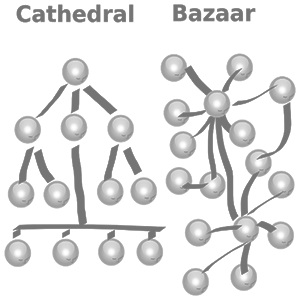
‘The Cathedral and the Bazaar: Musings on Linux and Open Source by an Accidental Revolutionary’ is an essay by Eric S. Raymond on software engineering methods, based on his observations of the Linux kernel development process and his experiences managing an open source project, fetchmail. It examines the struggle between top-down and bottom-up design. It was first presented by the author at the Linux Kongress in 1997 in Germany and was published as part of a book of the same name in 1999.
The essay contrasts two different free software development models: the Cathedral model, in which source code is available with each software release, but code developed between releases is restricted to an exclusive group of software developers. And, the Bazaar model, in which the code is developed over the Internet in view of the public. Raymond credits Linus Torvalds, leader of the Linux kernel project, as the inventor of this process. Raymond also provides anecdotal accounts of his own implementation of this model for the Fetchmail project.
read more »
Posted in Language, Technology |
Leave a Comment »



