February 27, 2013
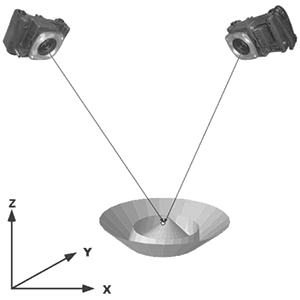
Photogrammetry [foh-tuh-gram-i-tree] is the practice of determining the geometric properties of objects from photographic images. Photogrammetry is as old as modern photography and can be dated to the mid-nineteenth century.
Photogrammetry is used in different fields, such as topographic mapping, architecture, engineering, manufacturing, quality control, police investigation, and geology, as well as by archaeologists to quickly produce plans of large or complex sites and by meteorologists as a way to determine the actual wind speed of a tornado where objective weather data cannot be obtained. It is also used to combine live action with computer-generated imagery in movie post-production; ‘The Matrix’ is a good example of the use of photogrammetry in film.
Posted in Technology |
Leave a Comment »
February 27, 2013

Many Japanese women are embarrassed at the thought of being heard by others during urination. To cover the sound of bodily functions, many women used to flush public toilets continuously while using them, wasting a large amount of water in the process.
As education campaigns did not stop this practice, a device was introduced in the 1980s that, after activation, produces the sound of flushing water without the need for actual flushing. A Toto brand name commonly found is the ‘Otohime’ (literally ‘Sound Princess‘ also homophone with a legendary goddess Otohime). This device is now routinely placed in most new public women’s rooms, and many older public women’s rooms have been upgraded.
Posted in Money, Technology |
Leave a Comment »
February 26, 2013
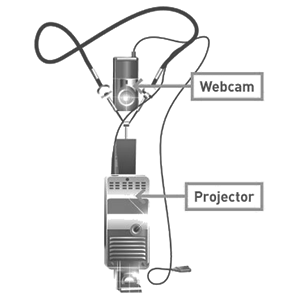
SixthSense is a wearable gestural interface device by Pranav Mistry, a PhD candidate in the Fluid Interfaces Group at the MIT Media Lab. The SixthSense technology comprises of a pocket projector, a mirror, and a camera contained in a pendant-like, wearable device. Both the projector the camera and sensors are connected to a mobile computing device in the user’s pocket. The projector projects visual information enabling surfaces, walls and physical objects around us to be used as interfaces; while the camera recognizes and tracks users’ hand gestures and physical objects using computer-vision based techniques.
The software program processes the video stream data captured by the camera and tracks the locations of the colored markers (visual tracking fiducials) at the tips of the user’s fingers. The movements and arrangements of these fiducials are interpreted into gestures that act as interaction instructions for the projected application interfaces. SixthSense supports multi-touch and multi-user interaction.
Posted in Technology |
Leave a Comment »
February 26, 2013
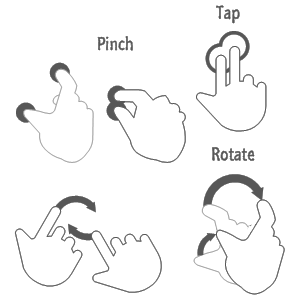
Gesture recognition is a topic in computer science and language technology with the goal of interpreting human gestures via mathematical algorithms. Gestures can originate from any bodily motion or state but commonly originate from the face or hand. Current focuses in the field include emotion recognition from the face and hand gesture recognition. Many approaches have been made using cameras and computer vision algorithms to interpret sign language.
However, the identification and recognition of posture, gait, proxemics (culture-specific, personal boundaries), and human behaviors is also the subject of gesture recognition techniques. Gesture recognition can be seen as a way for computers to begin to understand human body language, offering richer interaction between machines and humans than that afforded by a mouse and keyboard.
read more »
Posted in Language, Technology |
Leave a Comment »
February 26, 2013

The Peel P50 is a three-wheeled microcar originally manufactured from 1962 to 1965 by the Peel Engineering Company on the Isle of Man in the Irish Sea. It currently holds the record for the smallest automobile to go into production.
It has no reverse gear, but a handle at the rear allows the very lightweight car to be physically maneuvered when required. Designed as a city car, it was advertised as capable of seating ‘one adult and a shopping bag.’ The vehicle’s only door was on its left side, and equipment included a single windscreen wiper and only one headlight. Standard colors were Daytona White, Dragon Red, and Dark Blue. The 1963 model retailed for £199 when new. 50 of them were produced, and only 27 of them are known to be still in existence.
read more »
Posted in Humor, Technology |
Leave a Comment »
February 19, 2013

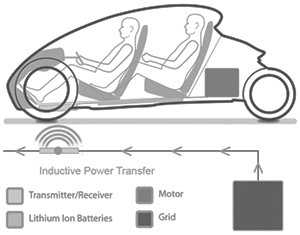
Wireless power or wireless energy transmission is the transmission of electrical energy from a power source to an electrical load without man-made conductors. Wireless transmission is useful in cases where interconnecting wires are inconvenient, hazardous, or impossible. The problem of wireless power transmission differs from that of wireless telecommunications, such as radio. In the latter, the proportion of energy received becomes critical only if it is too low for the signal to be distinguished from the background noise.
With wireless power, efficiency is the more significant parameter. A large part of the energy sent out by the generating plant must arrive at the receiver or receivers to make the system economical. The most common form of wireless power transmission is carried out using direct induction followed by resonant magnetic induction. Other methods under consideration are electromagnetic radiation in the form of microwaves or lasers and electrical conduction through natural media.
read more »
Posted in Technology |
Leave a Comment »
February 19, 2013


Phishing is the act of attempting to acquire information such as usernames, passwords, and credit card details by masquerading as a trustworthy entity in an electronic communication. Communications purporting to be from popular social web sites, auction sites, online payment processors, or IT administrators are commonly used to lure the unsuspecting public. Phishing emails may contain links to websites that are infected with malware.
Phishing is typically carried out by e-mail spoofing (altering the sender address) or instant messaging, and it often directs users to enter details at a fake website whose look and feel are almost identical to the legitimate one. Phishing is an example of social engineering (manipulating people into performing actions or divulging confidential information), and exploits the poor usability of current web security technologies. Attempts to deal with the growing number of reported phishing incidents include legislation, user training, public awareness, and technical security measures.
read more »
Posted in Money, Politics, Technology |
Leave a Comment »
February 19, 2013

PLA Unit 61398, referred to by the US as the ‘Comment Crew’ (owing to the collective’s past pattern of embedding HTML commands in the comments section of popular websites) is an alleged cyber-warfare unit of the Chinese military. As a hacker group the entity has been known to US intelligence agencies since 2002; they gave it the codename ‘Byzantine Candor.’
The unit is reported to operate out of a 12-story building in Shanghai and the surrounding neighborhood. The story was first broken by the ‘New York Times,’ based on information from a report by the computer security firm Mandiant, who were retained by the New York Times after a compromise of their own computer systems. Mandiant’s report states that PLA Unit 61398 is believed to be under the 2nd Bureau of the People’s Liberation Army General Staff’s Department (GSD) 3rd Department and that there is evidence that it contains an entity Mandiant calls APT1, part of the Advanced Persistent Threat attacking American corporations and government entities.
Posted in Money, Technology, War |
Leave a Comment »
February 19, 2013


The Chaos Computer Club (CCC) is one of the world’s biggest hackers organizations. The CCC is based in Germany and other German-speaking countries. The CCC describes itself as ‘a galactic community of life forms, independent of age, sex, race or societal orientation, which strives across borders for freedom of information….’ In general, the CCC advocates more transparency in government, freedom of information, and the human right to communication.
Supporting the principles of the hacker ethic, the club also fights for free universal access to computers and technological infrastructure. The CCC was founded in Berlin in 1981 at a table which had previously belonged to the Kommune 1 (the first politically motivated commune in Germany) in the rooms of the newspaper ‘Die Tageszeitung’ by Wau Holland and others in anticipation of the prominent role that information technology would play in the way people live and communicate.
read more »
Posted in Politics, Technology, World |
Leave a Comment »
February 19, 2013


2600: The Hacker Quarterly is an American publication that specializes in publishing technical information on a variety of subjects including telephone switching systems, Internet protocols and services, as well as general news concerning the computer ‘underground’ and left wing, and sometimes (but not recently), anarchist issues.
The magazine’s name comes from the phreaker discovery in the 1960s that the transmission of a 2600 hertz tone (which could be produced perfectly with a plastic toy whistle given away free with Cap’n Crunch cereal—discovered by friends of John Draper) over a long-distance trunk connection gained access to ‘operator mode’ and allowed the user to explore aspects of the telephone system that were not otherwise accessible.
read more »
Posted in Language, Politics, Technology |
Leave a Comment »
February 13, 2013

An anechoic [an-e-koh-ik] (echo-free) chamber is a room designed to completely absorb reflections of either sound or electromagnetic waves. They are also insulated from exterior sources of noise. The combination of both aspects means they simulate a quiet open-space of infinite dimension, which is useful when exterior influences would otherwise give false results.
Anechoic chambers, a term coined by American acoustics expert Leo Beranek, were originally used in the context of acoustics (sound waves) to minimize the reflections of a room. More recently, rooms designed to reduce reflection and external noise in radio frequencies have been used to test antennas, radars, or electromagnetic interference. Anechoic chambers range from small compartments the size of household microwave ovens to ones as large as aircraft hangars. The size of the chamber depends on the size of the objects to be tested and the frequency range of the signals used, although scale models can sometimes be used by testing at shorter wavelengths.
read more »
Posted in Technology |
Leave a Comment »
February 11, 2013
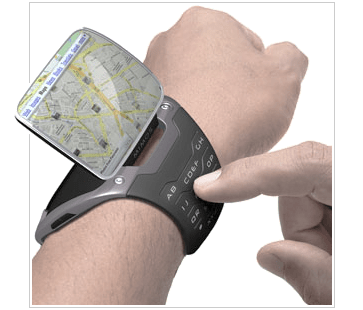
Wearable computers, also known as body-borne computers, are miniature electronic devices that are worn by the bearer under, with or on top of clothing. One of the main advantages of a wearable computer is consistency: there is a constant interaction between the computer and user, i.e. there is no need to turn the device on or off. Another useful feature is the ability to multi-task: it is not necessary to stop what you are doing to use the device; it is augmented into all other actions.
These devices can be incorporated by the user to act like a prosthetic. It can therefore be an extension of the user’s mind and/or body. Many issues are common to the wearables as with mobile computing, ambient intelligence (electronic environments that are sensitive and responsive to the presence of people), and ubiquitous computing research communities, including power management and heat dissipation, software architectures, wireless and personal area networks.
read more »
Posted in Technology |
Leave a Comment »



