January 10, 2013

The Google effect is the tendency to forget information that can be easily found using internet search engines such as Google, instead of remembering it.
The phenomenon was described and named by researchers Betsy Sparrow, Jenny Liu, and Daniel M. Wegner in 2011. Having easy access to the Internet, their study showed, makes people less likely to remember certain details they believe will be accessible online. People can still remember things they cannot find online, and how to find what they need on the Internet. Sparrow said this made the Internet a type of transactive memory. One result of this phenomenon is dependence on the Internet; if an online connection is lost, the researchers said, it is similar to losing a friend.
read more »
Posted in Health, Science, Technology |
Leave a Comment »
January 10, 2013

‘Don’t be evil‘ was the formal corporate motto (or slogan) of Google. It was first suggested either by Google employee Paul Buchheit at a meeting about corporate values that took place in early 2000, or by Google Engineer Amit Patel in 1999. Buchheit, the creator of Gmail, said he ‘wanted something that, once you put it in there, would be hard to take out,’ adding that the slogan was ‘also a bit of a jab at a lot of the other companies, especially our competitors, who at the time, in our opinion, were kind of exploiting the users to some extent.’
While the official corporate philosophy of Google does not contain the words ‘Don’t be evil,’ they were included in the prospectus of Google’s 2004 IPO (a letter from Google’s founders, later called the ”Don’t Be Evil’ manifesto’): ‘Don’t be evil. We believe strongly that in the long term, we will be better served — as shareholders and in all other ways — by a company that does good things for the world even if we forgo some short term gains.’
read more »
Posted in Money, Politics, Technology |
Leave a Comment »
January 9, 2013

‘Burning Chrome‘ is a short story, written by William Gibson and first published in ‘Omni’ in 1982. Gibson first read the story at a science fiction convention in Denver in the autumn of 1981, to an audience of four people, among them Bruce Sterling (who Gibson later said ‘completely got it’). It was collected with the rest of Gibson’s early short fiction in a 1986 volume of the same name.
‘Burning Chrome’ tells the story of two hackers who breaking into computer systems for profit. The two main characters are Bobby Quine who specializes in software and Automatic Jack whose field is hardware. A third character in the story is Rikki, a girl with whom Bobby becomes infatuated and for whom he wants to become wealthy. Automatic Jack acquires a piece of Russian hacking software that is very sophisticated and hard to trace. The rest of the story unfolds with Bobby deciding to break into the system of a notorious and vicious criminal called Chrome, who handles money transfers for organized crime, and Automatic Jack reluctantly agreeing to help.
read more »
Posted in Art, Language, Technology |
Leave a Comment »
January 9, 2013

‘Neuromancer‘ is a 1984 novel by William Gibson, a seminal work in the cyberpunk genre and winner of the science-fiction ‘triple crown’ — the Nebula Award, the Philip K. Dick Award, and the Hugo Award. It was Gibson’s first novel and the beginning of the ‘Sprawl’ trilogy (which takes place in a near-future world dominated by corporations and ubiquitous technology, after a limited World War III).
The novel tells the story of a washed-up computer hacker hired by a mysterious employer to work on a dangerous hack. ‘Neuromancer’ is considered the archetypal cyberpunk work. Gibson himself coined the term ‘cyberspace’ in his novelette ‘Burning Chrome,’ published in 1982 by ‘Omni’ magazine.
read more »
Posted in Art, Language, Technology |
Leave a Comment »
January 9, 2013

In 2009, Dennis LeRoy Anderson of Minnesota received widespread media attention for being arrested in a DWI case involving a motorized recliner. Riding a recliner which he had fitted with a motor, Anderson crashed into a car after leaving a local bar, where he had drunk a number of beers. The driver was convicted and the chair was confiscated by the police. The police auctioned the recliner away on Do-Bid.com for $3,700. 62-year-old Dennis LeRoy Anderson fitted his recliner with a lawnmower engine, wheels and steering wheel, which allowed the chair to reach up to 20 miles per hour. He had also installed a stereo, cup holders, headlights and a power antenna.
According to Minnesota law, a ‘motor vehicle’ is taken to mean ‘every vehicle that is self-propelled and every vehicle that is propelled by electric power obtained from overhead trolley wires. This means that a driver of any motorized vehicle, even a recliner, is liable under DWI legislation. Anderson’s blood alcohol content was three times over the legal limit for the state. In addition to this, vehicles can also be confiscated if the driver has a blood alcohol level over 0.2, or has a prior DWI conviction from the last 10 years. Anderson, in addition to having a blood alcohol level well over that limit, also had a prior conviction.
Posted in Humor, Politics, Technology |
Leave a Comment »
January 8, 2013

Anamanaguchi is a chiptune indie rock or ‘chip-punk’ band from New York City that ‘makes loud, fast music with a NES from 1985.’ The band has four members: lead songwriter Peter Berkman, bassist James DeVito, guitarist Ary Warnaar and drummer Luke Silas. Like other chiptune artists, Anamanaguchi creates music using synthesizers. However, unlike most chiptune bands, they use video game hardware from the mid-to-late 1980s: namely an NES and a Game Boy.
Berkman has stated that their music isn’t just based around video game music and that much of it is inspired by ‘[s]imple pop stuff, like Weezer and the Beach Boys.’ The band composed music for the videogame adaptation of the ‘Scott Pilgrim’ graphic novels, ‘Scott Pilgrim vs. the World: The Game.’ In 2010 it was announced that Anamanaguchi would appear in the popular music video game ‘Rock Band’ with the track ‘Airbrushed.’ The band’s song ‘Jetpack Blues, Sunset Hues’ is the current theme to Chris Hardwick’s ‘The Nerdist Podcast.’
Posted in Art, Games, Technology |
1 Comment »
January 8, 2013

The Story of Stuff is a 2007 short polemical animated documentary about the lifecycle of material goods. The documentary is critical of excessive consumerism and promotes sustainability. Filmmaker Annie Leonard wrote and narrated the film, which was funded by Tides Foundation, Funders Workgroup for Sustainable Production and Consumption, Free Range Studios and other foundations.
The video divides up the materials economy into a system composed of extraction, production, distribution, consumption, and disposal. To articulate the problems in the system, Leonard adds people, the government, and corporations. Leonard’s thesis, ‘you cannot run a linear system on a finite planet indefinitely’ is supported throughout the video by statistical data.
read more »
Posted in Money, Politics, Technology |
Leave a Comment »
January 6, 2013

A typical chain letter consists of a message that attempts to convince the recipient to make a number of copies of the letter and then pass them on to as many recipients as possible. Common methods used in chain letters include emotionally manipulative stories, get-rich-quickly pyramid schemes, and the exploitation of superstition to threaten the recipient with bad luck or even physical violence or death if he or she ‘breaks the chain’ and refuses to adhere to the conditions set out in the letter.
Chain letters started as actual letters that one received in the mail. Today, chain letters are generally no longer actual letters. They are sent through email messages, postings on social network sites, and text messages.
read more »
Posted in Language, Money, Technology |
Leave a Comment »
January 6, 2013

Viral phenomena are objects or patterns able to replicate themselves or convert other objects into copies of themselves when these objects are exposed to them.
The concept of something, other than a biological virus, being viral came into vogue just after the Internet became widely popular in the mid-to-late 1990s. An object, even an immaterial object, is considered to be viral when it has the ability to spread copies of itself or change other similar objects to become more like itself when those objects are simply exposed to the viral object.
read more »
Posted in Health, Language, Technology |
Leave a Comment »
January 6, 2013

Memetic [meh-met-ik] engineering is a term developed and coined by Leveious Rolando, John Sokol, and Gibran Burchett while they researched and observed the behavior of people after being purposely exposed (knowingly and unknowingly) to certain memetic themes. The term is based on Richard Dawkins’ theory of memes (a proposed basic unit of cultural information).
Memetic engineering refers to the process of developing memes, through ‘meme-splicing’ and ‘memetic synthesis,’ with the intent of altering the behavior of others in society or humanity; the process of creating and developing theories or ideologies based on an analytical study of societies, cultures, their ways of thinking and the evolution of their minds; and the process of modifying human beliefs, thought patterns, etc.
read more »
Posted in Language, Science, Technology |
Leave a Comment »
January 2, 2013
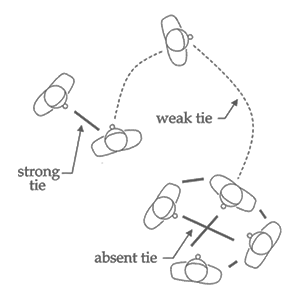
Heterophily [het-er-uh-fil-ee], or ‘love of the different,’ is the tendency of individuals to collect in diverse groups; it is the opposite of homophily (‘love of the same,’ the tendency of individuals to associate and bond with similar others). This phenomenon is notable in successful organizations, where the resulting diversity of ideas is thought to promote an innovative environment. Recently it has become an area of social network analysis. Most of the early work in heterophily was done in the 1960s by sociologist Everett Rogers in his book ‘Diffusion Of Innovations.’
Rogers showed that heterophilious networks were better able to spread innovations. Later, scholars such as Paul Burton, draw connections between modern Social Network Analysis as practiced by Stanford sociologist Mark Granovetter in his theory of weak ties (if A is linked to both B and C, then there is a greater-than-chance probability that B and C are linked to each other) and the work of German sociologist Georg Simmel. Burton found that Simmel’s notion of ‘the stranger’ is equivalent to Granovetter’s weak tie in that both can bridge homophilious networks, turning them into one larger heterophilious network.
Posted in Language, Science, Technology |
Leave a Comment »
January 2, 2013
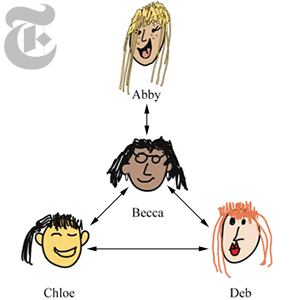
The friendship paradox is the phenomenon first observed by the sociologist Scott L. Feld in 1991 that most people have fewer friends than their friends have, on average. It can be explained as a form of sampling bias (e.g. non-random sample) in which people with greater numbers of friends have an increased likelihood of being observed among one’s own friends. In contradiction to this, most people believe that they have more friends than their friends have.
The same observation can be applied more generally to social networks defined by other relations than friendship: for instance, most people’s sexual partners have (on the average) a greater number of sexual partners than they have. In spite of its apparently paradoxical nature, the phenomenon is real, and can be explained as a consequence of the general mathematical properties of social networks.
read more »
Posted in Health, Science, Technology |
Leave a Comment »


 The Daily Omnivore