January 8, 2013

The Story of Stuff is a 2007 short polemical animated documentary about the lifecycle of material goods. The documentary is critical of excessive consumerism and promotes sustainability. Filmmaker Annie Leonard wrote and narrated the film, which was funded by Tides Foundation, Funders Workgroup for Sustainable Production and Consumption, Free Range Studios and other foundations.
The video divides up the materials economy into a system composed of extraction, production, distribution, consumption, and disposal. To articulate the problems in the system, Leonard adds people, the government, and corporations. Leonard’s thesis, ‘you cannot run a linear system on a finite planet indefinitely’ is supported throughout the video by statistical data.
read more »
Posted in Money, Politics, Technology |
Leave a Comment »
January 6, 2013

A typical chain letter consists of a message that attempts to convince the recipient to make a number of copies of the letter and then pass them on to as many recipients as possible. Common methods used in chain letters include emotionally manipulative stories, get-rich-quickly pyramid schemes, and the exploitation of superstition to threaten the recipient with bad luck or even physical violence or death if he or she ‘breaks the chain’ and refuses to adhere to the conditions set out in the letter.
Chain letters started as actual letters that one received in the mail. Today, chain letters are generally no longer actual letters. They are sent through email messages, postings on social network sites, and text messages.
read more »
Posted in Language, Money, Technology |
Leave a Comment »
January 6, 2013

Viral phenomena are objects or patterns able to replicate themselves or convert other objects into copies of themselves when these objects are exposed to them.
The concept of something, other than a biological virus, being viral came into vogue just after the Internet became widely popular in the mid-to-late 1990s. An object, even an immaterial object, is considered to be viral when it has the ability to spread copies of itself or change other similar objects to become more like itself when those objects are simply exposed to the viral object.
read more »
Posted in Health, Language, Technology |
Leave a Comment »
January 6, 2013

Memetic [meh-met-ik] engineering is a term developed and coined by Leveious Rolando, John Sokol, and Gibran Burchett while they researched and observed the behavior of people after being purposely exposed (knowingly and unknowingly) to certain memetic themes. The term is based on Richard Dawkins’ theory of memes (a proposed basic unit of cultural information).
Memetic engineering refers to the process of developing memes, through ‘meme-splicing’ and ‘memetic synthesis,’ with the intent of altering the behavior of others in society or humanity; the process of creating and developing theories or ideologies based on an analytical study of societies, cultures, their ways of thinking and the evolution of their minds; and the process of modifying human beliefs, thought patterns, etc.
read more »
Posted in Language, Science, Technology |
Leave a Comment »
January 2, 2013
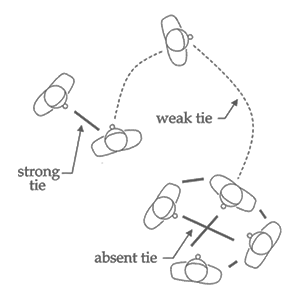
Heterophily [het-er-uh-fil-ee], or ‘love of the different,’ is the tendency of individuals to collect in diverse groups; it is the opposite of homophily (‘love of the same,’ the tendency of individuals to associate and bond with similar others). This phenomenon is notable in successful organizations, where the resulting diversity of ideas is thought to promote an innovative environment. Recently it has become an area of social network analysis. Most of the early work in heterophily was done in the 1960s by sociologist Everett Rogers in his book ‘Diffusion Of Innovations.’
Rogers showed that heterophilious networks were better able to spread innovations. Later, scholars such as Paul Burton, draw connections between modern Social Network Analysis as practiced by Stanford sociologist Mark Granovetter in his theory of weak ties (if A is linked to both B and C, then there is a greater-than-chance probability that B and C are linked to each other) and the work of German sociologist Georg Simmel. Burton found that Simmel’s notion of ‘the stranger’ is equivalent to Granovetter’s weak tie in that both can bridge homophilious networks, turning them into one larger heterophilious network.
Posted in Language, Science, Technology |
Leave a Comment »
January 2, 2013
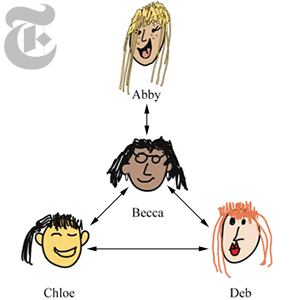
The friendship paradox is the phenomenon first observed by the sociologist Scott L. Feld in 1991 that most people have fewer friends than their friends have, on average. It can be explained as a form of sampling bias (e.g. non-random sample) in which people with greater numbers of friends have an increased likelihood of being observed among one’s own friends. In contradiction to this, most people believe that they have more friends than their friends have.
The same observation can be applied more generally to social networks defined by other relations than friendship: for instance, most people’s sexual partners have (on the average) a greater number of sexual partners than they have. In spite of its apparently paradoxical nature, the phenomenon is real, and can be explained as a consequence of the general mathematical properties of social networks.
read more »
Posted in Health, Science, Technology |
Leave a Comment »
January 2, 2013

In his online essay ‘Digital Maoism: The Hazards of the New Online Collectivism,’ in ‘Edge’ magazine in 2006, futurist Jaron Lanier criticized the sometimes-claimed omniscience of collective wisdom (including examples such as the Wikipedia article about himself), describing it as ‘digital Maoism.’
He writes ‘If we start to believe that the Internet itself is an entity that has something to say, we’re devaluing those people [creating the content] and making ourselves into idiots.’ His criticism aims at several targets which are at different levels of abstraction: any attempt to create one final authoritative bottleneck which channels the knowledge onto society is wrong, regardless whether it is a Wikipedia or any algorithmically created system producing meta information.
read more »
Posted in Politics, Technology |
Leave a Comment »
January 2, 2013
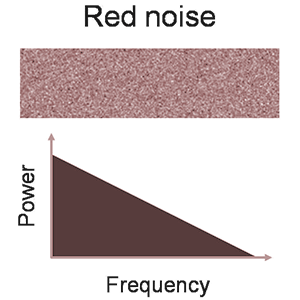
Noises are classified based on their spectral properties; they are named for the color they most resemble in the visible light spectrum. If the sound wave pattern of ‘red noise’ were translated into light waves, the resulting light would be red, and so on. White noise is an audio signal that contains all the frequencies audible to the human ear. It is analogous to white light, which contains all the colors of light visible to the human eye.
Pink noise is a signal that is louder at low frequencies and decreases at a constant rate. It is sometimes referred to as flicker noise particularly when it describes background noise emitted by an electronic device. Pink noise is used to make music, sound effects, or merely as a pleasant background sound and is reported to sound more like the ocean than white noise (which is often compared to the sound of rainfall or TV static) because of its bias towards lower frequencies.
read more »
Posted in Language, Science, Technology |
Leave a Comment »
December 24, 2012

Reclaim the Streets (RTS) is a collective with a shared ideal of community ownership of public spaces. Participants characterize the collective as a resistance movement opposed to the dominance of corporate forces in globalization, and to the car as the dominant mode of transport. Reclaim the Streets often stage non-violent direct action street reclaiming events such as the ‘invasion’ of a major road, highway or freeway to stage a party.
While this may obstruct the regular users of these spaces such as car drivers and public bus riders, the philosophy of RTS is that it is vehicle traffic, not pedestrians, who are causing the obstruction, and that by occupying the road they are in fact opening up public space. The events are usually spectacular and colorful with sand pits for children to play in, free food and music, however they have been known to degenerate into riots and violence. A Temporary Autonomous Zone sometimes results. The style of the parties in many places has been influenced by the rave scene in the UK, with sound systems playing dance music.
read more »
Posted in Money, Politics, Technology |
Leave a Comment »
December 22, 2012

A bandwidth cap, also known as a bit cap, limits the transfer of a specified amount of data over a period of time. Internet service providers commonly apply a cap when a channel intended to be shared by many users becomes overloaded, or may be overloaded, by a few users. Implementation of a bandwidth cap is sometimes termed a Fair Access Policy or Usage-based billing. In many situations, each user of a network is expected to use high speed transmission for only a short time, for example to download a megabyte web page in less than a second.
When use is continuous, as it might be in the case of file sharing, Internet radio or streaming video, a few users who use the connection at high rates for hours at a time may seriously impair the service of others. The concept is more relevant in cable internet where both the core network and the access network are shared, than in DSL where the core network is shared but the access network is not. It is most relevant in wireless internet, particularly satellite internet, where both the core network and the access network are shared and total network bandwidth is relatively narrow.
read more »
Posted in Money, Technology, World |
Leave a Comment »
December 21, 2012

Eclectic Method is the name of an audio-visual remix act, originally formed in London in 2001 by Geoff Gamlen, Ian Edgar, Johnny Wilson.
They quickly developed Eclectic Method’s audio-visual style into a live performance featuring video turntables (Pioneer DVJ-1000) – mixing the visuals and audio in real time. As a live act, they have traveled around the world playing hundreds of gigs in Asia, North America, South America, Europe and the Middle East.
read more »
Posted in Art, Money, Technology |
Leave a Comment »
December 20, 2012

Affective computing is the study and development of systems and devices that can recognize, interpret, process, and simulate human affects.
It is an interdisciplinary field spanning computer sciences, psychology, and cognitive science, which originated at MIT with Rosalind Picard’s 1995 paper on affective computing. A motivation for the research is the ability to simulate empathy. The machine should interpret the emotional state of humans and adapt its behavior to them, giving an appropriate response for those emotions.
read more »
Posted in Health, Language, Technology |
Leave a Comment »



