October 17, 2012

Virtual goods are non-physical objects purchased for use in online communities or online games. ‘Digital goods,’ on the other hand, may be a broader category including digital books, music, and movies.
Virtual goods have no intrinsic value and are intangible by definition. Including digital gifts and digital clothing for avatars, virtual goods may be classified as services instead of goods and are usually sold by companies that operate social networks, community sites, or online games. Sales of virtual goods are sometimes referred to as microtransactions, and the games that utilize this model are usually referred to as ‘freemium’ (free + premium) games.
read more »
Posted in Games, Money, Technology |
Leave a Comment »
October 16, 2012

‘Uranprojekt,’ informally known as the ‘Uranverein’ (‘Uranium Club‘), was an attempted clandestine scientific effort led by Germany to develop and produce atomic weapons during World War II.
This program started in April 1939, just months after the discovery of nuclear fission in January of that year, but ended quickly, due to German invasion of Poland, where many notable physicists were drafted into the Wehrmacht (Nazi military). However, the second effort began under the administrative auspices of the Wehrmacht’s Heereswaffenamt (HWA, ‘Army Ordnance Office’) on the day WWII began (September 1, 1939).
read more »
Posted in Technology, War |
1 Comment »
October 14, 2012

The Kill A Watt is an electricity usage monitor marketed by P3 International. It features a large LCD display and it enables cost forecasting.
It measures the energy used by individual appliances plugged into the meter, as opposed to in-home energy use displays, which display the energy used by an entire household. The name is a play on the word kilowatt. The device can give an indication of the standby power used by appliances.
Posted in Money, Technology |
Leave a Comment »
October 10, 2012
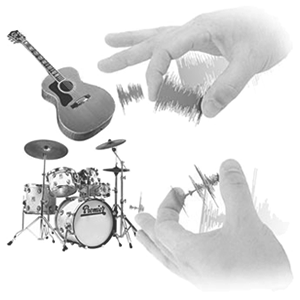
In music, sampling is the act of taking a portion, or sample, of one sound recording and reusing it as an instrument or a sound recording in a different song or piece. Sampling was originally developed by experimental musicians working with musique concrète and electroacoustic music, who physically manipulated tape loops or vinyl records on a phonograph.
In the late 1960s, the use of tape loop sampling influenced the development of minimalist music and the production of psychedelic rock and jazz fusion. In the 1970s, DJs manipulating vinyl on turntables gave birth to hip hop music, the first popular music genre based originally around the art of sampling.
read more »
Posted in Money, Politics, Technology |
Leave a Comment »
October 9, 2012

A powered exoskeleton, also known as powered armor, or exoframe, is a powered mobile machine consisting primarily of an exoskeleton-like framework worn by a person and a power supply that supplies at least part of the activation-energy for limb movement. Powered exoskeletons are designed to assist and protect the wearer. They may be designed, for example, to assist and protect soldiers and construction workers, or to aid the survival of people in other dangerous environments. A wide medical market exists in the future of prosthetics to provide mobility assistance for aged and infirm people.
Other possibilities include rescue work, such as in collapsed buildings, in which the device might allow a rescue worker to lift heavy debris, while simultaneously protecting the worker from falling rubble. A fictional ‘mech’ is different from a powered exoskeleton in that the mecha is typically much larger than a normal human body, and does not directly enhance the motion or strength of the physical limbs. Instead the human operator occupies a cabin or pilot’s control seat inside a small portion of the larger system. Within this cabin the human may wear a small lightweight exoskeleton that serves as a haptic control interface for the much larger exterior appendages.
read more »
Posted in Health, Technology, War |
Leave a Comment »
October 9, 2012

‘Technopoly: The Surrender of Culture to Technology’ is a book by Neil Postman published in 1992 that describes a society in which technology is deified, meaning ‘the culture seeks its authorization in technology, finds its satisfactions in technology, and takes its orders from technology.’ It is characterized by a surplus of information generated by technology, which technological tools are in turn employed to cope with, in order to provide direction and purpose for society and individuals. Postman considers technopoly to be the most recent of three kinds of cultures distinguished by shifts in their attitude towards technology – tool-using cultures, technocracies, and technopolies.
Each, he says, is produced by the emergence of new technologies that ‘compete with old ones…mostly for dominance of their worldviews.’ According to Postman, a tool-using culture employs technologies only to solve physical problems, as spears, cooking utensils, and water mills do, and to ‘serve the symbolic world’ of religion, art, politics and tradition, as tools used to construct cathedrals do. He claims that all such cultures are either theocratic or ‘unified by some metaphysical theory,’ which forced tools to operate within the bounds of a controlling ideology and made it ‘almost impossible for technics to subordinate people to its own needs.’
read more »
Posted in Language, Philosophy, Technology |
Leave a Comment »
October 8, 2012

The free culture movement is a social movement that promotes the freedom to distribute and modify creative works in the form of free content by using the Internet and other forms of media. The movement objects to overly-restrictive copyright laws. Many members of the movement argue that such laws hinder creativity. They call this system ‘permission culture.’ ‘Creative Commons’ is a well-known website which was started by legal activist Lawrence Lessig. It lists licenses that permit sharing under various conditions, and also offers an online search of various creative-commons-licensed productions.
The free culture movement, with its ethos of free exchange of ideas, is of a whole with the free software movement. Richard Stallman, the founder of the GNU project (a free UNIX competitor, and free software activist, advocates free sharing of information. He famously stated that free software means free as in ‘free speech,’ not ‘free beer.’ Today, the term stands for many other movements, including hacker computing, the access to knowledge movement, and the copyleft movement. The term ‘free culture’ was originally the title of a 2004 book by Lawrence Lessig, a founding father of the free culture movement.
read more »
Posted in Money, Politics, Technology |
2 Comments »
October 8, 2012

Information wants to be free is a slogan of technology activists invoked against limiting access to information. According to criticism of intellectual property rights, the system of governmental control of exclusivity is in conflict with the development of a public domain of information. The iconic phrase is attributed to American writer Stewart Brand who, in the late 1960s, founded the ‘Whole Earth Catalog’ and argued that technology could be liberating rather than oppressing.
The earliest recorded occurrence of the expression was at the first ‘Hackers’ Conference’ in 1984. Brand told Steve Wozniak: ‘On the one hand information wants to be expensive, because it’s so valuable. The right information in the right place just changes your life. On the other hand, information wants to be free, because the cost of getting it out is getting lower and lower all the time. So you have these two fighting against each other.’
read more »
Posted in Money, Politics, Technology |
Leave a Comment »
October 8, 2012

Patent troll is a pejorative term used for a person or company who enforces patents against one or more alleged infringers in a manner considered aggressive or opportunistic with no intention to manufacture or market the patented invention.
The Patent Troll was originally depicted in ‘The Patents Video,’ which was released in 1994 and sold to corporations, universities, and governmental entities. The metaphor was popularized in 2001 by Peter Detkin, former assistant general counsel of Intel, who chose the term from among a number of suggestions during a discussion with Anne Gundelfinger, Vice President and Associate General Counsel at Intel.
read more »
Posted in Money, Politics, Technology |
Leave a Comment »
October 8, 2012

A patent war is a ‘battle’ between corporations or individuals to secure patents for litigation, whether offensively or defensively. There are ongoing patent wars between the world’s largest technology and software corporations. Patent wars are not a new phenomenon. The Wright brothers, attributed with the invention of the airplane, sought to prevent competitors from manufacturing airplanes through litigation, stifling the development of the American airline industry. Alexander Graham Bell, credited with inventing the telephone, was dragged into a patent war against his rivals, which involved, in just 11 years, 600 lawsuits.
One notable case was Bell’s lawsuit against Western Union, a telegraph company backed by Elisha Gray (also credited with inventing the telephone). In the digital age, the rapid pace of innovation makes much of the patent system obsolete. In the 1980s, technology corporations in the United States and Japan engaged in a patent war, creating a scenario where companies were forced to ‘fight patent with patent.’ This bilateral patent war, partly exaggerated by the media, subsided by the mid 1990s.
read more »
Posted in Money, Politics, Technology |
3 Comments »
October 7, 2012
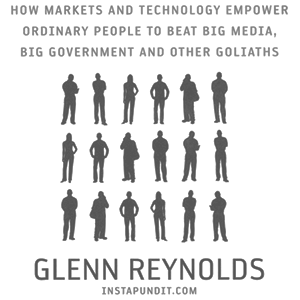
‘An Army of Davids: How Markets and Technology Empower Ordinary People to Beat Big Media, Big Government, and Other Goliaths’ is a2006 book by Glenn Reynolds, a law professor at the University of Tennessee also known as the blogger ‘Instapundit’.
The book looks at modern American society through the lens of individuals versus social institutions, and Reynolds concludes that technological change has allowed more freedom of action for people in contrast to the ‘big’ establishment organizations that used to function as gatekeepers. Thus, he argues that the balance of power between individuals and institutions is ‘flatting out,’ which involves numerous decentralized networks rising up. Reynolds divides the book into two distinct sections. The first focuses on trends currently taking place. The latter describes upcoming trends.
read more »
Posted in Money, Politics, Technology |
Leave a Comment »
October 7, 2012
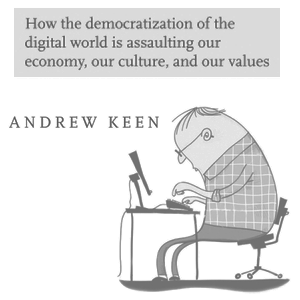
‘The Cult of the Amateur: How Today’s Internet Is Killing Our Culture’ is a 2007 book written by entrepreneur and Internet critic Andrew Keen; it is a critique of the enthusiasm surrounding user generated content, peer production, and other Web 2.0-related phenomena.
The book was written after Keen wrote a controversial essay in ‘The Weekly Standard’ criticizing Web 2.0 for being similar to Marxism, for destroying professionalism and for making it impossible to find high quality material amidst all the user-generated web content. The book was based in part on that essay. Keen argues against the idea of a ‘read-write culture’ in media, stating that ‘most of the content being shared— no matter how many times it has been linked, cross-linked, annotated, and copied— was composed or written by someone from the sweat of their creative brow and the disciplined use of their talent.’
read more »
Posted in Language, Technology |
Leave a Comment »



