October 7, 2012


Deletionism and inclusionism are opposing philosophies that largely developed and came to public notice within the context of the community of editors of the online encyclopedia Wikipedia. The terms are connected to views on the appropriate scope of the encyclopedia, and the appropriate point for a topic to be allowed to ‘include’ an encyclopedia article (i.e., ‘inclusion’) or ‘delete’ the article (i.e., ‘deletion’).
Inclusionism and deletionism are broad terms falling within a spectrum of views. The concepts are closely related to the concept of notability, with deletionists and inclusionists taking a strong or relaxed stance on ‘notability’ accordingly. Many users do not identify strongly with either position. ‘Deletionists’ are proponents of selective coverage and removal of articles seen as unnecessary or highly substandard. Deletionist viewpoints are commonly motivated by a desire that Wikipedia be focused on and cover significant topics – along with the desire to place a firm cap upon proliferation of promotional use (seen as abuse of the website), trivia, and articles which are of no general interest, lack suitable source material for high quality coverage, or are too short or otherwise unacceptably poor in quality.
read more »
Posted in Language, Politics, Technology |
Leave a Comment »
October 7, 2012


The reliability of Wikipedia (primarily of the English-language edition), compared to other encyclopedias and more specialized sources, is assessed in many ways, including statistically, through comparative review, analysis of the historical patterns, and strengths and weaknesses inherent in the editing process unique to Wikipedia.
Several studies have been done to assess the reliability of Wikipedia. A notable early study in the journal ‘Nature’ said that in 2005, ‘Wikipedia scientific articles came close to the level of accuracy in Encyclopædia Britannica and had a similar rate of ‘serious errors.’ The study was disputed by ‘Encyclopædia Britannica,’ and later ‘Nature’ responded to this refutation with both a formal response and a point-by-point rebuttal of Britannica’s main objections.
read more »
Posted in Education, Language, Technology |
2 Comments »
October 7, 2012
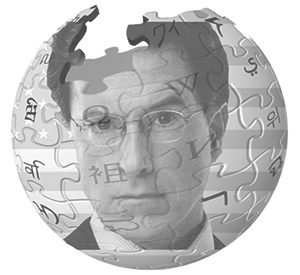

In a 2006 episode of the satirical news show ‘The Colbert Report,’ Stephen Colbert announced the neologism ‘Wikiality‘ (a portmanteau of the words ‘Wiki’ and ‘reality’) defined as ‘truth by consensus’ (rather than fact), modeled after the approval-by-consensus format of Wikipedia. He ironically praised Wikipedia for following his philosophy of ‘truthiness,’ in which intuition and consensus is a better reflection of reality than fact:
‘You see, any user can change any entry, and if enough other users agree with them, it becomes true. … If only the entire body of human knowledge worked this way. And it can, thanks to tonight’s word: ‘Wikiality.’ Now, folks, I’m no fan of reality, and I’m no fan of encyclopedias. I’ve said it before. Who is Britannica to tell me that George Washington had slaves? If I want to say he didn’t, that’s my right. And now, thanks to Wikipedia, it’s also a fact. We should apply these principles to all information. All we need to do is convince a majority of people that some factoid is true. … What we’re doing is bringing democracy to knowledge.’
read more »
Posted in Humor, Language, Technology |
Leave a Comment »
October 7, 2012
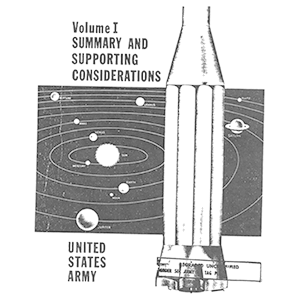
Project Horizon was a study to determine the feasibility of constructing a scientific / military base on the Moon. In 1959, a group at the Army Ballistic Missile Agency (ABMA) produced for the U.S. Department of the Army a report entitled ‘Project Horizon, A U.S. Army Study for the Establishment of a Lunar Military Outpost.’
The project proposal states the requirements as: ‘The lunar outpost is required to develop and protect potential United States interests on the moon; to develop techniques in moon-based surveillance of the earth and space, in communications relay, and in operations on the surface of the moon; to serve as a base for exploration of the moon, for further exploration into space, and for military operations on the moon if required; and to support scientific investigations on the moon.’
read more »
Posted in Technology, War |
Leave a Comment »
October 5, 2012
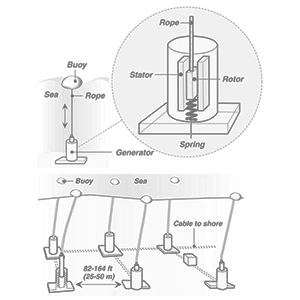
Wave power is the transport of energy by ocean surface waves, and the capture of that energy to do useful work – for example, electricity generation, water desalination, or the pumping of water (into reservoirs). Machinery able to exploit wave power is generally known as a wave energy converter (WEC). Wave power is distinct from tidal power and the steady gyre of ocean currents.
In 2008, the first experimental wave farm was opened in Portugal, at the Aguçadoura Wave Park. Waves are generated by wind passing over the surface of the sea. As long as the waves propagate slower than the wind speed just above the waves, there is an energy transfer from the wind to the waves. Both air pressure differences between the upwind and the lee side (the side sheltered from the wind) of a wave crest, as well as friction on the water surface by the wind, making the water to go into the shear stress causes the growth of the waves.
read more »
Posted in Money, Technology |
Leave a Comment »
October 5, 2012
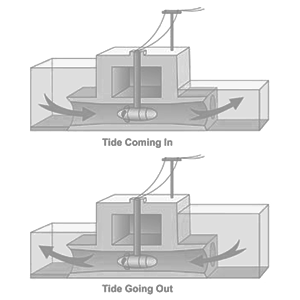
Tidal power, also called tidal energy, is a form of hydropower that converts the energy of tides into useful forms of power – mainly electricity. Although not yet widely used, tidal power has potential for future electricity generation. Tides are more predictable than wind energy and solar power. Among sources of renewable energy, tidal power has traditionally suffered from relatively high cost and limited availability of sites with sufficiently high tidal ranges or flow velocities, thus constricting its total availability.
However, many recent technological developments and improvements, both in design (e.g. dynamic tidal power, tidal lagoons) and turbine technology (e.g. new axial turbines, cross flow turbines), indicate that the total availability of tidal power may be much higher than previously assumed, and that economic and environmental costs may be brought down to competitive levels.
read more »
Posted in Money, Technology |
Leave a Comment »
October 4, 2012

In the United States, clean coal is any technology that may reduce emissions of carbon dioxide and other greenhouse gasses that arise from the burning of coal for electrical power. Typically, the term clean coal is used by coal companies in reference to carbon capture and storage (CCS), which pumps and stores emissions underground, and to plants using an Integrated gasification combined cycle (IGCC), which is technology that turns coal and other carbon based fuels into synthesis gas (‘syngas,’ which can be used to produce diesel, or converted into methane or other fuels).
Historically, the term has been used to refer to technologies for reducing emissions of ash, sulfur, and heavy metals from coal combustion. Carbon capture and storage technologies are being developed primarily in response to regulations by the EPA—most notably the ‘Clean Air Act’—and in anticipation of legislation that seeks to mitigate climate change. Currently, the electricity sector of the United States is responsible for about 41% of the nation’s carbon dioxide emissions, and half of the sector’s production comes from coal-fired power plants.
read more »
Posted in Money, Politics, Technology |
Leave a Comment »
October 4, 2012
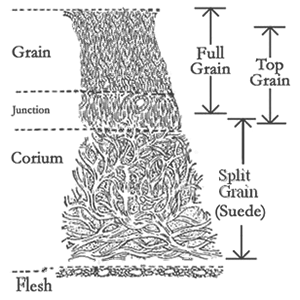
Leather is a durable and flexible material created by tanning animal rawhide and skin, often cattle hide. Traditionally, tanning used tannin, an acidic chemical compound from which the process draws its name (tannin is in turn named for an old German word for oak or fir trees, which supplied it).
Rawhide is made by removing the flesh and fat and then the hair (leather with the hair still attached is called ‘hair-on’) by use of an aqueous solution (this process is called ‘liming’ when using lime or ‘bucking’ when using lye), then scraping over a beam with a somewhat dull knife, and then drying (often while stretched). Liming or bucking also cleans the fiber network of the skin to encourage penetration of the tanning agent.
read more »
Posted in Art, Money, Technology |
Leave a Comment »
October 3, 2012

Feminist science fiction is a sub-genre of science fiction which tends to deal with women’s roles in society. Feminist science fiction poses questions about social issues such as how society constructs gender roles, the role reproduction plays in defining gender and the unequal political and personal power of men and women.
Some of the most notable feminist science fiction works have illustrated these themes using utopias to explore a society in which gender differences or gender power imbalances do not exist, or dystopias to explore worlds in which gender inequalities are intensified, thus asserting a need for feminist work to continue. According to professor Elyce Rae Helford: ‘Science fiction and fantasy serve as important vehicles for feminist thought, particularly as bridges between theory and practice. No other genres so actively invite representations of the ultimate goals of feminism: worlds free of sexism, worlds in which women’s contributions (to science) are recognized and valued, worlds in which the diversity of women’s desire and sexuality, and worlds that move beyond gender.’
read more »
Posted in Art, Sex, Technology |
1 Comment »
October 3, 2012
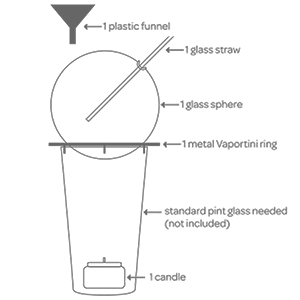
Alcohol Without Liquid is a process introduced first in Asia and Europe that allows people to take in liquor (distilled spirits) without actually consuming liquid. The machine vaporizes alcohol and mixes it with oxygen, allowing the consumer to breathe in the mixture.
The machine has been dubbed AWOL, a play on the military term AWOL (Absent Without Leave). The AWOL machine produces a very fine alcoholic mist. The continual intake of this mist over a twenty-minute period is the equivalent of taking one shot of distilled spirits. The machine was introduced to the United States in 2004.
read more »
Posted in Drugs, Health, Technology |
1 Comment »
October 2, 2012

‘The End of Work: The Decline of the Global Labor Force and the Dawn of the Post-Market Era’ is a non-fiction book by American economist Jeremy Rifkin, published in 1995.
Rifkin contended that worldwide unemployment would increase as information technology eliminated tens of millions of jobs in the manufacturing, agricultural, and service sectors. He predicted devastating impact of automation on blue-collar, retail and wholesale employees.
read more »
Posted in Language, Money, Technology |
Leave a Comment »
October 2, 2012

An infomorph is a virtual body of information that can possess emergent features such as personality. The term was first described in Charles Platt’s 1991 novel ‘The Silicon Man,’ where it refers to a single biological consciousness transferred into a computer through a process of mind transfer. In the book, a character refers to an infomorph as ‘intelligence held in a computer memory,’ and an ‘information entity.’
Russian artificial intelligence theorist Alexander Chislenko uses the same word in his 1996 essay ‘Networking in the Mind Age,’ to refer to a software agent that possesses distributed intelligence. Whether the vision shared in Platt’s novel will ever be more than a theory is uncertain, but computing power is still increasing exponentially, and the ‘Future of Humanity Institute’ at Oxford University have considered the philosophical and technical feasibility of this theory at some point in the future.
read more »
Posted in Philosophy, Technology |
1 Comment »



