August 2, 2012

A head-mounted display is a display device worn on the head or as part of a helmet, that has a small display optic in front of one (monocular HMD) or each eye (binocular HMD). A typical HMD has either one or two small displays with lenses and semi-transparent mirrors embedded in a helmet, eye-glasses (also known as data glasses), or visor. The display units are miniaturised and may include CRT, LCDs, Liquid crystal on silicon (LCos), or OLED. Some vendors employ multiple micro-displays to increase total resolution and field of view.
HMDs differ in whether they can display just a computer generated image (CGI), show live images from the real world, or a combination of both. Some HMDs allow a CGI to be superimposed on a real-world view. This is referred to as augmented reality or mixed reality. Combining real-world view with CGI can be done by projecting the CGI through a partially reflective mirror and viewing the real world directly. This method is often called ‘Optical See-Through.’ Combining real-world view with CGI can also be done electronically by accepting video from a camera and mixing it electronically with CGI. This method is often called ‘Video See-Through.’
read more »
Posted in Games, Technology, War |
1 Comment »
August 1, 2012

Project Glass is a research and development program by Google to develop an augmented reality head-mounted display (HMD). The intended purpose of Project Glass products would be the hands free displaying of information currently available to most smartphone users, and allowing for interaction with the Internet via natural language voice commands, in a manner which has been compared to the iPhone feature Siri.
The functionality and physical appearance (minimalist design of the aluminium strip with 2 nose pads) has been compared to the EyeTap (developed by Steve Mann at the University of Toronto), which was also referred to as ‘Glass’ (‘EyeTap Digital Eye Glass’). Though head-worn displays for augmented reality are not a new idea, the project has drawn media attention primarily due to its backing by Google, as well as the prototype, which is smaller and slimmer than previous designs for head-mounted displays.
read more »
Posted in Money, Technology |
Leave a Comment »
August 1, 2012

In human–computer interaction, WIMP stands for ‘windows, icons, menus, pointer.’ denoting a style of interaction using these elements of the user interface. It was coined by Merzouga Wilberts in 1980. Although its usage has fallen out of favor, it is often incorrectly used as an approximate synonym of ‘graphical user interface’ (GUI). Any interface that utilizes graphics can be termed a GUI, and WIMP systems are a derivative of such systems.
However, while all WIMP systems utilize graphics as a key element (namely the Icon and Pointer element) and therefore all WIMPs are GUIs, the reverse is not true – some GUIs are not based in windows, icons, menus and pointers and thus are not WIMPs. For example, most mobile phones utilize icons (graphics represent and result in an action being performed) and some may have menus but very few include a pointer or run their utilities/programs in a window.
read more »
Posted in Technology |
Leave a Comment »
August 1, 2012
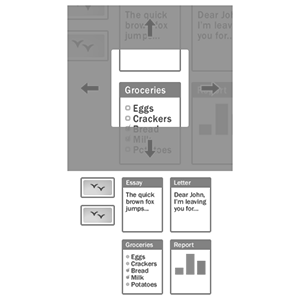
In computing post-WIMP comprises work on user interfaces, mostly graphical user interfaces, which attempt to go beyond the paradigm of windows, icons, menus and a pointing device, i.e. WIMP interfaces.The reason WIMP interfaces have become so prevalent since their conception at Xerox PARC is that they are very good at abstracting workspaces, documents, and their actions. Their analogous paradigm to documents as paper sheets or folders makes WIMP interfaces easy to introduce to novice users. Furthermore their basic representations as rectangular regions on a 2D flat screen make them a good fit for system programmers, thus favoring the abundance of commercial widget toolkits in this style.
However WIMP interfaces are not optimal for working with complex tasks such as computer-aided design, working on large amounts of data simultaneously, or interactive games. WIMPs are usually pixel-hungry, so given limited screen real estate they can distract attention from the task at hand. Thus, custom interfaces can better encapsulate workspaces, actions, and objects for specific complex tasks. Applications for which WIMP is not well suited include those requiring continuous input signals, showing 3D models, or simply portraying an interaction for which there is no defined standard widget.
read more »
Posted in Technology |
Leave a Comment »
August 1, 2012

In computing, a natural user interface (NUI) is one that is effectively invisible, or becomes invisible with successive learned interactions, to its users, and is based on nature or natural elements (i.e. physics, also known as Natural Philosophy).
The word natural is used because most computer interfaces use artificial control devices whose operation has to be learned. A NUI relies on a user being able to quickly transition from novice to expert. While the interface requires learning, that learning is eased through design which gives the user the feeling that they are instantly and continuously successful. Thus, ‘natural’ refers to a goal in the user experience – that the interaction comes naturally, while interacting with the technology, and that the interface itself is natural.
read more »
Posted in Technology |
Leave a Comment »
July 31, 2012


Kinect is a motion sensing input device released by Microsoft in 2010 for the Xbox 360 game console, and in 2012 for Windows PC. Based around a webcam-style add-on peripheral, it enables users to control and interact with software without the need to touch a game controller (through a natural user interface using gestures and spoken commands).
The project is aimed at broadening the Xbox 360’s audience beyond its typical gamer base. Kinect competes with the Wii Remote Plus and PlayStation Move with PlayStation Eye motion controllers for the Wii and PlayStation 3 home consoles, respectively. After selling a total of 8 million units in its first 60 days, the Kinect holds the Guinness World Record of being the ‘fastest selling consumer electronics device.’
read more »
Posted in Games, Money, Technology |
Leave a Comment »
July 31, 2012

The Dreameye is a digital camera released for the Dreamcast in 2000 in Japan only. It was designed to be used as a webcam and a digital still camera, and there were plans for games to involve the Dreameye. The Dreameye was only released in Japan, and Dreameye functionality was absent in non-Japanese versions of the games it could be used with. It came with the Divers 2000 Dreamcast (a rare all-in-one console unit developed by Fuji, intended as a video communications and gaming device for the consumer and hospitality markets) but was also sold separately. The DreamEye can be seen as the first use of a digital camera on a video games console.
The Dreameye came with a microphone headset, a stand, batteries, software, a cable to connect it to the Dreamcast, and a Dreameye microphone plug card. The Dreameye takes pictures at approximately 0.3 megapixels (640×480 pixels), but in order to send them via e-mail the pictures in question had to be first saved to a Dreamcast memory card. Upon transferring the pictures off of the card they resized to a resolution of 320px by 240px.
Posted in Games, Technology |
Leave a Comment »
July 31, 2012
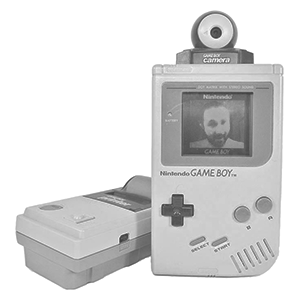
The Game Boy Camera is an official Nintendo accessory for the handheld Game Boy and Super Game Boy gaming consoles and was released in 1998. It is also compatible with all of the Game Boy platforms (with the exception of Game Boy Micro). The camera can take 256×224 (down scaled to half resolution on the unit with anti-aliasing), black & white digital images using the 4-color palette of the Game Boy system.
It interfaced with the Game Boy Printer, which utilized thermal paper to print any saved images, making a hard copy. Both the camera and the printer were marketed by Nintendo as light-hearted entertainment devices aimed mainly at children. The Game Boy Camera was used to take the photographs for the album cover of Neil Young’s album ‘Silver & Gold.’
Posted in Games, Technology |
Leave a Comment »
July 30, 2012

Po Bronson (b. 1964) is an American journalist and author who lives in San Francisco. After attending Lakeside School in Seattle, he graduated from Stanford University in 1986 and briefly worked as an assistant bond salesman in San Francisco.
He abandoned finance to pursue writing, publishing short stories and eventually a comedic novel based upon his bond trading experiences. ‘Bombardiers’ was an international best seller in 1995.
read more »
Posted in Language, Money, Technology |
Leave a Comment »
July 30, 2012

Machine-to-machine (M2M) refers to technologies that allow both wireless and wired systems to communicate with other devices of the same ability. M2M uses a device (such as a sensor or meter) to capture an event (such as temperature, inventory level, etc.), which is relayed through a network (wireless, wired, or hybrid) to an application (software program), that translates the captured event into meaningful information (for example, ‘items need to be restocked’).
Such communication was originally accomplished by having a remote network of machines relay information back to a central hub for analysis, which would then be rerouted into a system like a personal computer. However, modern M2M communication has expanded beyond a one-to-one connection and changed into a system of networks that transmits data to personal appliances.
read more »
Posted in Money, Technology |
Leave a Comment »
July 27, 2012

Participatory culture is a neologism in reference of, but opposite to a Consumer culture — in other words a culture in which private persons (the public) do not act as consumers only, but also as contributors or producers (‘prosumers’). The term is most often applied to the production or creation of some type of published media.
This new culture as it relates to the Internet has been described as ‘Web 2.0.’ In participatory culture ‘young people creatively respond to a plethora of electronic signals and cultural commodities in ways that surprise their makers, finding meanings and identities never meant to be there and defying simple nostrums that bewail the manipulation or passivity of ‘consumers.”
read more »
Posted in Money, Technology, World |
Leave a Comment »
July 27, 2012


‘Cyber Rights: Defending Free speech in the Digital Age’ is a 1998 non-fiction book about cyberlaw, written by free speech lawyer Mike Godwin. Godwin graduated from the University of Texas School of Law in 1990 and was the first staff counsel for the Electronic Frontier Foundation (EFF). Written with a first-person perspective, ‘Cyber Rights’ gives the reader a background in legal issues and history pertaining to free speech on the Internet.
It documents the author’s experiences in defending free speech online, and puts forth the thesis that ‘the remedy for the abuse of free speech is more speech.’ Godwin emphasizes that decisions made about the expression of ideas on the Internet have an impact on freedom of speech in other mediums of communication as well, as granted by the First Amendment to the United States Constitution.
read more »
Posted in Language, Politics, Technology |
Leave a Comment »



